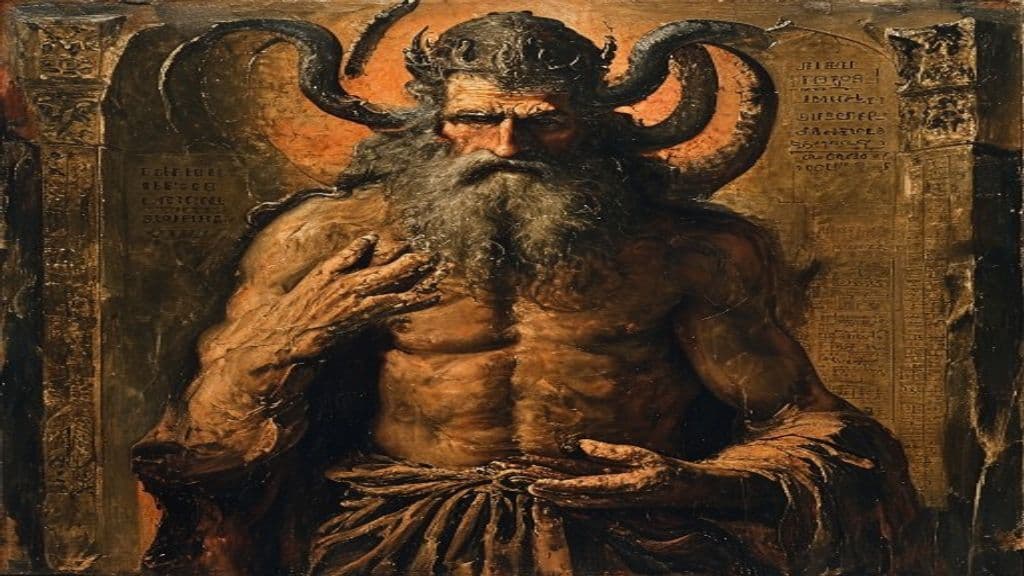
In the prophetic scriptural register (as in Jeremiah 49 and related prophetic citations), Melchom appears as the Ammonite god or idolic 'king' whose presence is rhetorically described as inheriting the land of Gad while the Ammonites dwelt there. Later Christian-era interpretive traditions, reflected in commentary (e.g. Jamieson-Fausset-Brown as quoted in modern summaries) and demonological compilations (notably Collin de Plancy's Dictionnaire Infernal as summarized on modern reference sites), narrativize a transformation: after the Ammonites were displaced from Gad (an event linked in commentary to Israelite actions under King David), Melchom is described as having been cast down from his idolic throne and reclassified as a lesser demon within an infernal order.
No physical description or iconographic details for Melchom are provided in the supplied sources. The available materials identify him by name and by functional/semantic association with the Hebrew root melech ('king') and with Ammonite idolic kingship, but do not furnish attested bodily, sculptural, or zoomorphic features.
In prophetic texts Melchom functions as the named foreign idol whose 'inheritance' or occupation of Gad signals rival sovereignty and territorial claim. In later demonological accounts (as reported in modern summaries of the Dictionnaire Infernal and echoed in commentary), Melchom is described as a lesser infernal official: specifically characterized as a paymaster or purse-bearer who administers payment to servants in Hell — an administrative/bureaucratic office within the infernal hierarchy. The transformation from local idolic king to infernal functionary is an interpretive move in post-biblical tradition rather than a detail narrated in the biblical texts themselves.
Melaeneus
Melaeneus (Ancient Greek Μελαινέα / Μελαινέυς) is an Arcadian prince in Greek myth, listed among the fifty sons of King Lycaon and credited in literary tradition as the eponymous founder of the Arcadian settlement Melaeneae. He appears only as a genealogical/foundational figure and as one of Lycaon’s sons punished by Zeus; no independent deeds, cult, or physical description are preserved in the cited sources.
Melampus
Melampus (Μελάμπους) is a legendary human seer and healer of Greek mythic tradition, originally associated with Pylos and later with Argos. Sources present him as the ancestral founder of a hereditary house of seers (the Melampodidae), a culture‑hero who performs cures and divinations for kings and communities and who, in some accounts (per Herodotus), introduced aspects of Dionysian worship.
Melaneus
Melaneus is a name applied to several minor figures in ancient Greek mythic genealogies and narratives, most notably a son of Apollo described as a founder-king of Oechalia and a noted archer. Other fragmentary attestations use the name for an Ethiopian chief killed in the Perseus–Phineus conflict and possibly an Indian figure, indicating the name's reuse for distinct minor personages.
Melanion (Milanion)
Melanion (also spelled Milanion) is an Arcadian prince in Greek myth who wins the huntress Atalanta in marriage, typically by prevailing in her footrace with the aid of divine intervention. He is a mortal heroic figure frequently conflated with the name Hippomenes in variant traditions.
Melanippe
Melanippe (Ancient Greek: Μελανίππη, lit. 'black mare') is a personal name applied to several distinct female figures in Greek mythic tradition — including a daughter of the centaur Chiron transformed into a mare, an Amazon warrior, a Meleagrid princess turned into a guinea‑fowl, and various genealogical wives and daughters. The name recurs across metamorphosis narratives, Amazon cycles, and genealogical lists rather than designating a single unified supernatural being.
Melchizedek
A brief biblical royal‑priest figure described in Genesis as 'king of Salem' and 'priest of El Elyon' (the Most High). He blesses Abraham, brings out bread and wine, and is later invoked in Jewish and Christian traditions as a typological precedent for legitimate priesthood and tithing.
Meleager
Meleager is a named mortal hero of ancient Greek myth, a prince of Calydon famed as the leader and host of the Calydonian boar hunt. His life is bound to a prophesied household token (a charred piece of wood), his actions precipitate family conflict and metamorphosis, and he is remembered in local cult at Calydon and in epic and Hellenistic literary traditions.
Melete
Melete (Ancient Greek: Μελέτη) is one of the original triad of Boeotian Muses—Aoide (song), Melete (practice/contemplation), and Mneme (memory)—personified in ancient Greek cultic contexts as the principle of practice, meditation, or rehearsal necessary for poetic and musical performance.
Melia
Melia is a mythic nymph figure in ancient Greek tradition, presented in some sources as an Oceanid or local naiad consort of the river-god Inachus and as a cultic/genealogical mother linked to Argive and Theban origin myths.
Meliboea
Meliboea (Ancient Greek: Μελίβοια) is a personal name borne by multiple mythic women in classical Greek tradition: chiefly two Oceanid nymphs (an Arcadian/Okeanid of Mount Kyllene and a Syrian Oceanid loved by the river-god Orontes), a Niobid who survives the slaughter and becomes known as Chloris, and several mortal/eponymous heroines associated with places such as Ephesus and the Thessalian town Meliboea. The name functions across local genealogies and foundation stories rather than indicating a single coherent supernatural entity.
Meliboea of Ephesus
Meliboea of Ephesus is a mortal maiden in Greek myth whose love-story with a youth named Alexis is presented as an aetiology explaining the Ephesian cult epithets of Aphrodite Automate and Epidaetia. The surviving account (recorded in later commentarial literature, cited via Servius) recounts her failed suicide, flight to a boat that sailed by divine will, and the subsequent foundation of a temple in thanksgiving.
Melion
Melion is the named protagonist of a late twelfth–early thirteenth‑century Breton lai who is a knight in King Arthur's service and who, by means of a magical ring, is transformed into a wolf, lives among wolves and at Arthur's court in lupine form, and is ultimately restored to human shape.
Community Record
- [1]Melchom — Wikipedia. Wikipedia article 'Melchom' summarizing identification with the Ammonite idol (Milcom/Moloch/Melech) and noting demonological treatment in Collin de Plancy's Dictionnaire Infernal.wiki
- [2]Jeremias (Jeremiah) Chapter 49 — Douay-Rheims Bible. Douay-Rheims translation of Jeremiah 49 (as cited in the provided materials): contains the prophetic question linking Melchom to possession of Gad ('Why then hath Melchom inherited Gad').literary
- [3]Amos Chapter 1 — Douay-Rheims Bible. Douay-Rheims translation of Amos cited among provided materials; prophetic context for denunciations of foreign nations and their gods.literary
- [4]Jamieson-Fausset-Brown Commentary (as quoted on Wikipedia). Summary on Wikipedia quoting Jamieson-Fausset-Brown commentary: interprets Melchom as cast down from his idolic throne after the Ammonites were displaced and describes his later depiction as a lesser demon and 'paymaster' in Hell.other
- [5]Wikidata: Melchom. Wikidata entry for Melchom (referenced in the supplied materials as a secondary cataloging source).wiki