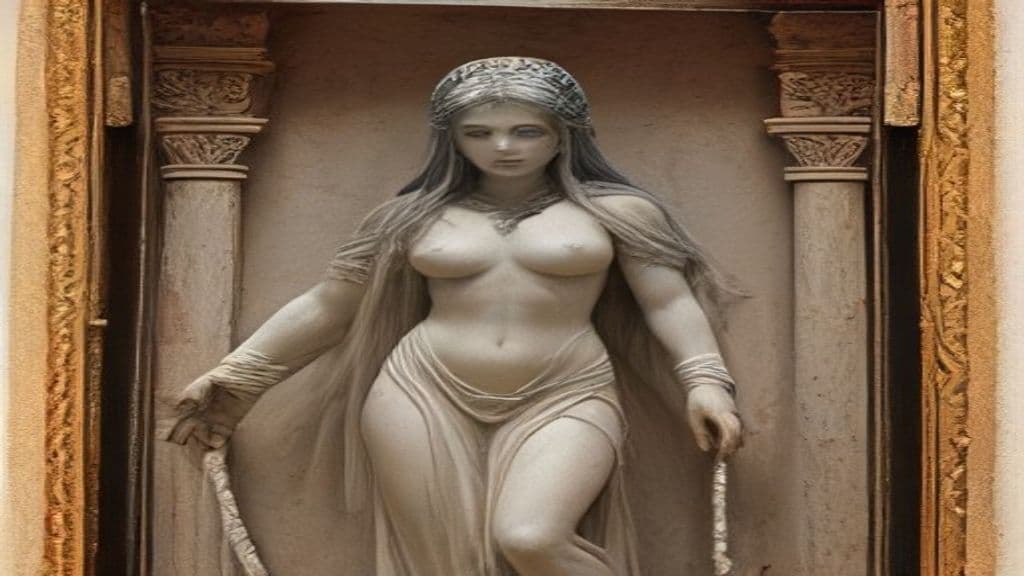
Meliboea (Ancient Greek Μελίβοια, glossed in sources as literally 'honey cattle') is presented in classical tradition as a young woman of Ephesus who fell in love with a youth named Alexis. The two swore to marry when the time was right, but Meliboea's parents arranged another match. On the day of the enforced marriage she attempted suicide by leaping from her roof but was unharmed; she fled to the shore and boarded a vessel. According to the attested account preserved in later sources (summarized in modern references that cite Servius), the ropes of the ship untied 'on their own accord' and, by the will of the gods, the boat carried her to Alexis's land while he held a feast. The reunited couple erected a temple to Aphrodite bearing the epithets Automate and Epidaetia; the story functions explicitly as an aetiology for those local cult-names in Ephesus (sources: Servius as cited in modern summaries/Wikipedia and compendia).
The surviving summaries do not provide a physical description beyond identifying Meliboea as a 'young woman' or 'maiden' from Ephesus. No details of clothing, distinguishing features, or supernatural form are recorded in the supplied materials.
Meliboea is portrayed as a mortal human actor whose decisions (falling in love, swearing marriage, attempting suicide, fleeing) set the narrative in motion; the miraculous elements in the story—most notably the ropes untying themselves and the boat carrying her to Alexis—are explicitly attributed to divine agency rather than to any power of Meliboea herself. The primary 'capacity' ascribed to her in the tradition is to serve as the human protagonist whose experience explains the epithets and temple of Aphrodite at Ephesus.
Weaknesses
- othernot applicable (mortal figure — no supernatural weaknesses recorded)
Wards
- othernot applicable (no warding practices against Meliboea recorded)
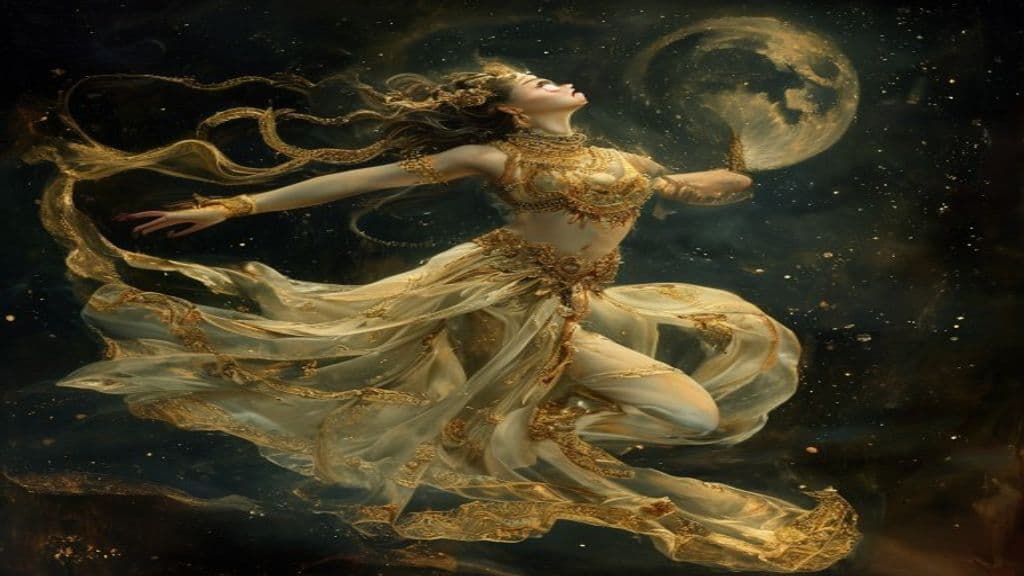
Apsara
Celestial dancers and water nymphs of Hindu cosmology — beautiful semi-divine beings who dance at the court of Indra and, by his command, descend to earth to distract sages from excessive asceticism.

Rusalka
Water spirits in Slavic folklore — the spirits of young women who died by drowning or suicide, bound to rivers and lakes. Beautiful and dangerous, they can bewitch men to their deaths.
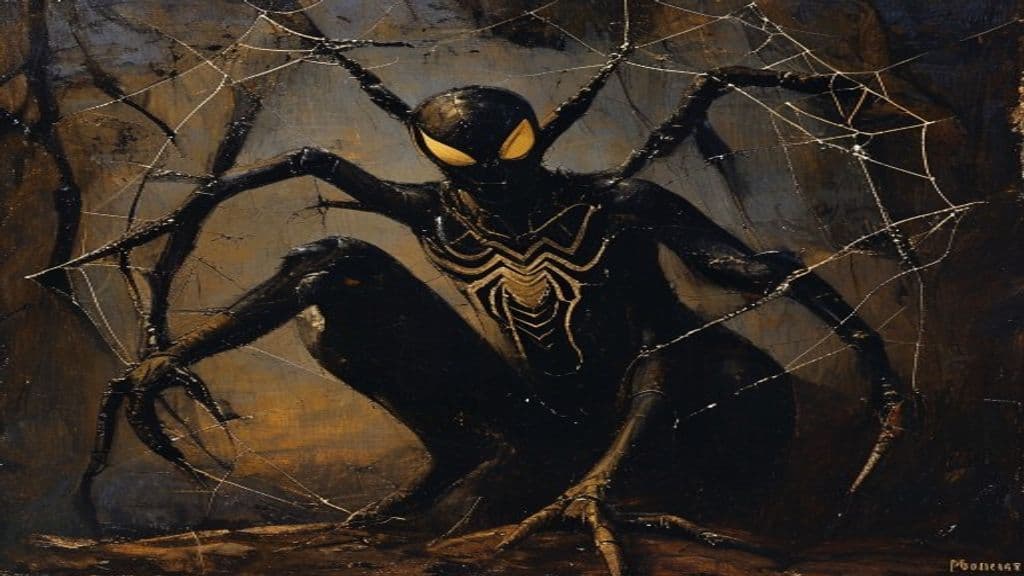
Anansi
The spider trickster god of Akan folklore — cunning, mischievous, and wise. Keeper of stories and teacher of human beings, brought through the slave trade into Caribbean and African-American tradition.
Melchizedek
A brief biblical royal‑priest figure described in Genesis as 'king of Salem' and 'priest of El Elyon' (the Most High). He blesses Abraham, brings out bread and wine, and is later invoked in Jewish and Christian traditions as a typological precedent for legitimate priesthood and tithing.
Melchom
Melchom (also attested as Milcom, Moloch, Melech) is named in Judeo-Christian prophetic literature as the Ammonite idolic 'king' associated with possession of the Israelite tract of Gad; later Christian demonological tradition (via works such as Collin de Plancy's Dictionnaire Infernal as summarized in modern reference sources) recasts Melchom as a lesser infernal spirit with a bureaucratic office in Hell.
Meleager
Meleager is a named mortal hero of ancient Greek myth, a prince of Calydon famed as the leader and host of the Calydonian boar hunt. His life is bound to a prophesied household token (a charred piece of wood), his actions precipitate family conflict and metamorphosis, and he is remembered in local cult at Calydon and in epic and Hellenistic literary traditions.
Melete
Melete (Ancient Greek: Μελέτη) is one of the original triad of Boeotian Muses—Aoide (song), Melete (practice/contemplation), and Mneme (memory)—personified in ancient Greek cultic contexts as the principle of practice, meditation, or rehearsal necessary for poetic and musical performance.
Melia
Melia is a mythic nymph figure in ancient Greek tradition, presented in some sources as an Oceanid or local naiad consort of the river-god Inachus and as a cultic/genealogical mother linked to Argive and Theban origin myths.
Meliboea
Meliboea (Ancient Greek: Μελίβοια) is a personal name borne by multiple mythic women in classical Greek tradition: chiefly two Oceanid nymphs (an Arcadian/Okeanid of Mount Kyllene and a Syrian Oceanid loved by the river-god Orontes), a Niobid who survives the slaughter and becomes known as Chloris, and several mortal/eponymous heroines associated with places such as Ephesus and the Thessalian town Meliboea. The name functions across local genealogies and foundation stories rather than indicating a single coherent supernatural entity.
Melion
Melion is the named protagonist of a late twelfth–early thirteenth‑century Breton lai who is a knight in King Arthur's service and who, by means of a magical ring, is transformed into a wolf, lives among wolves and at Arthur's court in lupine form, and is ultimately restored to human shape.
Melite
Melite is a water-associated female figure in Greek myth recorded in multiple, variable traditions: a Nereid (daughter of Nereus and Doris) often glossed as 'the Nereid of the calm seas', a local naiad associated in some accounts with Mount Melite/Phaeacia, and an eponymous heroine of the Athenian deme Melite (daughter of Apollo or Myrmex). She functions mainly as a named sea-nymph/personification and local eponym rather than a figure with an extensive individual mythology.
Mellified Man
A medicinal substance created by steeping a human cadaver in honey. (Note: * Power tier should be Lesser (given it's a medicinal substance created by humans) rather than Primordial. * Abilities should reflect that Mellified Man has no supernatural or paranormal abilities, bu)
Melpomene
Melpomene is one of the Nine Muses of ancient Greek tradition, the personified patron of tragic song and dramatic poetry. Daughter of Zeus and Mnemosyne, she is invoked in literary contexts for tragic composition and is commonly represented with tragic mask and buskins.
Melqart
Melqart is the principal tutelary deity of the Phoenician city of Tyre, venerated as the city's divine patron, protector of its colonies, and a central figure in Phoenician/Punic civic religion. He is associated in the sources with an annual 'awakening' festival often interpreted as a dying-and‑rising motif, and his name was invoked to sanction oaths and protect settlements.
Meme (Memesaga)
Meme, also called Memesaga in modern summaries, is a named Mesopotamian goddess attested in secondary literature as a local caregiver/healing figure who was later assimilated with the major medicine goddess Gula. She is counted among a network of Mesopotamian medicine goddesses alongside Gula, Ninisina, Ninkarrak, Nintinugga and Bau.
Community Record
- [1]Meliboea of Ephesus (Wikipedia). Wikipedia contributors, 'Meliboea of Ephesus,' Wikipedia, The Free Encyclopedia.wiki
- [2]Meliboea | Facts, Information, and Mythology (Pantheon.org summary). Pantheon.org, 'Meliboea' (summary entry).other
- [3]Map of Greece and Western Asia Minor - Greek Mythology Link. Map resource situating Ephesus in western Asia Minor.other