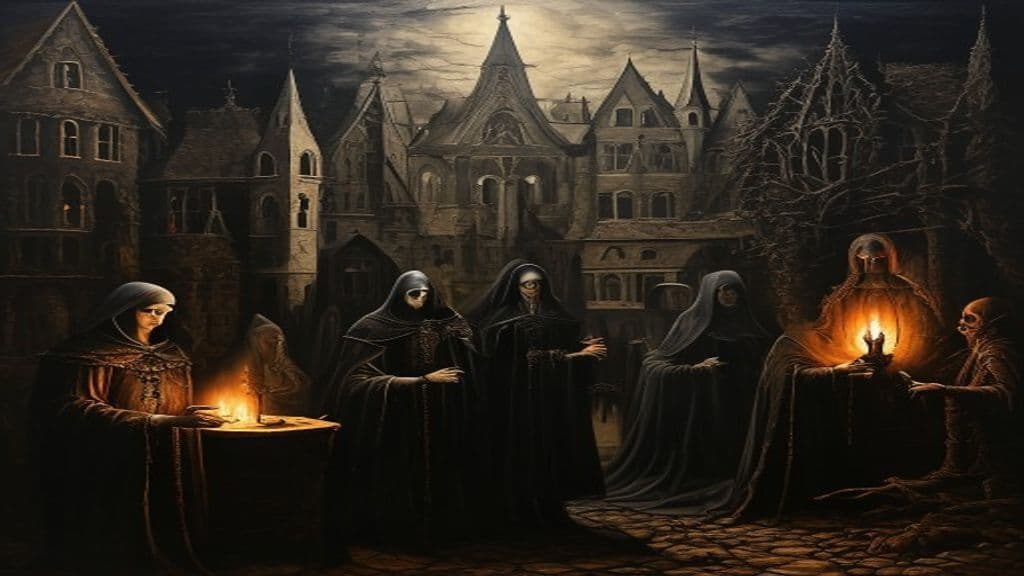
These entities are invisible or insubstantial, with no physical description provided.
The incantations suggest they have malevolent intentions and pose a threat to humans, but specific details about their powers or behaviors are not provided.
Weaknesses
None recorded.
Wards
- incantationsMerseburg charms
Baduhenna
Baduhenna is a named female deity attested once in Tacitus (Annals) as having a sacred grove (lucus) in ancient Frisia; modern scholarship interprets her name as linking a battle element with the matronal name-element and therefore views her as a local matron-like goddess with associations to war and a cult-site.
Family Trees of the Norse Gods
The complex relationships between Norse gods, as portrayed in the Eddas and other sources, reveal a network of family ties and kin connections that shape their interactions and powers. (Note: 1. Power tier should be Primordial (too general) -> change to Ancient=deity-level. 2. The statement that no sensory cues are explicitly described in the source material is misleading, as it implies no)
Frigg
Frigg is an Old Norse goddess of the Æsir, foremost among the pantheon as Odin's wife, associated with marriage, motherhood and foresight. She dwells in Fensalir and is attested across North and West Germanic traditions (Old Norse Frigg; Old English Frīg; Old High German Frīja; Lombardic Frea). Her name survives in the weekday Friday and persisted in Scandinavian folklore after Christianization.
Norse gods
A category of divine figures attested in Old Norse literature, inscriptions, place-names, and related evidence; members of the indigenous Norse/Germanic religious framework who appear in mythic narratives and were objects of worship and modern commemoration.
Numbers in Germanic Paganism (Norse Tradition)
The concept of Numbers holds symbolic significance across various contexts within Germanic paganism, appearing in both mythology and the lunar calendar, and is considered a fundamental aspect of ancient Germanic folklore. (Note: - Power tier should be "Primordial" as cosmic-level significance is implied (e.g., appearing throughout surviving attestations of ancient Germanic folklore). - Abilities: add that these numbers are us)
Odin
Odin (Old Norse: Óðinn) is the chief god of the Norse (Æsir) pantheon, a multifaceted deity associated with wisdom obtained by sacrifice, poetic inspiration, death and warfare, and rulership over the hall Valhöll where chosen slain warriors (einherjar) dwell. He appears throughout Germanic tradition from Roman-era accounts through the Viking Age and in later folklore as leader of the Wild Hunt.
Rebirth in Germanic Paganism
Concept of rebirth through naming and/or family line in pre-Christian Germanic society, tied to continuation of identity and heritage. (Note: * Power tier should be Lowered to Lesser (local spirit) as the abilities described do not suggest a cosmic or deity-level power. * Summary is accurate, but it could be more concise. * Origin story lac)
Thor (Þórr)
Thor (Old Norse Þórr) is a central god in the pre-Christian Germanic/Norse religious framework, primarily associated with thunder, storms, strength, protection, fertility, and the welfare of farmers. He is a hammer-wielding warrior who fights monstrous enemies (notably Jörmungandr) and is widely attested from Roman-era Germania through the Viking Age, with ongoing cultural presence in personal and place-names and weekday nomenclature (Thursday).
Völva (Norse seer)
Female seer or prophetess in Norse mythology, possessing mystical knowledge and power to see into the future. (Note: 1. The power tier should be Primordial, as Ancient typically refers to deities and Völva are mortal beings with mystical abilities. 2. Sensory cues should include dreams, which is a common way for Völ)
Wōden
Wōden (reconstructed Proto‑Germanic Wōðanaz) is the chief figure of Germanic paganism attested across Norse mythological sources and historical records of Northern Europe; scholarship reconstructs his name as linked to frenzy or possession and to poetic inspiration. Surviving information about him comes largely from medieval Norse literature and later historical commentaries of the Germanic world.
Æsir
Æsir are the principal gods of Old Norse and wider Germanic religion, used both as a general term for gods and as a specific family of deities contrasted with the Vanir; the term is also attested in some early-medieval English contexts as a label for potentially harmful unseen beings.
Merrow
A sea-being of Irish/Celtic folklore, the Merrow (Hiberno-English) denotes a class of half-human marine supernatural persons — often female 'sea-maidens' and uglier male counterparts — capable of interaction and occasional intermarriage with humans. Medieval Irish terms connect the figure to older siren- and sea-nymph motifs, while 19th-century collectors shaped much of the modern folk image.
Community Record
- [1]