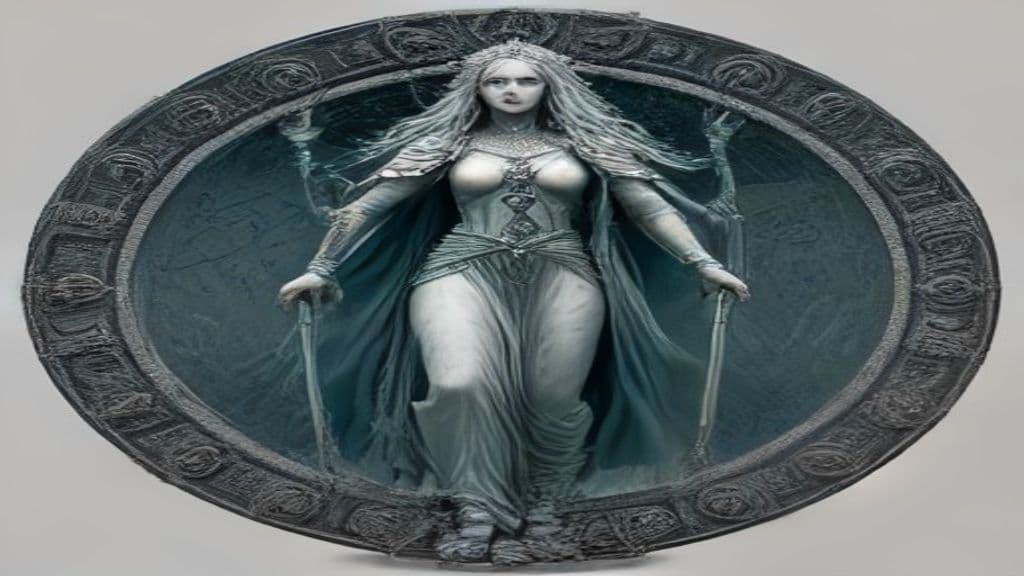
Linguistic evidence reconstructs the theonym to Proto-Germanic *Frijjō, from an adjectival stem *frijaz meaning 'free' and related to words for love and friendship; this etymology is a scholarly reconstruction rather than a narrative myth. In mythic sources she is presented as a principal Æsir goddess, wife of Odin and mother of Baldr. Continental attestations such as Lombardic Frea (Origo Gentis Langobardorum / Historia Langobardorum) show her acting on behalf of peoples (advising the Winnili) and indicate the theonym circulated in various Germanic ethnic traditions.
Surviving textual evidence provides no consistent, detailed bodily description or fixed iconography for Frigg. Sources locate her in the wetland halls called Fensalir and associate her with a household retinue of named female figures (Fulla; associations with Lofn, Hlín, Gná), but explicit descriptions of garments, facial features, or standardized visual attributes are not attested in the provided material.
Attested roles and abilities include prophecy and clairvoyance (foreknowledge), functions connected to marriage and motherhood, and social influence within the divine household as Odin's consort and mother of Baldr. In continental legend (Lombardic account) a form of the goddess (Frea) counsels and engineers events—advising the Winnili women and manipulating Godan's bed so that he grants victory—demonstrating competence in counsel and intervention in human/divine affairs. The sources present these capacities (foresight, domestic and social authority, persuasive intervention) rather than describing specific magical rituals or enumerated supernatural powers beyond prophetic sight and influence.
Weaknesses
- otherno specific weaknesses or wards attested in sources
Wards
- otherno specific protective wards or countermeasures attested in sources
Fulla
Fulla (Old Norse Fulla; Old High German Volla/Folla) is a named goddess (ásynja) in the Germanic tradition, attested as Frigg's trusted attendant and confidante in Old Norse sources and as a named singer in the Old High German Merseburg horse-healing charm.
Freyja
Freyja is a major Vanir goddess in Norse mythology associated with love, beauty, fertility, gold, war, and the seiðr form of magic. She rules the field Fólkvangr and the hall Sessrúmnir, where she receives half of those slain in battle, and is attested across the Poetic Edda, the Prose Edda, skaldic poetry, and later Scandinavian folklore.
Andvari
Andvari is a dwarf from Old Norse sources (attested in the 12th century) who lives beneath a waterfall, hoards gold, owns a magical ring called Andvaranaut, can change into a pike, and curses the gold when it is stolen—events that set in motion tragic outcomes in Norse heroic narrative.
Angrboða
Angrboða is a jötunn (giantess) in Norse myth attested briefly in the Poetic Edda and Prose Edda as the partner of Loki and the mother of three world‑shaping offspring: Fenrir, Jörmungandr, and Hel. Surviving medieval attestations are sparse; most descriptions of her beyond genealogy derive from modern retellings and popular culture.
Ask and Embla
In Norse myth Ask (Askr) and Embla (Embla) are the first human man and woman, fashioned from wood/trees by the gods at the beginning of the cosmos and endowed with the gifts that make them human; they serve as the progenitors of humankind in the Norse cosmological narrative.
Atter
In Norse tradition, Atter refers to various forms of poison, corruption, or noxious influence that can manifest physically or morally. (Note: * Power tier should be Primordial only for its ability to cause cosmic-scale harm (e.g., societal consumption). However, most of its described abilities fall under Greater or Lesser powers, implying A)
Aurboða
Aurboða is a jötunn (giantess) in Norse mythology attested as the wife of the jötunn Gymir and mother of the jötunn Gerðr; the name also appears separately as one of the nine maidens in the poem Fjölsvinnsmál. Her name is debated etymologically as either 'gravel-bidder' (aurr + boða) or, in an alternative reading, 'gold-bidder' (aur + boða).
Auðumbla
Auðumbla is the primeval cow of Old Norse cosmogony attested in the Prose Edda: she nourishes the primordial jötunn Ymir with rivers of milk and by licking salty rime-stones reveals Búri, an ancestor of the gods. Her name and role link fertility, nourishment, and the emergence of key lineages in the Norse origin narrative.
Baduhenna
Baduhenna is a named female deity attested once in Tacitus (Annals) as having a sacred grove (lucus) in ancient Frisia; modern scholarship interprets her name as linking a battle element with the matronal name-element and therefore views her as a local matron-like goddess with associations to war and a cult-site.
Baldr
Baldr (Old Norse Baldr; Old English Bældæġ; Old High German Balder/Palter) is a god in Germanic mythology. In the Norse branch he is named as a son of Odin and Frigg and as a member of the Aesir, attested alongside brothers such as Thor and Váli in the supplied sources.
Barri
Barri (also attested Barrey/Barey) is a mythic place-name in Old Norse tradition, named in Skírnismál and Snorri Sturluson’s Gylfaginning as the rendezvous-site where Freyr and Gerðr will meet nine nights after prior events. The term is etymologically ambiguous between a grove/wood and an island or a grain-field, and scholars debate whether its semantic field evokes woodland or agricultural fertility.
Baugi
Baugi is a jötunn (giant) in Old Norse myth who appears as a secondary actor in the mead of poetry narrative preserved in Skáldskaparmál and the þulur. He is presented as the brother of Suttungr, provides and uses an auger named Rati to bore into the mountain Hnitbjörg, and figures in Odin's (Bölverk’s) bargain and deception to obtain the mead of poetry.
Beli
Beli is a jötunn (giant) in Old Norse myth known chiefly as an adversary slain by the god Freyr. Attestations are fragmentary: he appears in Eddic and skaldic references as the named foe of Freyr and as an element in kennings, and scholars treat the fuller myth as largely lost.
Bergelmir
Bergelmir is a jötunn in Norse mythology, attested as a descendant of the primordial giant Aurgelmir (Ymir) and portrayed as the survivor who preserves the frost-jötunn line after the primeval flood caused by Ymir's death. He appears in two primary Old Norse contexts: the poem Vafþrúðnismál (where he is implied to be an infant laid in a lúðr) and Snorri Sturluson's Gylfaginning (where he and his wife escape on a lúðr).
Community Record
- [1]Frigg (Wikipedia). Wikipedia: 'Frigg' article (entries on name, roles, Fensalir, Lombardic Frea, weekday name, post‑conversion folklore).wiki
- [2]Frigg (Wikidata). Wikidata entry for Frigg.other
- [3]Unraveling the Myth: Why Do Gods Have a Grudge Against Loki? #loki #norsemythology #shorts (archive). Archive video excerpt referencing Frigg in a modern retelling of mythic episodes.other
- [4]Uppsala teater, Chateau Barowiak, kvarteret Frigg, Vaksalagatan, Uppsala 1901 - 1902 (archive). Archive item referencing cultural uses of the name Frigg in later contexts.other