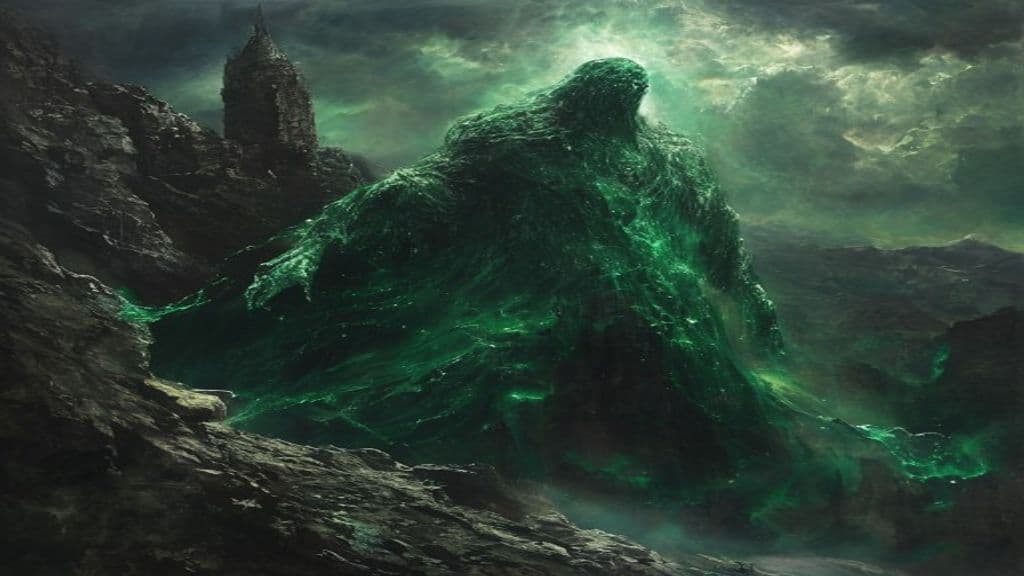
According to Persian tradition, Mount Qaf was created by God from shining emerald material. It serves as the homeland of the jinn.
Made of 'shining emerald' material, suggesting an otherworldly or supernatural quality.
As the homeland of the jinn, it's implied that these entities possess supernatural abilities and behaviors.

Barbad
Barbad (Persian: باربد) was a celebrated late 6th–early 7th-century Persian musician-poet, music theorist and composer associated with the Sasanian court of Khosrow II. Preserved mainly through later Arabic and Persian literature and oral tradition, he functions in medieval and modern memory as the archetypal court minstrel of Sasanian musical culture.
Gaokerena
In Persian and Zoroastrian legends, Gaokerena is a mythic Haoma plant with extraordinary healing properties that grant immortality to resurrected bodies when eaten. (Note: - Power tier should be Ancient (deity-level) as it is a mythic Haoma plant with extraordinary healing properties and grants immortality, indicating a higher level of power. - Abilities need clarificat)
Scheherazade
Legendary human narrator and storyteller in the Persian tradition, known for recounting stories to save herself and others from execution. (Note: - Power tier: Primordial (Scheherazade's abilities are more akin to cosmic in scope, as she uses her storytelling to influence the fate of an entire kingdom and its people.) - No weaknesses listed (Ex)
Mothman
A modern American folkloric figure originating from a cluster of 1966–67 sightings around Point Pleasant, West Virginia. Described in press reports and later retellings as a large humanoid or winged creature with notable eyes, the Mothman legend has been variously interpreted as misidentified wildlife, hoaxing/sensationalism, or a paranormal omen linked in some retellings to the Silver Bridge collapse.
Mothra
Mothra (Japanese: モスラ, Mosura) is a moth-like giant monster (kaiju) originating in Japanese popular media. First appearing in a 1961 serial/novelization and Toho's 1961 film Mothra, the character is recurrently portrayed as a colossal, often heroic/protective kaiju associated with an island culture and featured across multiple Toho and later Monsterverse films.
Motoro
Motoro is a tribal god of the Ngariki people of Mangaia in Polynesia. In the available account he is called i'o ora ('god of the living') and is noted for a myth in which he was cast into the sea during a quarrel with his elder brothers; his spirit later arrived at Mangaia on a piece of hibiscus. His followers were exempt from being used as human sacrifices.
Motutaiko Island
In Māori tradition, Motutaiko Island is a culturally significant island within Lake Taupō, associated with the black petrel bird and reflecting the Māori worldview's emphasis on connection between natural features and human society. (Note: - Power tier: Minor Spirit (given its local significance and limited abilities) - Weaknesses: drought not mentioned in source material - Wards and weaknesses inconsistent with the provided information)
Mount Meru (Buddhist Tradition)
Sacred, five-peaked mountain at the center of all physical, metaphysical, and spiritual universes in Buddhist cosmology. (Note: 1. Power tier: Downgrade to "Primordial" to "Greater". A Primordial entity would be a fundamental aspect of the universe's creation or structure, rather than a specific geographical location. Mount Me)
Mountain God (Korean tradition)
Tutelary deity associated with mountains in Asian cultures, similar to dizhu shen and City Gods. (Note: 1. Power tier: Reduce to Lesser (Mountain Gods do not necessarily possess deity-level powers) 2. Appearance: Provide specific information about physical appearance or characteristics 3. Abilities: Cla)
Mountain spirit (Shanling / Wushan) — limited-source entry
The supplied corpus provides only minimal, non-ethnographic attestations: an English Wikipedia disambiguation page listing geographic places called 'Spirit Mountain' and a Wikidata item classifying 'mountain spirit' as a 'type of sprite.' No primary or traditional Taoist descriptions, rituals, or narratives are present in the provided materials.
Moussa Gname
A revered culture hero of the Songhai people, celebrated for his pivotal role in shaping West African folklore and mythology. (Note: * Power tier: Unclear, but likely Lesser or Minor Spirit given the lack of specific abilities * Origin story: Should be revised to "Origin unknown" as no detailed origin story is found in the source m)
Mozagro
Mozagro is attested in the provided sources as a modern toponym and commercial name rather than a supernatural being. It appears as a geographic feature (Pico Mozagro referenced in pastoral/cattle imagery), a triangulation station in Cieza, Spain, and as the name of a contemporary digital agribusiness marketplace serving smallholder farmers. The supplied materials contain no folkloric, mythic, or supernatural descriptions of Mozagro.
Community Record
- [1]Wikipedia. General knowledge resource, citing no specific sources.wiki