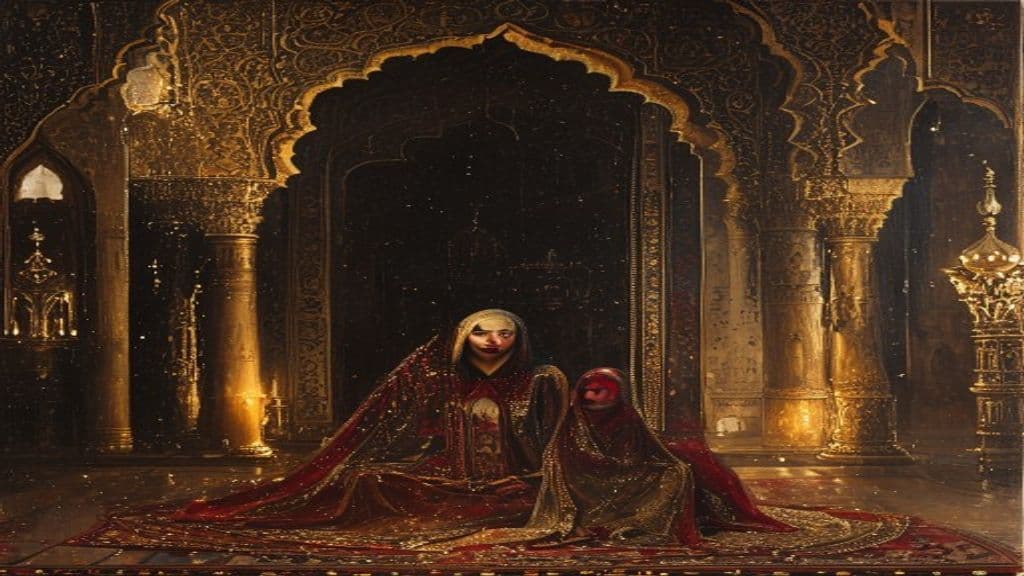
Not provided in source material.
No physical description is provided in the source material.
Scheherazade's abilities are largely narrative-based, as she recounts stories over the course of 1,001 nights to save herself and other women from execution.
Weaknesses
- conditionexecution
Wards
None recorded.
Barbad
Barbad (Persian: باربد) was a celebrated late 6th–early 7th-century Persian musician-poet, music theorist and composer associated with the Sasanian court of Khosrow II. Preserved mainly through later Arabic and Persian literature and oral tradition, he functions in medieval and modern memory as the archetypal court minstrel of Sasanian musical culture.
Gaokerena
In Persian and Zoroastrian legends, Gaokerena is a mythic Haoma plant with extraordinary healing properties that grant immortality to resurrected bodies when eaten. (Note: - Power tier should be Ancient (deity-level) as it is a mythic Haoma plant with extraordinary healing properties and grants immortality, indicating a higher level of power. - Abilities need clarificat)
Mount Qaf
Legendary mountain in Persian tradition and Arab mythology, considered homeland of the jinn. (Note: * Power tier: Primordial (based on being created directly from "shining emerald material" by God) * Abilities: Not explicitly described in source material; should be removed or rephrased * Sensory cue)
Zafarnamah (Mustawfi)
Persian epic poem written by Hamdallah Mustawfi, exploring Iranian history and culture. (Note: 1. Power tier should be Ancient (deity-level) does not fit; Primordial is typically reserved for entities related to the creation of the world or fundamental forces. 2. Appearance section is missing 3)
Scalfort
Scalfort is attested in the supplied sources only as a family name token and not as a supernatural or folkloric being. The available documents are historical and military in nature and do not attribute mythic features, powers, or rituals to the name.
Scapino
Scapino (also Scapin) is a stock theatrical character from the Italian commedia dell'arte tradition. A zanni (servant) figure, he is a trickster-servant known for scheming, self-preservation, and a tendency to 'escape' from fights and commitments; he appears in commedia performances and in plays derived from that repertoire (notably Molière's Les Fourberies de Scapin).
Scarphe (Scarpheia)
Scarphe (Ancient Greek: Σκάρφη), also attested as Scarpheia (Σκάρφεια), was an ancient town of the Epicnemidian Locrians in central Greece. Mentioned in Homer’s Catalogue of Ships and attested by classical geographers and historians, it is recorded as a civic, economic, and military place whose site is tentatively identified near modern Molos.
Sceafa
Sceafa is an Old English legendary ancestral figure: a mysteriously arriving child found asleep in a small boat with a handful of grain, later accepted and made a progenitor of royal lines (notably in Lombard and some Anglo-Saxon pedigrees). He functions as an etiological founder whose miraculous origin legitimizes dynastic descent.
Schrat
A diverse legendary creature in Jewish tradition associated with nature, particularly woodlands and domestic spaces, with malevolent intentions towards humans. (Note: 1. The power tier should be Lowered to Lesser (local spirit) based on the description in the source material. 2. Add a mention of Schrat being associated with mischief and household pests, which is me)
Scyld Scefing
Scyld Scefing (Old English) / Skjöldr (Old Norse) is a legendary early king and eponymous progenitor figure in Anglo-Saxon and Scandinavian genealogical and literary tradition. He appears across medieval sources as a founding ancestor used to legitimise royal lines rather than as a described supernatural being.
Scylding
The Scyldings (Old English Scyldingas; Old Norse Skjǫldungar) are a legendary royal dynasty of early medieval Anglo‑Scandinavian tradition, described in sources such as Beowulf, Norse saga genealogies and Latin chronicles. They function as a mytho‑historical lineage that anchors claims to rulership, heroic identity, and dynastic origin rather than as a singular supernatural being.
Scylla
A six-headed sea monster lurking in a narrow strait, snatching sailors from passing ships — the original origin of the phrase 'between Scylla and Charybdis.'
Community Record
- [1]