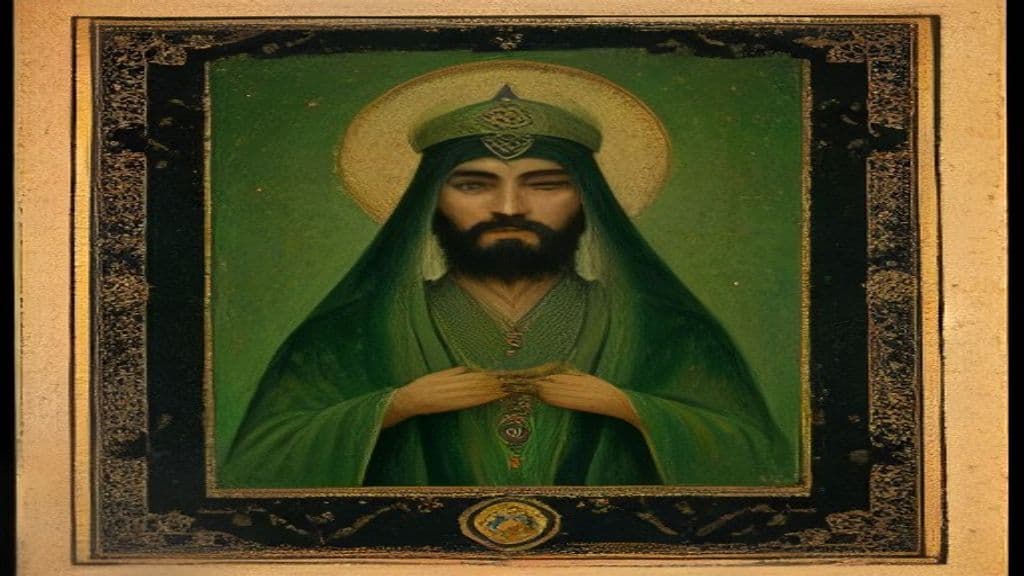
Barbad is represented in later Arabic and Persian sources as the chief minstrel-poet at the court of Shahanshah Khosrow II (r. 590–628). While modern tradition often treats him as the foundational figure of Sasanian music, surviving evidence shows his reputation was transmitted by oral tradition into early Arabic poetry (the earliest extant mention is an Arabic poem by Khaled ibn Fayyaz, d. c. 718) and later medieval Persian works such as Ferdowsi’s Shahnameh and Nizami’s accounts, which mythologized episodes of his life. Scholarly discussion of his name indicates Arabic forms are often arabicizations of an original Pahlavi form (Pahrbad/Pahlbad) as argued by Theodor Nöldeke and supported by Ahmad Tafazzoli’s readings of a Sasanian seal.
No contemporary Sasanian descriptions of Barbad's physical appearance are preserved. Later literary anecdotes contain motifs rather than reliable portraits—examples include a story recorded in medieval Persian sources in which Barbad dressed entirely in green to gain access to the royal garden and court of Khosrow (attested in later accounts such as Ferdowsi and other medieval writers). Beyond such narrative motifs, no verified physical portrait or detailed contemporary description survives in the cited sources.
Barbad is consistently described in the sources as an exceptional musician-poet and composer, serving as the court's chief minstrel-poet under Khosrow II and playing a lute-like instrument identified with the barbat. Medieval accounts and poets (for example Nizami and Ferdowsi in later literature) ascribe to him major innovations in musical practice and an extraordinary aesthetic power (literary praise such as Khosrow dreaming of 'a minstrel called Barbad whose art could make even poison taste delicious' appears in later tradition). These attributions derive from centuries-later Arabic and Persian literary memory rather than surviving Sasanian musicological texts; nearly all specifics of his compositions are transmitted as titles or legendary claims rather than extant musical works.
Weaknesses
- otherNone recorded in sources
Wards
- otherNot applicable — Barbad is a historical/cultural figure and no warding practices are recorded
Gaokerena
In Persian and Zoroastrian legends, Gaokerena is a mythic Haoma plant with extraordinary healing properties that grant immortality to resurrected bodies when eaten. (Note: - Power tier should be Ancient (deity-level) as it is a mythic Haoma plant with extraordinary healing properties and grants immortality, indicating a higher level of power. - Abilities need clarificat)
Mount Qaf
Legendary mountain in Persian tradition and Arab mythology, considered homeland of the jinn. (Note: * Power tier: Primordial (based on being created directly from "shining emerald material" by God) * Abilities: Not explicitly described in source material; should be removed or rephrased * Sensory cue)
Scheherazade
Legendary human narrator and storyteller in the Persian tradition, known for recounting stories to save herself and others from execution. (Note: - Power tier: Primordial (Scheherazade's abilities are more akin to cosmic in scope, as she uses her storytelling to influence the fate of an entire kingdom and its people.) - No weaknesses listed (Ex)
Baphomet
Baphomet is a mutable Western esoteric and cultural figure: in medieval inquisitorial records the name labels an alleged idol or head invoked in accusations against the Knights Templar; in 19th‑century occultism Éliphas Lévi reimagined Baphomet as a symbolic androgynous human‑goat figure embodying reconciled opposites; in modern culture the term and imagery are widely repurposed across conspiracy discourse, art, and fiction.
Bar Juchne
A colossal bird from Jewish tradition, described as having a massive wingspan large enough to block out the sun. (Note: * Power tier should be at least Ancient, given its ability to block out the sun. * Origin story section is missing, with no information provided by Source 1. * No specific weaknesses or wards mentione)
Barachiel
Barachiel (Hebrew: בַּרַכְאֵל, Baraḵʾēl, 'God has blessed') is an archangelic figure in Jewish mystical literature and in Byzantine Catholic and Eastern Orthodox Christian devotion, traditionally associated with blessings, guardianship of family and married life, and as chief of guardian angels. Mystical texts place him over the second heaven and attended by a vast retinue of ministering angels; Christian iconography portrays him with symbols of blessing such as a white rose, rose petals, a bread basket, or a staff.
Baraka (Mortal Kombat)
Baraka is a recurring fictional character in the Mortal Kombat franchise portrayed as a Tarkatan warrior and antagonist. First introduced as a playable fighter in Mortal Kombat II, he appears across multiple games and in film adaptations, varying between playable roster member and non-playable opponent depending on the installment.
Barama
The available sources do not describe a supernatural being named Barama. The string "Barama" appears in the supplied corpus as a toponym, a language name, an institutional name, and a radio-station name, but there is no folkloric, ritual, or mythological information about a goddess or spirit called Barama in these sources.
Barbara Gordon
Barbara Joan Gordon is a recurring fictional character in DC Comics' Batman mythos, introduced as the costumed vigilante Batgirl and later reimagined as Oracle, a paraplegic information broker and technical advisor to other heroes. She functions as a human, non-supernatural operative whose roles alternate between field crime-fighter and behind-the-scenes intelligence specialist across publication eras and media adaptations.
Barbara Kean (tradition)
No folkloric, mythological, or supernatural documentation for an entity named "Barbara Kean" is present in the supplied sources. The available materials do not describe her as a spirit, deity, monster, or other unseen being.
Barbariccia
Barbariccia is one of the Malebranche devils in Dante Alighieri's Inferno (Canto 22), portrayed as a corporal enforcer and a subordinate commander who supervises other devils in Bolgia Five of the Eighth Circle (the Malebolge). The name is Italian and literally means "curly beard."
Barbary corsairs
Organized maritime raiders and state‑linked privateers operating from North African ports (notably Algiers, Tunis, Tripoli, and Salé) from medieval times into the 19th century; engaged in ship capture, coastal raids, and the seizure of captives for slave markets and ransom, and in some Muslim sources framed as a form of naval jihad.
Community Record
- [1]Barbad. Wikipedia: Barbadwiki
- [2]Wikidata: Barbad entry. Wikidata Q244other
- [3]Barbad Award (modern cultural usage). Wikipedia: Barbad Awardwiki
- [4]Archive materials and modern references (selected links provided in research notes). Archive link listed among research notesother
- [5]Modern commentary and cultural references (selection). Essay: Music of the Past — referenced in research notesother