
In local belief the lights are manifestations of phaya nak, the giant serpent (Nāga) said to live in the Mekong River. Observers and some commentators state the phenomenon is 'hundreds of years old' as a folk occurrence; however, the explicit official labeling as 'Phaya Nak lights' dates from a local council renaming in the mid-1980s, replacing an earlier local usage of 'ghost lights.' Scientific and skeptical accounts do not treat the phaya nak attribution as a physical origin but record it as the prevailing cultural explanation.
Reportedly seen as glowing reddish balls ranging from small sparkles up to the size of basketballs. Accounts describe them quickly rising from the water to heights of a couple of hundred metres before disappearing. Numbers observed vary widely across events, from tens to thousands in some reports.
Described in sources primarily as a visual phenomenon that 'emerge from the water and ascend into the air' and vanish at height. Locally attributed agency assigns the display to phaya nak, but scientific and skeptical commentators advance alternative causal accounts — including tracer rounds or flare guns fired across the river, flammable marsh gases such as phosphine, and laboratory-produced plasma analogues — and dispute spontaneous-burning-gas explanations. Sources present these competing explanations without consensus.
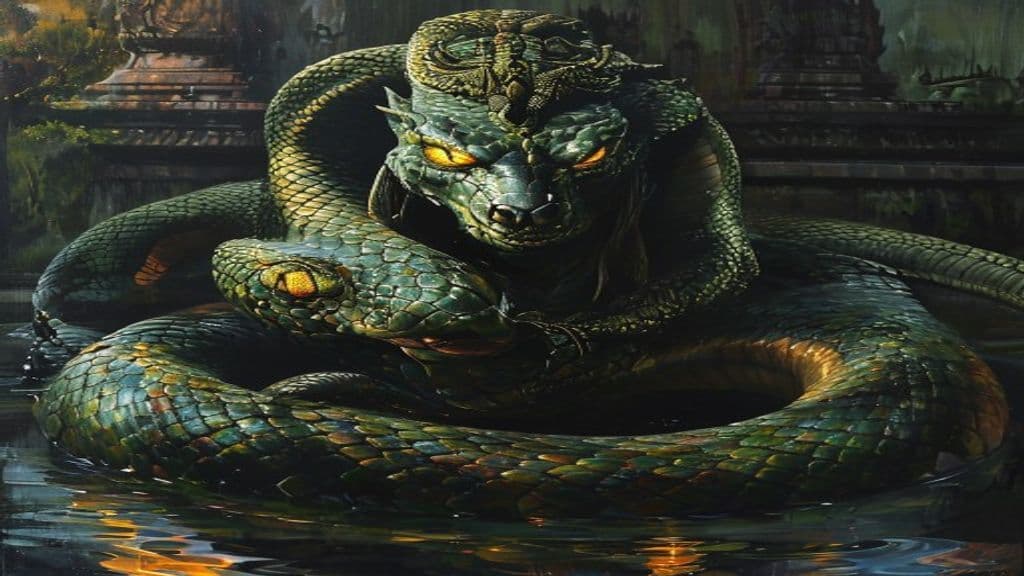
Naga
Divine serpent beings of Hindu, Buddhist, and Jain cosmology — powerful guardians of water, earth, and underground treasures. Revered as deities in South and Southeast Asia.
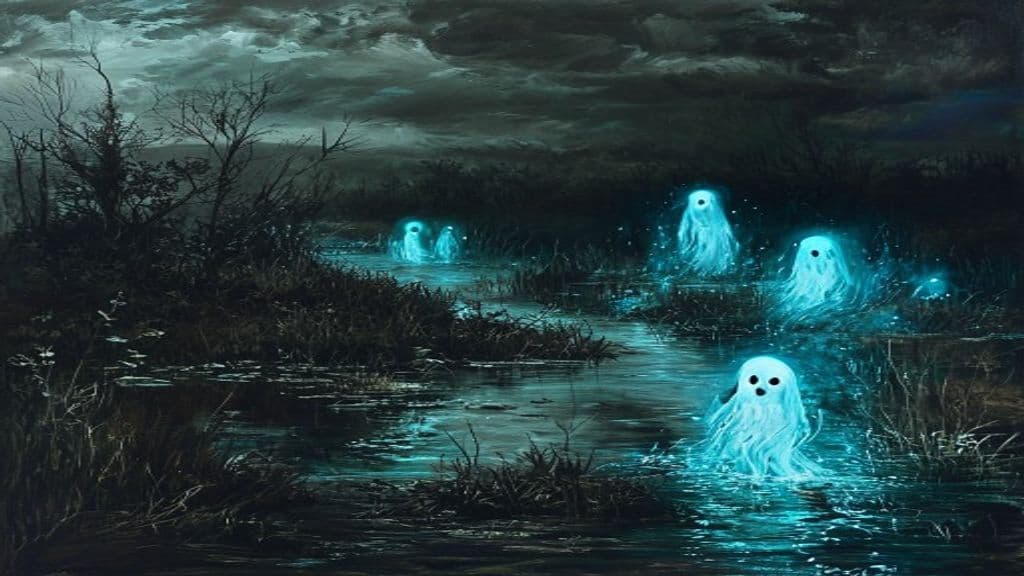
Will-o'-the-Wisp
A wandering light seen over marshy ground at night, leading travellers astray into bogs and fens. Possibly a spirit, possibly the soul of the unbaptised dead, possibly the devil himself.
Phi Tai Hong
Phi Tai Hong (ผีตายโหง) are vengeful, restless spirits in Thai folklore arising from people who die suddenly and violently. They are feared as especially dangerous and difficult to exorcise; the pregnant-woman variant (Tai Thang/Tai Thong Klom) is regarded as particularly malevolent.
Pop (ghost)
Pop (Thai: ปอบ, Pop or Pob) is a Thai folkloric spirit believed to inhabit or possess a living person (commonly a sorceress) and to leave the host at night to feed on human viscera, especially intestines. Village traditions describe types, hereditary or transmissible lines, face-switching deception, and a hierarchical superior spirit (Ha Gom) that commands lesser Pops.
Nachzehrer
A German revenant who gnaws its own shroud in the grave while draining the life-force of surviving family members, causing them to waste away one by one.
Naga
Divine serpent beings of Hindu, Buddhist, and Jain cosmology — powerful guardians of water, earth, and underground treasures. Revered as deities in South and Southeast Asia.
Naga (serpent)
A mythic multiheaded water-serpent figure in South and Southeast Asian (Khmer) art and origin myth, serving as a semi-divine protector, ancestor-emblem, and symbol of water, fertility, and royal legitimacy. The lexical form 'naga' is also reused in modern fiction as a personal epithet (e.g., Slayers' 'Naga the Serpent'), but that use is distinct from the Khmer mythic being.
Naga (water deity) — Buddhist tradition
The provided source treats Nagas as members of the general category "water deities": mythological beings associated with bodies of water such as seas, great rivers, springs, and wells. The excerpt does not supply tradition-specific origins, physical descriptions, or detailed functions for Nagas in Buddhist texts.
Naga People (Lanka)
A class of super-humans inhabiting a subterranean world in Sri Lankan tradition, often depicted as serpents. (Note: 1. Power tier should be Primordial instead of Ancient, given their association with serpent symbolism and cosmic significance in Sri Lankan and Indian mythology. 2. Add sensory cues based on source ma)
Nagam / Naagam (lexical attestation)
The string 'Nagam' or 'Naagam' appears in the provided sources as a toponym, personal name, and media title; the supplied materials do not document a serpent deity, supernatural being, or folk-belief content for 'Nagam' in South Indian tradition.
Nagin
Nagin refers in the supplied sources to the female form of the South Asian serpent-being (Nāginī / Nagini) and to popular-media uses of that figure (film and television). Sources identify Nāginī as the feminine form of Nāga, note a locally worshipped form (Nagini or Naiṇī Devī) in the Central Himalaya, and link the term to folkloric shape‑shifters called Ichchadhari Nāgas as well as to multiple cinematic and television adaptations.
Nagini (Nāginī / Nāgnī / Naiṇī Devī)
Nāginī denotes a female member of the Naga, a class of semi-divine serpent beings in Indian religion and mythology. The form Nāgnī or Naiṇī Devī is recorded as the name of a serpent goddess worshipped in the valley of the Pindar river in the Indian Himalaya. The lexical form also appears in unrelated modern usages listed on the same disambiguation page.
Nagual (Maya tradition)
A human shapeshifter in Maya tradition who transforms into their tonal animal counterpart. (Note: - Power tier: Greater (not Ancient, as it's regional rather than deity-level) - Sensory cues: unknown (according to source material, not explicitly stated) - Weaknesses: no information provided - Ward)
Nahual (Nagual)
In Mesoamerican folk religion, a nahual (also spelled nagual) is a human believed able to shapeshift into a linked animal 'tonal' counterpart. Nagualism connects personal power and spiritual insight to a human's relationship with that animal aspect.
Community Record
- [1]Naga fireball. Wikipedia contributors. "Naga fireball." Wikipedia, The Free Encyclopedia.wiki
- [2]Naga fireball (Wikidata). Wikidata entry Q2138833, classified as an 'atmospheric phenomenon'.wiki
- [3]Gamefront Warcraft 3 Collection (archive.org) — unrelated material noted. Archive.org item included in provided materials but contains no substantive information on the Naga fireball phenomenon.other