
In Khmer indigenous mythology as reflected in Angkorian and museum descriptions, the Khmer people trace descent from a naga princess who joined a prince from the island of Java; this origin myth underwrites the naga's role as an ancestor-emblem and national symbol. In Angkor-period royal imagery the naga is incorporated into state religion and royal legitimating programs (for example, Jayavarman VII’s association with a Buddha seated on a naga), though museum texts emphasize these commemorative and symbolic deployments rather than a single liturgical narrative form.
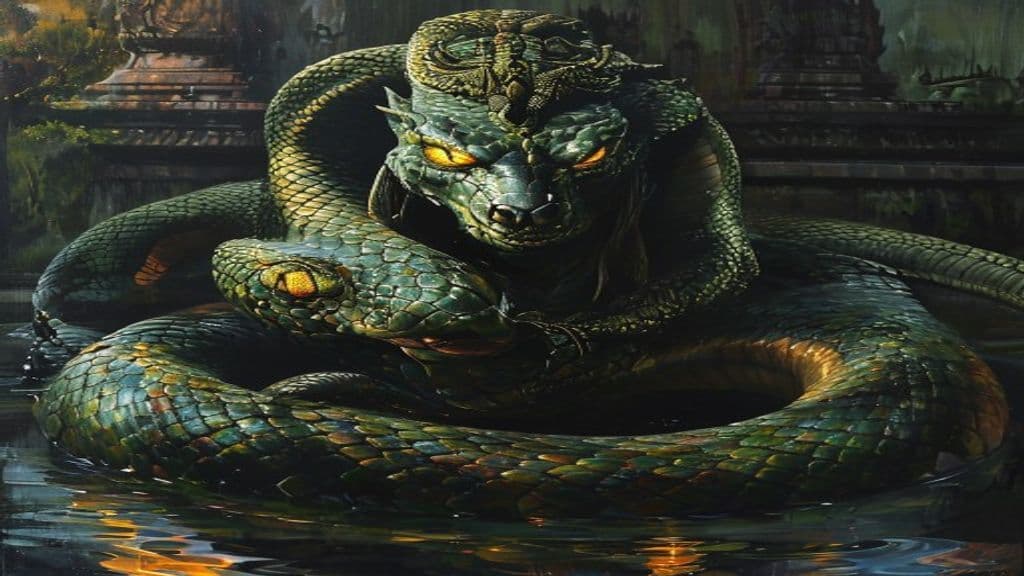
In Khmer/Angkor-period material the naga is depicted as a large, often multiheaded water-serpent with an expanded hood; representations include multiheaded serpent-hoods sheltering seated Buddhas, crowned or bejeweled royal variants, and decorative serpent finials and palanquin fittings in bronze and stone. Naga motifs appear on architectural reliefs, portable ritual objects (palanquins, finials, hooks), and sculptural compositions where the serpent may shelter or support sacred figures.
As described in the provided museum and art-historical sources, the naga functions symbolically: it acts as a protective emblem in iconography (e.g., sheltering an enthroned Buddha), as an emblem of royal legitimacy and descent (used in royal fittings and linked to origin myths), and as a water-associated symbol that evokes fertility and the prosperity of the land (for example, images pairing a naga with ceremonial rice offerings). Separately, modern popular fiction appropriates the lexical form 'Naga' as a sorceress' name (Slayers' Naga the Serpent), a human character with great magical powers and distinctive personal traits; that fictional use is a name/epithet and not the same as the Khmer mythic serpent.
Weaknesses
None recorded.
Wards
- symboluse of naga imagery as protective emblem
Nabataean Religion
Ancient Arabian polytheistic tradition with aniconic worship practices, centered around multiple local gods and deities. (Note: 1. Power tier should be "Ancient" as the sources describe multiple local deities and deities from other cultures (Baalshamin, Isis, Tyche, Dionysus), indicating deity-level powers. 2. Add sensory cues)
Naberius
Naberius is a marquis-ranked spirit in the Western grimoral/Goetic tradition (Lesser Key of Solomon) described as commanding legions and teaching arts—especially rhetoric—and associated with restoring or (in one source) removing honors. He appears in canine and corvine forms and is catalogued among early modern demonological lists.
Nabu
Nabu is the Mesopotamian deity of writing, scribes, wisdom, and the rational arts; a divine scribe and announcer who records destinies, serves as an oracle, and is identified with the planet Mercury in Babylonian astrological tradition.
Nacht-Alb
A German-language folkloric night-being invoked in older parlance to explain sudden nocturnal terror in children; described in archival material as a fabled visitor that frightens sleeping children and is associated with what modern medicine calls pavor nocturnus.
Nachzehrer
A German revenant who gnaws its own shroud in the grave while draining the life-force of surviving family members, causing them to waste away one by one.
Naga
Divine serpent beings of Hindu, Buddhist, and Jain cosmology — powerful guardians of water, earth, and underground treasures. Revered as deities in South and Southeast Asia.
Naga (water deity) — Buddhist tradition
The provided source treats Nagas as members of the general category "water deities": mythological beings associated with bodies of water such as seas, great rivers, springs, and wells. The excerpt does not supply tradition-specific origins, physical descriptions, or detailed functions for Nagas in Buddhist texts.
Naga People (Lanka)
A class of super-humans inhabiting a subterranean world in Sri Lankan tradition, often depicted as serpents. (Note: 1. Power tier should be Primordial instead of Ancient, given their association with serpent symbolism and cosmic significance in Sri Lankan and Indian mythology. 2. Add sensory cues based on source ma)
Naga fireball (Bang Fai Phaya Nak)
A seasonal luminous phenomenon observed along the Mekong River, locally attributed to phaya nak (giant river serpents, Nāga) and described as glowing reddish balls that rise from the water and disappear after ascent. Scientific and skeptical commentators characterize it as an atmospheric/visual phenomenon and advance alternative explanations such as tracer rounds, flare guns, marsh gases, or plasma-like effects.
Nagam / Naagam (lexical attestation)
The string 'Nagam' or 'Naagam' appears in the provided sources as a toponym, personal name, and media title; the supplied materials do not document a serpent deity, supernatural being, or folk-belief content for 'Nagam' in South Indian tradition.
Nagin
Nagin refers in the supplied sources to the female form of the South Asian serpent-being (Nāginī / Nagini) and to popular-media uses of that figure (film and television). Sources identify Nāginī as the feminine form of Nāga, note a locally worshipped form (Nagini or Naiṇī Devī) in the Central Himalaya, and link the term to folkloric shape‑shifters called Ichchadhari Nāgas as well as to multiple cinematic and television adaptations.
Nagini (Nāginī / Nāgnī / Naiṇī Devī)
Nāginī denotes a female member of the Naga, a class of semi-divine serpent beings in Indian religion and mythology. The form Nāgnī or Naiṇī Devī is recorded as the name of a serpent goddess worshipped in the valley of the Pindar river in the Indian Himalaya. The lexical form also appears in unrelated modern usages listed on the same disambiguation page.
Community Record
- [1]Naga Finial (Cleveland Museum of Art object description). Cleveland Museum of Art, object description for Naga finial (Angkor-period palanquin fitting), archive.orgacademic
- [2]Naga-enthroned Buddha (Cleveland Museum of Art object description). Cleveland Museum of Art, object description for Naga-enthroned Buddha, archive.orgacademic
- [3]One of a Pair of Decorated Palanquin Hooks and Rings (object description). Cleveland Museum of Art, decorated palanquin hook description, archive.orgacademic
- [4]Naga the Serpent (fictional character) — Wikipedia. Wikipedia: Naga the Serpent (fictional character in the Slayers franchise)wiki
- [5]Wikidata: Naga the Serpent. Wikidata entry for Naga the Serpent (fictional character)other