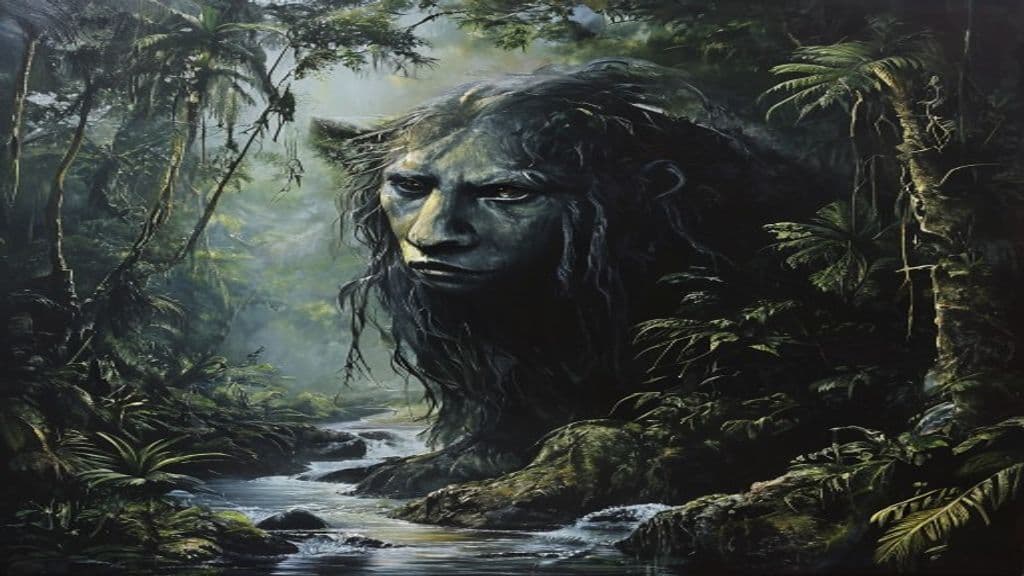
The Nawao are said to be descended from Lua-nu'u and were associated with the pre-Menehune era of Hawaii.
Wild, large-sized; no further details provided regarding their appearance or physical characteristics.
Characterized as a 'hunting people'; no explicit information given about their abilities and behaviors beyond this characterization.
Weaknesses
- conditioncultural erasure
Wards
None recorded.

Ikatere
In Māori and Polynesian mythology, Ikatere is a Primordial fish god and the father of all sea creatures. (Note: - Power tier: Primordial is accurate based on the source. - Abilities: The source does not mention specific abilities or behaviors; this should be clarified or removed. - Sensory cues: No information )
Kumu-Honua
The first man in Hawaiian creation myth, considered a divine or semi-divine figure. (Note: 1. Power tier should be Primordial, as it's a creator figure and not explicitly described with deity-level powers. 2. Abilities section needs to be rewritten or deleted since there are no specific des)
Laka
A 'popular hero' in Hawaiian mythology, associated with heroic qualities. (Note: * Power tier should be revised to Greater or Ancient since it's referred to as a "popular hero" and is associated with heroic qualities, suggesting a higher power level. * Appearance should state that)
Māori Mythological Entities
Supernatural beings in Māori mythology associated with the origins of the world and connected to the whakapapa. (Note: 1. Power tier: should be "Primordial" is correct, but consider rephrasing for clarity. 2. Origin story: should be more specific about what these entities are, rather than just stating they're part of )
Pangatoru (Māori canoe)
A traditional Māori ocean-going canoe used in the migrations that settled New Zealand. (Note: 1. Power tier should be Minor Spirit or at least Lesser (it's not described as having supernatural abilities), and "Greater" is too high. 2. No information about sensory cues, wards, or weaknesses is )
Tūwhakararo
A chief in Māori mythology, significant figure in the migration myth of Hawaiki. (Note: 1. Power tier: Downgrade to Greater (he is not described as having supernatural abilities, but his significance lies in his leadership). 2. Sensory cues: Add "None mentioned" or "Unknown". 3. Weakness)
Navadurga
Navadurga (Sanskrit: नवदुर्गा, Navadurgā) denotes nine interrelated manifestations or stages of the goddess Durga worshipped together during Navaratri, Durga Puja, and in regional jatras and masked-dance traditions (notably in Nepal). They function as collective aspects of a single divine being tied to the nine-day contest with the demon-king Mahishasura and to communal rites of protection, victory, and renewal.
Navagraha
Navagraha (Sanskrit: नवग्रह, 'nine grahas') is a canonical ninefold grouping within Hindu astronomy and astrology comprising seven visible planetary bodies plus the two lunar nodes; in Jyotisha tradition they are treated as deities or celestial agents whose positions and periods are believed to influence human affairs. The grouping developed over time through Vedic, Indic, and later contacts with Hellenistic and Near Eastern planetary ideas and became a standard framework for astrological calculation, temple installation, and remedial ritual by the medieval period.
Navajo Ghosts (Yéʼiitsoh-related spirits)
Spirits of the deceased in Navajo contexts that are invoked in accounts of 'ghost sickness' and in folktales; they are experienced as agents or influences tied to pathological grief and may be discussed alongside concerns about witchcraft and skinwalkers in contemporary sources.
Nayenezgani (Naayééʼ Neizghání)
Mythical hero from Navajo mythology who rid the world of the Naayééʼ alongside his brother Tóbájízhchíní, playing a significant role in Navajo cosmology. (Note: - Summary: Add "play a significant role in Navajo cosmology" after "world's creation". - Power tier: Reduce from Primordial to Ancient (deity-level), as Nayenezgani is considered a hero and not a cosm)
Naʼashjéʼii Asdzą́ą́ (Naashjeii Asdzaa) — "Spider Woman / Spider Grandmother"
Naʼashjéʼii Asdzą́ą́, commonly rendered in English as Spider Woman or Spider Grandmother, is a Navajo ancestral/feminine figure entrusted by the Holy People to weave the pattern of the universe. She functions in Navajo narrative as a teacher and guide encountered by culture heroes and embodies an instructional, creative, and guardian role rather than a malicious spirit in the provided sources.
Neaera
Neaera (Νέαιρα / Neaira) is a personal name applied in Greek tradition to several minor female figures—principally nymph-types (an Oceanid, a Thrinacian nymph consort of Helios, and a Thracian naiad wife of river-god Strymon). She functions mainly as a localized nature-associated mythic figure and as a genealogical consort/mother rather than as an independently culted major deity.
Community Record
- [1]Wikipedia: Nawaowiki