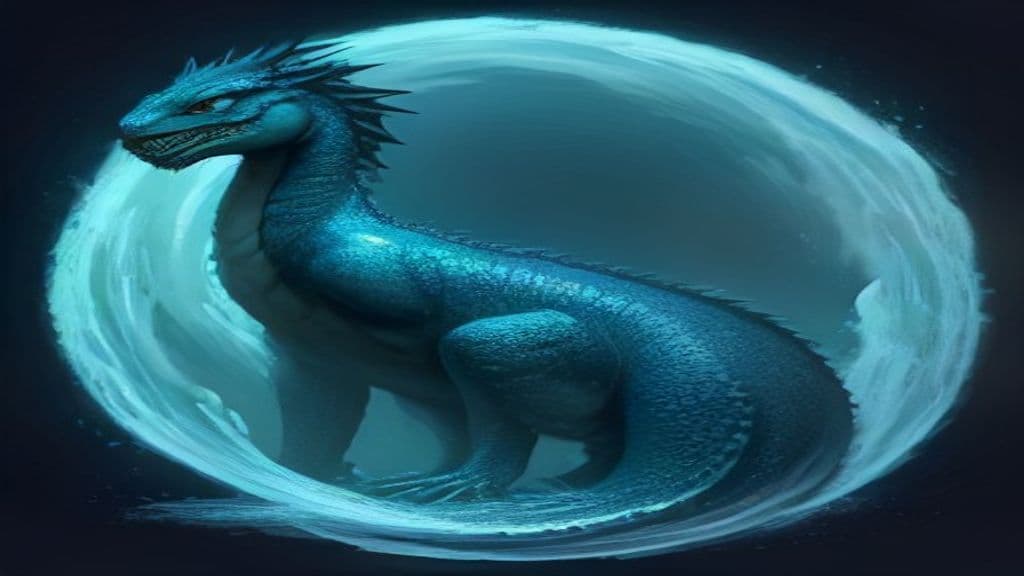
The sources supplied do not preserve a native origin myth or narrative cycle specifically for the Nhang. English-language summaries place the Nhang within Armenian mythology — a syncretic tradition said to have originated from Proto-Armenian Indo-European roots and to have incorporated elements from Hurrian, Urartian, Caucasian, Mesopotamian, Zoroastrian, and Greek mythologies. From this broader cultural-historical context it may be inferred that a water-dragon-type figure would belong to an indigenous corpus influenced by neighboring Near Eastern and Caucasian motifs, but the supplied material contains no direct origin story, cosmogonic role, or genealogy for the Nhang itself.
No primary-description is present in the provided sources. The English gloss "Water Dragon" implies a draconic, water-associated creature, but the supplied materials do not record any attested physical details (such as size, coloration, limb count, or monstrous attributes). The absence of an Armenian-language spelling or textual excerpt in the cited sources prevents documentation of traditional iconography or visual markers.
The supplied sources do not attribute any concrete abilities, powers, or characteristic behaviors to the Nhang. General material on the motif of shapeshifting in world myth is present among the sources, but that work does not link shapeshifting specifically to the Nhang; therefore no powers (for example, control of water, shapeshifting, or harmful acts) can be responsibly asserted from the provided material.
Aralez (Aralezner)
Aralez (Aralezner in plural) are ancient Armenian dog-like spirit-beings traditionally credited with resurrecting fallen warriors by licking their wounds. Described in source material as part of the older strata of Armenian sacred imagination, they occupy a liminal role between animals, spirits, and ancient gods.
Hayk
Legendary patriarch and founder of the Armenian nation, considered an ancestral figure without supernatural powers. (Note: 1. Power tier should be set to "Primordial" since Hayk is considered an ancestral figure and a central part of Armenian mythology, implying a cosmic or foundational significance. 2. Sensory cues and w)
Vishap
The vishap (Armenian՝ վիշապ) is a draconic, water-associated being in Armenian tradition tied to mountains, storms, and fertility. It is depicted as a winged serpent or composite dragon that causes storms, whirlwinds, eclipses and is antagonized by the culture-hero Vahagn; it also appears in ritual and poetic contexts as a symbol of water, wealth and ambiguous power.
Ngā Mānawa
Ngā Mānawa is a collective name in a Māori tradition (notably attested for Ngāti Awa) for the five 'Fire Children', the sons of Mahuika and Auahitūroa. The five figures are mapped to the five fingers of the hand in regional Māori finger-naming systems, linking elemental fire, genealogy, and human anatomy.
Ngāti Ranginui
Ngāti Ranginui is a Māori iwi (tribe) based in the Tauranga / Bay of Plenty region of Aotearoa New Zealand. The iwi traces descent from the ancestor Ranginui (of the Takitimu canoe), exercises kaitiakitanga (guardianship) within a defined rohe, maintains marae and governance bodies, and has engaged in Treaty settlement and resource management processes in the contemporary period.
Ngātokimatawhaorua
An ancestral canoe in Māori tradition, symbolizing navigation expertise and cultural heritage. (Note: * Power tier: Primordial is unlikely, given the description of an ancestral canoe as a cultural symbol, rather than a cosmic entity. * Appearance: Add note that Ngātokimatawhaorua has no physical appe)
Ngātoro‑i‑rangi
Ngātoro‑i‑rangi is an ancestral ariki‑tohunga (high priest and navigator) in Māori tradition associated with the Arawa canoe migration and the central North Island of Aotearoa. His deeds—naming places, stamping springs into being, confronting hostile atua, and calling for sacred geothermal fire—serve as foundational narratives that legitimate tribal descent (notably Ngāti Tūwharetoa) and explain geothermal and volcanic features of the Taupō/Tongariro region.
Ngải (research note)
The supplied sources do not document a Vietnamese earth- or plant-spirit called "ngải" used in sorcery. Materials provided instead show homographs or similar forms of the sequence 'ngai/ngài/ngāi' in unrelated cultural contexts (an East African creator deity "Ngai", the Māori tribal name "Ngāi Tahu", and Vietnamese honorific usages such as "Ngài"). This entry records only what is present in the provided sources and identifies gaps where data on a Vietnamese ngải is absent.
Nian (Year Beast)
A folkloric monstrous beast in modern Chinese popular accounts that is said to emerge annually at the turn of the year to raid villages. The legend functions as an etiological explanation for many Chinese New Year customs—fireworks, red decorations, loud noises, and the lion dance—though explicit references to a named creature called nian in older textual sources are scarce.
Nibelung
A personal or clan name in Norse mythology associated with misty or ambiguous realms, also giving its name to the Middle High German epic Nibelungenlied. (Note: - Power tier: Primordial (given the ambiguous and multifaceted nature suggested by source material) - Appearance: Add a note that specific physical description does not exist, but may be implied by as)
Nicostratus
Nicostratus is attested in Greek mythographic and reference material as a son of Menelaus, variously said to be by Helen of Troy or by a slavewoman. He appears in genealogical listings and name-disambiguation contexts rather than as an active character in surviving narrative episodes.
Nidhi
Nidhi (Sanskrit: निधि, nidhi) is a Sanskrit term meaning 'treasure' and within Hindu mythological tradition denotes the set of nine treasures (navanidhi) belonging to Kubera, the god of wealth. In some tantric practice each nidhi is personified and has a guardian-spirit that may receive worship; beyond this core role their nature and characteristics are poorly explained in surviving sources.
Community Record
- [1]Armenian mythology. Wikipedia, "Armenian mythology"wiki
- [2]Shapeshifting. Wikipedia, "Shapeshifting"wiki
- [3]SHAPESHIFTERS.htm (mirror). Mirror copy of shapeshifting overview, "SHAPESHIFTERS.htm"other