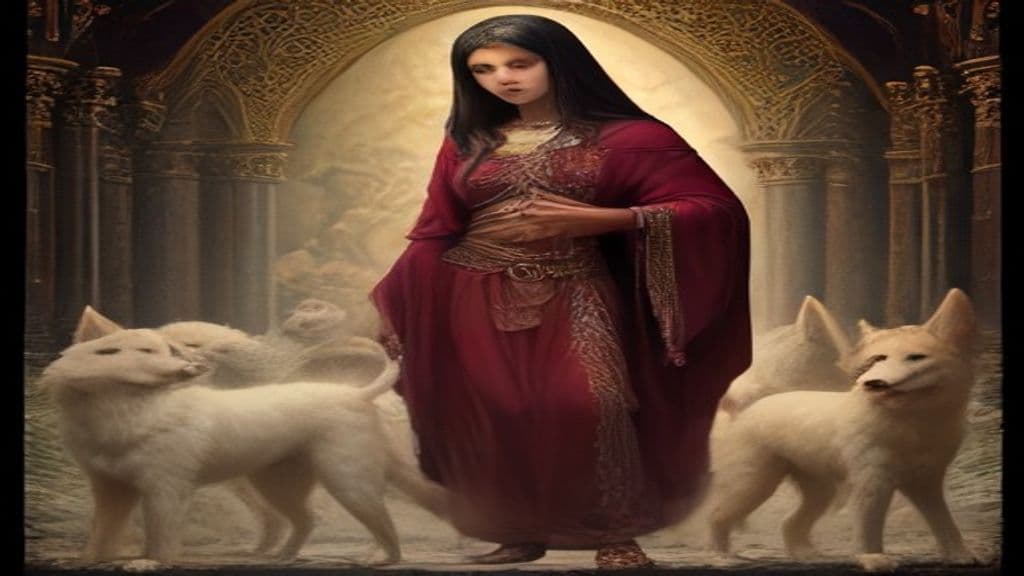
Aralez appear in the pre-Christian layer of Armenian mythic thought and are described in the sources as among the oldest gods or sacred beings of the Armenian pantheon. The attested descriptions position them within the older strata of Armenian belief (described as Proto-Armenian heritage in summaries of Armenian mythic origins), where animal-associated spirits and deities played roles in the fate of warriors and the community. While one source explicitly calls them among the oldest gods of the Armenian pantheon, the provided material does not record any specific cosmogonic narrative or a detailed mythic genealogy for the Aralez; instead, they are presented as established, ancient supernatural helpers associated particularly with battle and the restoration of life.
Sources consistently describe Aralez as canine or dog-like creatures and at least one source characterizes them as "invisible spirits of dogs." No further morphological details — such as size, color, or anthropomorphic traits — are provided in the supplied excerpts. The material therefore supports a basic image of dog-like spiritual beings whose visibility may vary (sometimes characterized as invisible), but it does not furnish richer physical description.
The primary and repeatedly attested ability of the Aralez is to resurrect fallen warriors by licking their wounds. This restorative function is described as their defining role in extant summaries: they appear in contexts connected to warriors and battlefields and effect revivification through a licking action. Beyond this wound-licking resurrection, the supplied sources do not attribute additional powers or behaviors to Aralez, nor do they provide ritual formulas, limits to the power, or narrative accounts that elaborate further abilities.
Weaknesses
- othernone attested in sources
Wards
- otherno warding practices attested in sources
Hayk
Legendary patriarch and founder of the Armenian nation, considered an ancestral figure without supernatural powers. (Note: 1. Power tier should be set to "Primordial" since Hayk is considered an ancestral figure and a central part of Armenian mythology, implying a cosmic or foundational significance. 2. Sensory cues and w)
Nhang (Water Dragon)
Nhang, glossed in English as the "Water Dragon," is cited in English-language overviews as a water-associated monstrous figure within Armenian mythic tradition. The available sources note its classification only as a water-dragon label; no detailed native accounts, descriptions, or ritual material are provided in the supplied material.
Vishap
The vishap (Armenian՝ վիշապ) is a draconic, water-associated being in Armenian tradition tied to mountains, storms, and fertility. It is depicted as a winged serpent or composite dragon that causes storms, whirlwinds, eclipses and is antagonized by the culture-hero Vahagn; it also appears in ritual and poetic contexts as a symbol of water, wealth and ambiguous power.
Ara
Ara (Sumerian: A) is a minor Mesopotamian goddess attested as a servant or attendant of the god Enki. Earlier scholarship sometimes conflated her theonym with the attendant deity Isimud, but modern treatments distinguish Ara as a separate divine household figure.
Arachne
Arachne is a mortal woman from classical Greco-Roman myth (best known from Ovid's Metamorphoses, Book 6) whose unrivaled weaving skill and challenge to the goddess Athena/Minerva lead to her metamorphosis into a spider; the tale functions as an etiological myth explaining why spiders spin webs and as a cautionary exemplum about hubris toward the gods.
Aradia
Aradia is a name and motif appearing in late-19th-century folklorist literature (notably Charles G. Leland's Aradia, or the Gospel of the Witches) and in Italian, Sardinian, and adjacent regional folklore where cognate names (Arada, Araja, Erodiade/Irodiada) are attached to a nocturnal female host associated with Diana/Herodias. Sources portray Aradia variously as a messianic teacher of witchcraft (Leland) and as part of a tradition of night-flying female spirits and regional fairy-queen figures (folklore surveys).
Arae (Arai)
In Greek myth the Arae (Αραι, Arai) are female chthonic spirits who personify curses—especially imprecations of the dead—and act as underworld enforcers of vengeance and blood-redress. They are often treated as interchangeable with or closely related to the Erinyes (Furies) and are invoked in dramatic and ritual speech when murder, household pollution, or ancestral guilt demand retribution.
Arahura (Māori canoe)
Divine Māori canoe made of pounamu, associated with the Ngāi Tahu tribe and spiritual significance. (Note: * Power tier: Not specified, assume Lower or Lesser as it's associated with the tribe and not described as a deity-level being * Abilities: Remove the mention of spiritual significance and connection )
Aram (Nahapet)
Legendary leader and patriarch in Armenian tradition who united Armenians into one state. (Note: - Power tier: Primordial (given cosmic/unifying abilities) - Summary: Expand to include "unification of Armenians" as a key aspect of his leadership - Abilities: More specific and detailed description)
Arang (Korean folklore)
Vengeful spirit driven by a desire for justice in Korean folklore, particularly during the Joseon Dynasty. (Note: 1. Power tier should be Primordial since it is described as having a cosmic level of influence in causing fear among magistrates. 2. The description for weaknesses is missing; add that Arang's weaknes)
Aranzaḫ
Aranzaḫ is the Hurrian divine personification of the river Tigris, treated in Hurrian religion as a numen and river-god who appears in the Kumarbi Cycle and as an ally-protector in the tale of Gurparanzaḫ. The figure is attested in Hurrian theophoric names and is discussed in scholarship in relation to later regional cultic references to the Tigris source.
Aranātha
Aranātha is the eighteenth Tīrthaṅkara (ford‑maker) in the Jain tradition of the present half‑cycle (Avasarpini). In the provided sources he is presented as a spiritual exemplar born in the Ikshvaku dynasty at Hastinapur who attains siddhahood (liberation) after completing his life.
Community Record
- [1]Aralez (Aralezner) entry (Wikipedia summary of Armenian mythology). Wikipedia, "Armenian mythology" (Aralez entry referenced in source list)wiki
- [2]Aralez, the Gods of Ancient Armenians - Art-A-Tsolum. Aralez, the Gods of Ancient Armenians, Art-A-Tsolum (online article summarizing Aralez as canine resuscitators and "invisible spirits of dogs")other
- [3]Armenia – Animals « Cradle of Civilization (Aratta blog). Aratta (Cradle of Civilization blog), summary identifying Aralez/Aralezes as dog-like creatures or spirits in Armenian materialother
- [4]2014 June 12 « Cradle of Civilization (Aratta blog). Aratta (Cradle of Civilization blog), contextual material on Armenian mythic landscape used for cultural contextother