
No narrative origin myth for Nindara is preserved in the supplied sources. His attestation appears in administrative offering lists, a balbale hymn of Nanshe, and royal inscriptions (notably a neo-Sumerian/Gudea context), which together indicate a cultic presence rather than a mythic biography. Thus his ‘origin’ in the record is reconstructible only as a member of Nanshe’s divine circle and as a municipal/girded cult figure whose status is visible through temple building, offerings, and festival participation.
The surviving texts do not preserve an iconographic or anthropomorphic description of Nindara. No depiction or standardized visual attributes are attested in the provided material. The textual record does, however, associate him with a bird called dar (darmušen, possibly a francolin) in cultic vocabulary, and preserves epithets and temple affiliations (for example, his temple Elaltum at Ki'esa) that form the primary evidence for his cultic identity.
Nindara's attested functions derive from epithets and cultic contexts rather than explicit narratives of power. His most common epithet is lugal-uru16, rendered 'the powerful master,' suggesting a locally powerful male deity. In a balbale hymn of Nanshe he is called 'the tax collector of the sea,' and elsewhere 'the lord of the holy sea,' pointing to maritime or harbor-related responsibilities in the worship centers. A royal inscriptional context (Gudea) credits Nindara with giving the ruler strength, indicating participation in royal legitimation and temple patronage. Offerings, New Year festival attestations (possibly nuptial/betrothal offerings with Nanshe), and a recorded boat festival show his role in standard cultic provisioning and communal liturgy. Overall, the sources present a modest, regionally focused divine patron with martial/strength and localized maritime associations; his wider character remains opaque.
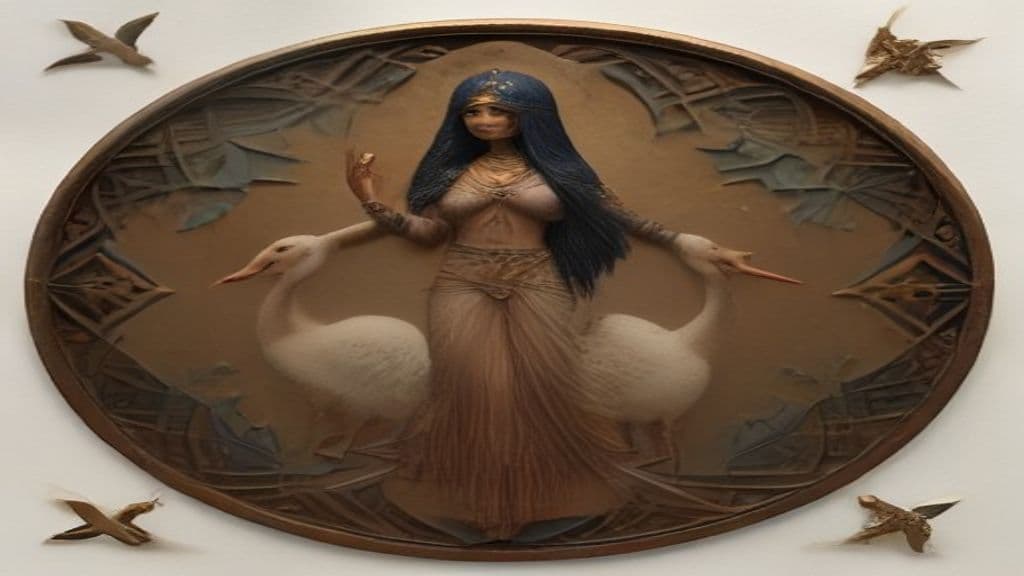
Nanshe
Nanshe is a Sumerian/Mesopotamian goddess associated with marshes and the sea, the fishes and water‑birds of those biomes, and with divination (notably dream interpretation), social justice, and civic welfare. Her primary cult center was the city Nina (Tell Zurghul); she appears across a long Mesopotamian chronology from the Uruk period into the first millennium BCE.

Hendursaga
Hendursaga (Sumerian Dḫendur-saŋ) is a Mesopotamian deity described in hymnic and god-list sources as a divine night watchman who patrols city streets, bears an insignia (staff or torch), and protects nocturnal travelers from hostile supernatural beings. He is attested in connection with the state of Lagash and is equated with the Akkadian Išum in later bilingual contexts.

Dumuzi-abzu
Dumuzi-abzu is a Mesopotamian city tutelary deity worshiped in the state of Lagash, attested as the patron goddess of the city Kinunir. She appears in offering lists connected to the Nanshe cultic circle, is associated with temples and sanga priests, and is listed among deities thought to confer virtue on rulers in Lagash texts.
Nilus
Nilus (Greek: Νεῖλος, Latin: Nilus) is the Greek personification of the Nile River attested in classical genealogies as a son of Oceanus and Tethys and historically referenced as a river-deity who received cultic honors in Egypt, notably at Niopolis. The name also functions separately as a Christian personal name borne by several saints and clerics; those human bearers are distinct from the river-personification.
Nimi (King)
In Hindu mythology, Nimi is a king and ancestor of the Janaka lineage of Mithila. He serves as an early ruler of the Videha kingdom and is connected to the Suryavamsha dynasty. (Note: - Power tier should be Primordial (cosmic) given that he's considered an ancestor of the Suryavamsha dynasty and connected to Manu (a primeval deity in Hindu mythology). - Summary needs minor adjustme)
Nimintabba
Nimintabba is a Sumerian local goddess attested at the city of Ur, known primarily from a temple founded by king Shulgi circa 2100 BCE and from associated foundation deposits and a dedicatory inscription.
Nimrod
Biblical figure and human king who defied God's authority, described as 'mighty' and rebellious. (Note: - Power tier should be Primordial, not Ancient, as it is unclear if he had supernatural or deity-level abilities. - Weaknesses should include 'hubris' or 'arrogance', which contributed to his downfall)
Ninagal
Ninagal (also spelled Ninagala) is a Mesopotamian deity regarded as a divine smith. He functions as the craftsman-god responsible for the fabrication and ritual preparation of cult statues and other temple paraphernalia and was associated with the artisan deities of the Mesopotamian pantheon.
Ninazu
Ninazu is a Mesopotamian chthonic deity associated with the underworld, healing, snakes, and vegetation; his cult originated in Enegi and Eshnunna and appears in hymns, god lists, and incantations from the Early Dynastic through first-millennium traditions.
Nindub
Nindub is a Mesopotamian deity attested in Early Dynastic and Ur III sources from Lagash/Girsu associated with ritual purification, lustration, and the preparation and consecration of temples. In literary texts (notably the Gudea cylinders) he functions as a divine ritual specialist who provides incense, performs lustration, and supplies a temple plan inscribed on lapis lazuli.
Ninduluma
Ninduluma (also attested as Ninildu in some sources) is a Mesopotamian deity associated with carpentry and the carpenters' craft, attested in offering lists and literary texts and primarily worshiped in or near the city of Zabalam.
Nine-tailed Fox
A long-lived fox-spirit figure from Chinese myth (九尾狐) that appears across East Asia (e.g., kitsune, kumiho). Associated with age-linked transformation, shapeshifting into humans, ambiguous morality (trickster/seducer or occasionally honorable), and in some doctrinal sources a celestial/ritual role with talismans and jiao rites.
Ninegal
Ninegal (Sumerian Ninegalla; Akkadian Belet Ekalli / Belet-Ekallim) is a Mesopotamian tutelary goddess whose domain is the palace. Attested from the Early Dynastic period through the first millennium BCE, she functioned in cult as the divine guarantor of palace integrity and the sovereignty of rulers, and in some literary contexts appears as an epithet or manifestation of Inanna.
Ningal
Ningal (Sumerian dNIN.GAL, "Great Queen") is a Mesopotamian goddess, chiefly known as the consort of the moon god Nanna/Sin and the tutelary goddess of the city of Ur. She appears across Mesopotamian periods in god-lists, hymns and laments where she functions as wife, mother (commonly attested as mother of Inanna and Utu), mourner of the city, and local protective presence.
Ningen
A modern Japanese internet-originated aquatic humanoid cryptid said to inhabit the Southern Ocean and Antarctic ice margins, described in online posts and popular media since the mid-2000s as a large whale-like or mermaid-like creature with humanlike facial features and limb-like appendages.
Community Record
- [1]Nindara - Wikipedia. Wikipedia: 'Nindara' article (summary of attestations, epithets, offerings, temple and Gudea inscriptional references)wiki
- [2]Nindara (Wikidata). Wikidata entry Q1817013 (classification as Sumerian god)other
- [3]Nail of Gudea (Walters Art Museum object 48.1457) object commentary. Museum object commentary referencing Gudea's temple building for Nindara and royal cultic connectionother
- [4]Drehem Ur III offering tablet (summarized). Summary in Wikipedia noting a Drehem tablet recording a fat-tailed sheep offered to Nindara in Kesh (Ur III administrative evidence)wiki