
Ninimma does not have a single coherent origin myth preserved in the surviving fragments cited here. She appears in god lists and hymns as a member of Enlil’s household centered on Nippur. In variant mythic traditions (attested in some texts) she appears in the cycle of Enki and Ninhursag/Enki and Ninmah: in one variant Enki impregnates Ninimma and she is named as the mother of Uttu. Other sources and later local traditions recast her genealogy (for example, Seleucid Uruk texts associate her with Enmesharra). Overall her parentage and kinship relations vary by period and manuscript tradition rather than forming a single canonical origin.
No consistent iconography or detailed physical description is preserved in the fragments cited. Hymnic lines emphasize her offices and titles — e.g., 'seal-holder of the treasury', 'caretaker of the great gods', 'lady of all the great rites in the E-kur', and 'heavenly scribe' — rather than providing corporeal portraiture.
Texts and hymns attribute to Ninimma administrative and ritual-specialist capacities: she is presented as a heavenly scribe or custodian of rites and divine records (scribal/archival role), a nurse and caretaker within Enlil’s household, and a birth-assistant who in an Old Babylonian hymn participates in cutting umbilical cords and fixing fates. From the Middle Babylonian period she is incorporated into incantation sequences (notably Šurpu) and invoked among deities called upon to break curses or effect healing. An Old Babylonian letter invokes Nisaba and Ninimma together in a formula requesting wisdom, indicating at least one attested occasion of petitioning her for intellectual aid.

Nisaba
Nisaba is an ancient Sumerian goddess chiefly associated with writing, the scribal arts, wisdom, and grain. Attested from the Fara (Early Dynastic) period onward, she functions as the divine patron and legitimizer of literacy, accounting, and the institutional arts of tablets and archives, and later becomes identified with grain itself.

Ninkasi
Ninkasi is the Mesopotamian divine personification and cultic goddess of beer, associated with the production, consumption and social/ritual effects of beer. She appears in god lists, hymns (notably the Hymn to Ninkasi) and administrative and ritual contexts from the Early Dynastic through later Mesopotamian periods.

Enki (Ea)
Enki, also known by the Akkadian form Ea, is a major Mesopotamian deity associated with wisdom, crafts, magic and incantations, and the freshwater deep called the Abzû. Centered at the cult-city Eridu (temple E‑Abzû), he functions in myths as a crafty counsellor, culture‑hero and creator figure who aids humans and orders aspects of the world.

Ninhursag
Ninhursag is a principal Sumerian mother/earth/mountain goddess—literally 'lady of the sacred mountain'—associated with fertility, birth, creation, and the living earth; she appears across multiple Sumerian myths and served cultic and tutelary roles in Early Mesopotamian religion.
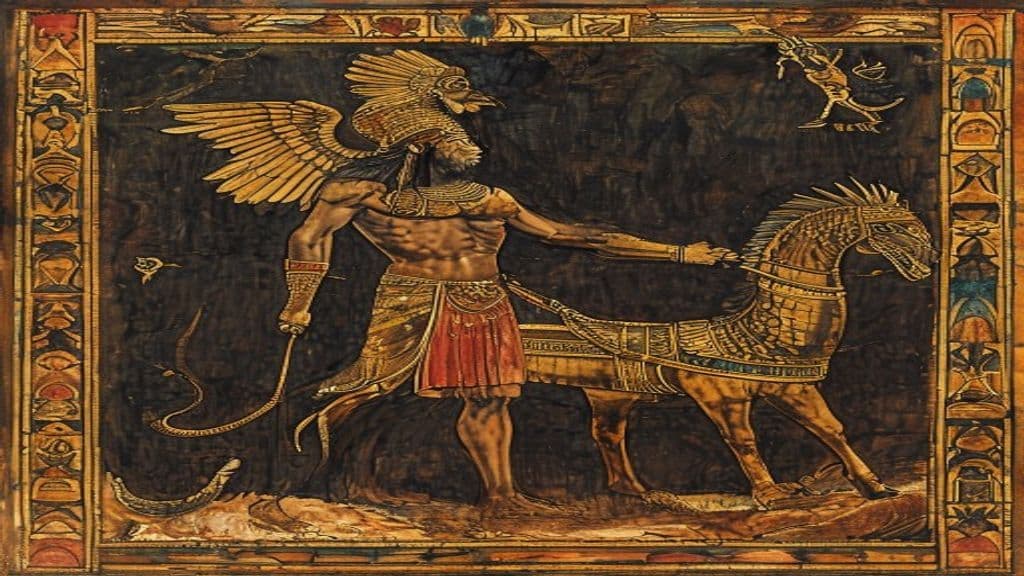
Ninurta
Ninurta is a major deity of ancient Mesopotamia (Sumerian–Akkadian–Assyrian–Babylonian) whose roles include agriculture, healing/exorcism, law and scribal authority, and martial champion of the gods. He is attested from the mid-third millennium BC onward and was venerated at city cult-centers such as Nippur (Eshumesha), Girsu/Lagash (as Ninĝirsu), and later in Assyrian Kalhu.

Enmesharra
Enmesharra is a Mesopotamian theogonic and ancestral deity, presented in texts as a member of an older generation of gods associated with the underworld and with earlier or superseded divine prerogatives summed up by the Sumerian term me.
Community Record
- [1]Ninimma (Wikipedia). Wikipedia entry 'Ninimma' (summary of scholarship and textual attestations)wiki
- [2]Wikidata: Ninimma. Wikidata item for Ninimmaother
- [3]A song to Ninimma (Ninimma A) – translation. ETCSL translation of hymn 'A song to Ninimma' (fragmentary lines identifying her titles and roles)literary
- [4]A song to Ninimma (Ninimma A) – composite cuneiform text. ETCSL composite cuneiform text for hymn 'A song to Ninimma' (textual fragments referencing E-kur and Enlil associations)literary
- [5]Kusibanda (Wikipedia). Wikipedia entry noting Kusibanda as described in at least one source as Ninimma's husbandwiki