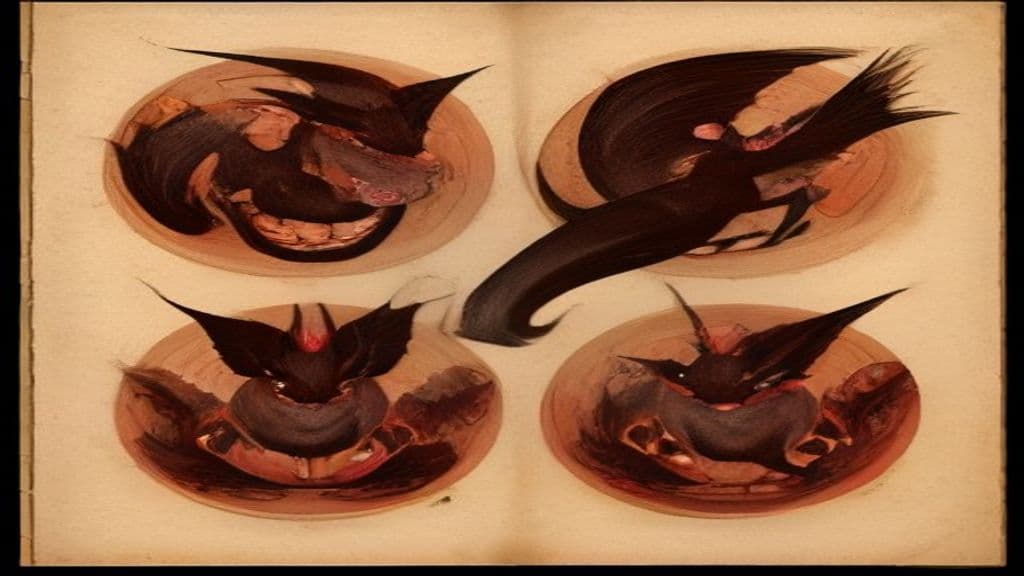
Edo-period encyclopedic and illustrated sources treat the nobusuma as a kind of yōkai linked to nocturnal mammals: some entries and images identify it with musasabi (flying squirrels) while other textual traditions describe a life-cycle in which bats age into nobusuma and later into a yamachichi. Sources present these identifications and transmutation ideas side by side rather than as a single canonical origin.
Descriptions vary across sources and illustrations. Toriyama Sekien's Konjaku Gazu Zoku Hyakki depicts a flying-squirrel–like creature with fleshy wings that, when folded, resemble bat wings; other texts and illustrations render it more batlike or rat-colored and small in form. Woodblock depictions sometimes show a small winged beast that can come to lie upon or cover a person's face with its forepaws.
Sources report a range of behaviors: some accounts say it will latch onto a human and cover the eyes and mouth, in some variants to feed on blood; other traditions (via a later form, yamachichi) say an aging bat will suck the breath from a sleeping person, potentially causing death if unwitnessed. Illustrated and textual sources also record a behavior of biting off or extinguishing the tip of a torch carried by a traveler and seemingly 'breathing' or consuming the flame. Other reports identify attacks on animals (for example cats) in local legends.
Weaknesses
- conditionbright torch or lantern light (may blind or deter musasabi/flying-squirrel forms)
- conditionbeing observed by others (some accounts suggest an attack witnessed by another human produces a non-lethal or life-lengthening effect)
Wards
- conditionmaintain visible flame or witness presence (implied by accounts noting light affects flying-squirrel forms and that being observed alters outcomes)

Nixie
A category of water spirit from Germanic and neighbouring European folklore associated with lakes, streams, ponds and waterfalls. Commonly described as shapeshifting and linked to enchanted music, nixies may be helpful or dangerous to humans depending on local tales.
Njörðr (Njord)
Njörðr is a Vanir deity in Old Norse religion associated with the sea, navigation, fishing, wind, wealth, and crop fertility. He resides in Nóatún, is counted among the Vanir who were incorporated into the wider Norse divine order after a truce with the Æsir, and is father of Freyr and Freyja. Sources describe him as linked to maritime well-being and as having an unhappy marriage with the goddess Skaði.
Nkisi (minkisi)
Nkisi (pl. minkisi, mikisi, zinkisi) are Kongo‑region spiritual agents and the material containers that house or activate them. Employed by specialist practitioners (banganga/nganga), minkisi mediate with ancestors and other powers for healing, protection, justice, oath‑sealing, and the punishment or restraint of harmful forces.
Nkondi (minkondi)
Nkondi are aggressive minkisi figures of the Kongo (Bakongo) tradition: carved statuettes that house an ancestral or spiritual power isolated and placed into them by a ritual specialist (nganga). Functioning as hunters or enforcers, nkondi are activated to investigate, punish, or otherwise intervene in social wrongs and dangerous unseen forces.
Nkunzi
The supplied sources do not document a folkloric supernatural entity named 'Nkunzi.' The term appears in the provided material as a personal name, a toponym (a mountain in South Africa), and as the given name of an author who wrote about sangoma practice, but no ethnographic descriptions, origin story, appearance, abilities, rituals, or protective measures for a spirit called Nkunzi are present in the provided items.
Noah
Noah is the tenth antediluvian patriarch in Abrahamic traditions who, at God's command, builds an ark to preserve his family and representatives of land animals from a divinely sent Flood. After the waters recede he offers burnt offerings, receives a covenant from God (with the rainbow as its pledge), and becomes the progenitor of post‑diluvian humanity.
Nocnitsa
A Slavic night spirit or 'night hag' that torments sleepers—especially children—by visiting at night, producing nightmares or sensations of pressure on the chest, and in some accounts drawing life energy from victims.
Noldor
The Noldor are a kindred (clan) of Elves in J. R. R. Tolkien's legendarium, one of the three High Elf clans who migrated to Valinor and later returned to Middle-earth. Renowned for their skill in craft, lore and warfare, their history — including the Oath of Fëanor and the Flight of the Noldor — is central to the events of The Silmarillion.
Nomion
Nomion is not attested in the provided sources as a coherent supernatural being or folkloric class. The term appears primarily as a taxonomic epithet in lepidoptery and as a modern proper name in popular culture; a single Wikidata label links the name to a supposed ruler in Caria but this is uncited in the supplied materials.
Nommo (West African Tradition)
Primordial ancestral spirits considered sacred by the Dogon people of Mali, associated with water and spiritual guidance. (Note: - Power tier: Primordial (matches description in source material) - Abilities: Remove redundancy, keep only one ability mentioned in source material (Masters of the Water) - Sensory cues: Add informat)
Nonacris
Nonacris (Ancient Greek Νώνακρις) appears in classical sources as a multi-faceted name: an Arcadian town and its springs, a mythic woman associated with that place (wife of King Lycaon in some accounts), and in some sources identified as the naiad of the town's springs. Ancient writers and modern summaries treat the personal and place identities as interwoven rather than wholly separate.
Nootaikok
In Inuit tradition Nootaikok is a spirit bound to large ice masses—described as presiding over and living inside icebergs and glaciers—and is attested as one who, alongside Agloolik, led hunters to seals.
Community Record
- [1]Nobusuma (Wikipedia). Wikipedia entry summarizing Edo-period sources and traditions for nobusuma / tobikurawiki
- [2]Konjaku Gazu Zoku Hyakki (Toriyama Sekien, 1779). Toriyama Sekien's illustrated Konjaku Gazu Zoku Hyakki (1779), depiction and caption identifying a flying-squirrel–like nobusuma and noting batlike features and fleshy wings.literary
- [3]Wakan Sansai Zue (encyclopedic entry). Wakan Sansai Zue entry conflating musasabi/momoka with nobusuma and describing bat/flying-squirrel identifications.literary
- [4]Ehon Hyaku Monogatari (Takehara Shunsen, 1841). Ehon Hyaku Monogatari account describing a life-cycle in which an aging bat becomes a nobusuma and later a yamachichi that can suck the breath from sleepers.literary
- [5]Kyōka Hyaku Monogatari (1853 depiction). Illustration of a tobikura covering a person's face, part of the Edo-period pictorial tradition.literary
- [6]Baiō zuihitsu (local legend citation). Local legend cited in sources reporting a winged, weasel-like beast identified as a nobusuma responsible for attacks on cats and dwelling in deep mountains.folk