
The nurikabe appears in modern folklore collections chiefly through Kunio Yanagita's field-recording work, which popularized accounts from the sea coast of Onga County (Chikuzen Province, now Fukuoka) and other Kyūshū localities. The compound name literally means "plastered wall" (塗り/塗 + 壁), evoking a built surface that blocks movement; local craft practices (for example, Usuki's oil-plaster technique) have been suggested in sources as possible material influences on this concept. In addition, pre-modern picture-scroll images (a white three‑eyed quadruped labeled "nurikabe" in Bakemono no e and a similar 1802 copy) were discovered in the 2000s and complicated modern understandings by showing an animal-like iconography that contrasts with the field-record description of a path turning into a wall. Yanagita's 20th-century collection remains the primary textual anchor that transmitted the nurikabe tale nationally.
Yanagita's principal field-record describes the phenomenon as the traveler's destination or the space ahead "suddenly turn[ing] into a wall," without extensive anthropomorphic detail; the emphasis in earliest textual attestation is on the sudden appearance of a blocking surface rather than on a personified creature. Iconographic evidence from a pre-modern picture scroll labeled "nurikabe" depicts a white, three‑eyed quadruped variously described as dog‑ or elephant‑like, and a near-identical 1802 copy shows the same beastly form. Later popular depictions (notably Shigeru Mizuki's manga imagery) reimagined the nurikabe as a flat wall with eyes, arms, and legs — an artistic invention that differs from both the field-record text and the older picture‑scroll animal images. Commentators sometimes infer invisibility in modern retellings, but the primary field quote records only that the way ahead becomes a wall.
Primary behavior recorded in folklore is to appear on a path at night and block or misdirect travelers by making the destination ahead become a wall and rendering the traveler unable to go forward. Some modern summaries report the wall as "quite tall" and "wide enough to dampen any attempts to go around it," and certain local accounts say the obstruction extends indefinitely if one attempts to bypass it. In Ōita Prefecture variants the same phenomenology is sometimes attributed to tanuki or weasel trickery: the effect is described as a sudden loss of vision or a "blind wall" caused by an animal's action (for example, hopping onto a traveler's obi knot or spreading body parts into a sheet), restoring the nursery of animal-trickster motifs. Folklore frames the nurikabe largely as an explanatory agent for ordinary travel disorientation at night rather than as a lethal predator.
Weaknesses
- ritualsweep the bottom with a stick
- conditioneffect attributable to tanuki/itachi — can be dispelled by waiting and smoking (local variant)
- otherpreventing tanuki from riding the obi knot (local preventative clothing practice)
Wards
- ritualsweep at the base with a stick
- ritualsit and smoke a puff of tobacco
- conditiontie obi to prevent tanuki riding
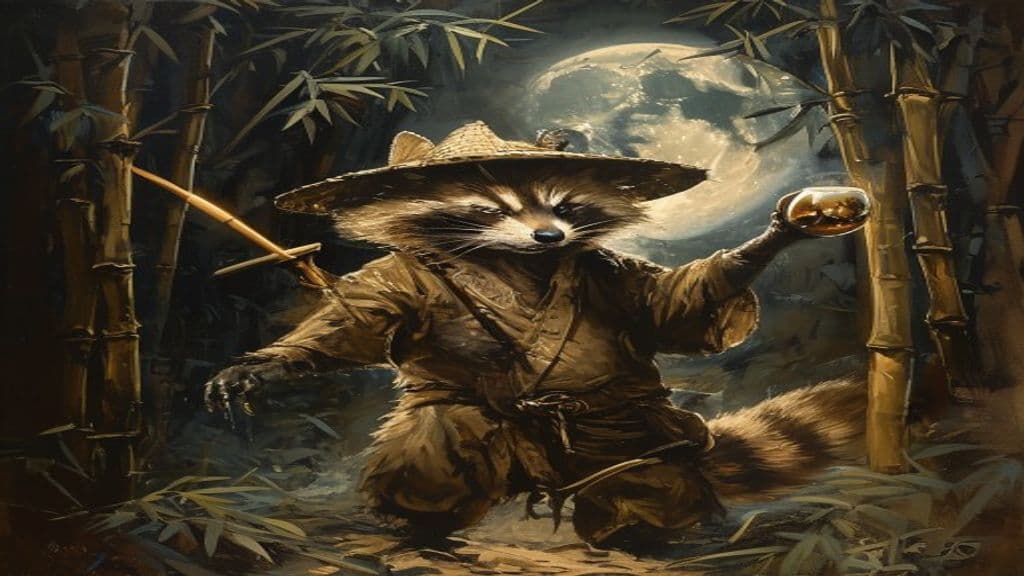
Tanuki
The raccoon-dog spirit of Japanese folklore — a cheerful trickster and master of shape-shifting, less dangerous than the kitsune but far more mischievous. Famous for leaves transformed into money.
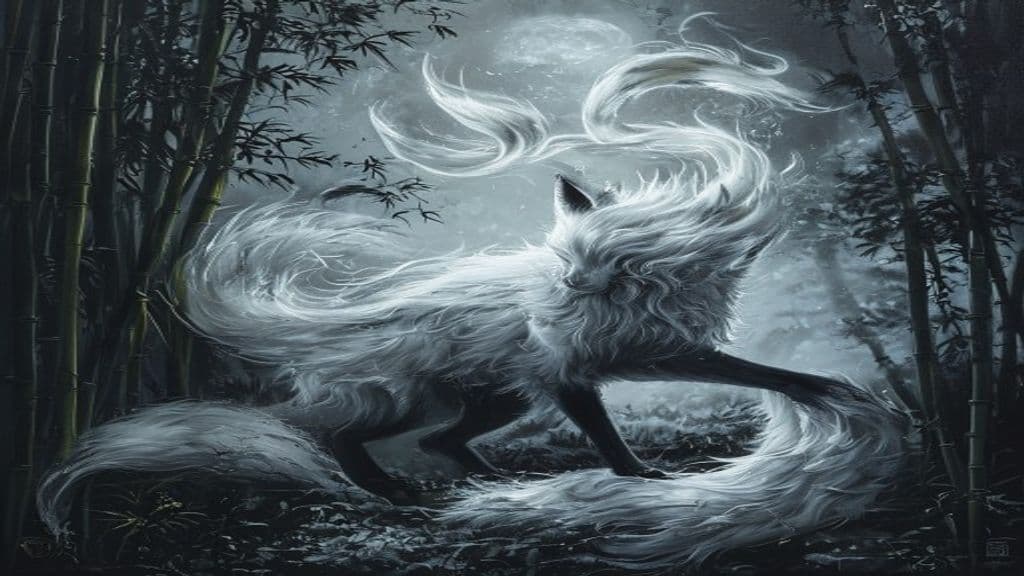
Kitsune
Fox spirits of Japanese mythology — intelligent, long-lived beings who gain additional tails (up to nine) as they age and grow in power. They serve as messengers of the god Inari and as powerful tricksters.
Abumi-guchi
A Japanese yōkai classed as a tsukumogami: an animated stirrup (abumi) depicted in Sekien Toriyama's Gazu Hyakki Tsurezure Bukuro. Traditional accounts say it is formed from a stirrup that belonged to a soldier who fell in battle and that it waits where the stirrup lies for its dead owner to return.
Abura-sumashi
A yōkai spirit from the Amakusa region of Kumamoto Prefecture, Japan, said to inhabit mountain passes. Traditionally explained as the ghost of a person who stole oil, it appears to surprise travelers and is represented in modern media with a straw-coat body and a potato- or stone-like head.
Akaname
Akaname is a Japanese yōkai associated with baths, bathtubs, toilets, and other places where scum and filth accumulate. Traditionally depicted as a child-like creature that licks grime, it functions in folklore as a cautionary figure tied to cleanliness; a few narrative variants cast it as dangerously predatory.
Akateko
Akateko (赤手児, lit. 'red child's hand') is a yōkai from Japanese folklore commonly told as a small, red, disembodied child's hand that appears from trees—especially the Japanese honey locust—and startles travelers; in some regional variants it is accompanied by a specter of a young woman or manifests as paired foot- or leg-like apparitions. Accounts vary between mostly harmless trickster apparition and a violent variant that attacks humans.
Akubōzu
Akubōzu (灰坊主, Akubōzu) is a household yōkai from parts of Akita and Iwate Prefectures in northern Japan said to live in the ashes of the hearth. Sources say they appear when people (notably children) play with or dig in hearth/furnace ash; the figure is cited as part of a broader Tōhoku motif warning against disturbing ash.
Akuma
Akuma (悪魔/あくま) in Japanese sources is an evil spirit, devil, or demon associated with misfortune and mental disturbance. The term appears in Buddhist texts and Heian-period literature and was later used to translate the Christian figure of Satan, as well as the Buddhist Mara.
Akurojin-no-hi
Akurojin-no-hi (悪路神の火, "fire of the god of the bad road") is a flamelike ghost from the folklore of Mie Prefecture, Japan. It is reported to appear on rainy nights; those who encounter it and do not run away are said to become gravely ill. The phenomenon is sparsely documented and is usually compared to will-o'-the-wisp type ghost-lights.
Amabie
Amabie is a mid-19th-century Japanese yogenjū-type wondrous creature attested in kawaraban and related pamphlet culture that emerges from the sea (in canonical accounts) to prophesy about harvests and epidemics and prescribes that its image be drawn and shown to the sick as a protective measure.
Amanojaku
Amanojaku (天邪鬼 / あまのじゃく) is a Japanese yōkai-type being portrayed as a contrarian, heart-reading trickster. Treated in different contexts as a small ogre (ko-oni), a wicked demon (jaki) in Buddhist iconography, and a folkloric spirit that provokes human vice, it appears across regional tales with variable roles from malicious kidnapper to household oddity.
Amanozako
Amanozako is a Japanese divine/monstrous figure described in classical summaries as a furious, contrarian kami produced from the ferocious aspect (ara-mitama) of the storm-god Susanoo; later glosses present her as an ancestor-figure for ill-tempered yōkai such as tengu and amanojaku.
Amefurikozō
Amefurikozō (雨降小僧 or 雨降り小僧) is an Edo-period yōkai figure depicted in classical illustrated and popular print culture as a youthful attendant associated with rain. Classical sources (notably Sekien Toriyama's Konjaku Gazu Zoku Hyakki) present it as a kozō-type servant linked by captional wordplay to a rain deity; later popular literature elaborates its rain-producing role and playful mischief on rainy nights.
Ameonna
Ameonna (雨女, "rain woman") is a figure in Japanese folklore treated as a yōkai associated with rain. Sources depict her both as a rain-calling supernatural being (sometimes helpful in drought) and as a folk label for an unlucky person whom rain seems to follow; a key pictorial source is Toriyama Sekien's Konjaku Hyakki Shūi.
Community Record
- [1]Nurikabe (Wikipedia). Wikipedia: Nurikabe article (entries on etymology, Yanagita quotation, iconography, and regional variants)wiki
- [2]Nurikabe (Wikidata). Wikidata entry on Nurikabe (cultural diffusion notes, modern media mentions)wiki
- [3]Bakemono no e and 1802 copy (picture‑scroll iconography references). Iconography section summarizing the pre-modern picture scroll labeled 'nurikabe' (white three‑eyed quadruped) and an 1802 near-identical copy; discussed in secondary sources cited by the Wikipedia articleother
- [4]GeGeGe no Kitarō materials (Mizuki depiction). Archive: GeGeGe no Kitarō design sheets and modern popular depictions influenced by Shigeru Mizukiother
- [5]Nurikabe puzzle and cultural diffusion. Wikipedia: article on the Nurikabe logic puzzle (notes on name derived from the folkloric "invisible wall" concept and popular-cultural extensions)wiki