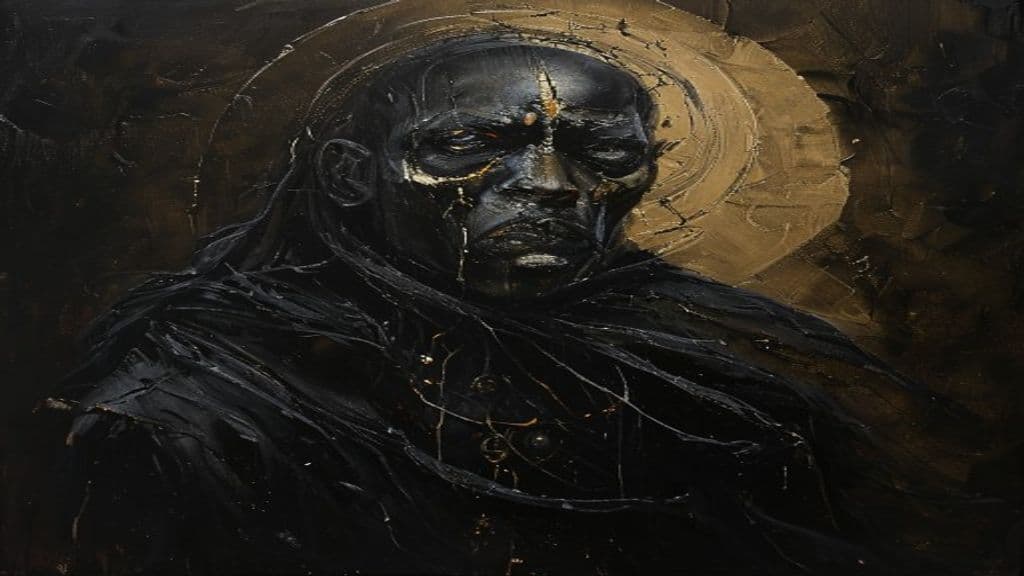
No physical description is given in the source material. Supernatural beings are often described through metaphor or association with other entities.
The Obambo can possess individuals, causing them to become ill or afflicted. It has the power to desire a home be built for it, but this may not necessarily be an active power. The entity can choose to exert either negative (evil) or positive influence.
Weaknesses
- conditionincorrect burial practices
Wards
- ritualproper burial and treatment of corpses
Emela-ntouka
A cryptozoological animal from Central African tradition, feared for its deadly capabilities. (Note: 1. Power tier: Based on its name and association with elephants, it's likely a Greater entity, not Lesser. 2. Abilities: The source doesn't describe its powers beyond being an "elephant killer", imply)
Werehyena
A supernatural being from Central African tradition and the Arabian Peninsula that can shapeshift between human and hyena forms. (Note: 1. Power tier: Should be "Greater" instead of "Ancient", as the source material does not describe the Werehyena as a deity-level entity. 2. Origin story: Should state that the origin is unknown or not)
Nāga (Nag/Nagini)
Nāgas are a class of divine or semi-divine serpent beings in South Asian tradition, occupying a liminal space between human and snake, associated with water and the netherworld (Patala). They appear in varied forms from ordinary snakes to half-human, half-serpent figures and have a long ritual history across South Asia.
Nāgas
Nāgas are serpent-associated nonhuman beings in South Asian religious literature. In the Mahāvaṃsa and related scholarship they appear as salient 'snake-beings' who act as otherworldly agents, sometimes depicted as devoted worshippers of the Buddha and elsewhere as hoarders of relics.
Nāmaka
In Hawaiian mythology, Nāmaka is a sea goddess and an older sister to the volcano goddess Pele-honua-mea. She is associated with the natural elements of water and earth. (Note: * Power tier should be Greater, not Ancient, since her domain is tied to a powerful regional aspect (sea) rather than a cosmic or deity-level one. * Summary needs to include the fact that she is a sea)
Oba
Oba is principally attested in the provided sources as a West African royal title (Yoruba and Bini) meaning 'ruler' and as a widespread modern proper name and toponym. The corpus contains no sustained folkloric account of an independent supernatural being called 'Oba'; references to ritual or religious function concern human office-holders rather than a nonhuman spirit.
Obalufon Alayemore
Obalufon Alayemore (Ọbalùfọ̀n II, Alayemore) is a historical Ooni of Ile Ife who was deified after death and is venerated in the Yoruba religious-cultural corpus as an oríṣa and patron of art, weaving, and bronze/brass casting. He appears in royal succession lists as the third Ooni of Ife and is associated with material-culture representations such as brass heads and masks.
Obariyon
Obariyon is attested in modern reference works as a yōkai associated with local folklore of Niigata Prefecture, Japan. The supplied sources provide no traditional descriptions, origin myths, abilities, rituals, iconography, or warding practices for Obariyon. The name has also been used as a contemporary professional wrestling persona in event listings, which do not supply folkloric information.
Obatala
Obatala is a high-ranking primordial orisha in the Yoruba religious framework, widely described as the sculptor of humankind who molds human bodies and is regarded as father of humanity and owner of all heads. He is associated with wisdom, coolness of thought, and senior or royal status among the orisha; some traditions connect him to the founding of Ife.
Obayifo
A supernatural entity from Ashanti folklore that inhabits the bodies of humans, emitting a phosphorescent light and exhibiting vampiric/witch-like qualities. (Note: - Power tier: Lesser (inhabiting human bodies, not cosmic/Primordial) - Abilities: Remove "exhibiting supernatural powers" as it's not mentioned in the source material - Weaknesses: Add information ab)
Obi Divination
A system of divination used in the Yoruba tradition and its derivatives, involving palm nuts or coconut pieces to communicate with ancestors and deities. (Note: 1. Remove "Greater" power tier as Obi divination is a system of divination, not an entity with supernatural abilities. 2. Add sensory cues related to the use of palm or kola nuts/coconut pieces (e.g.,)
Obia (West African Folklore)
A monstrous entity sent by witches to commit heinous crimes against humanity, described as a massive animal. (Note: - Power tier: Primordial (given its cosmic-level impact on human society) - Origin story: Needs to be added from source material - Sensory cues: Unknown is not sufficient; needs to be revised or more )
Community Record
- [1]Obambowiki