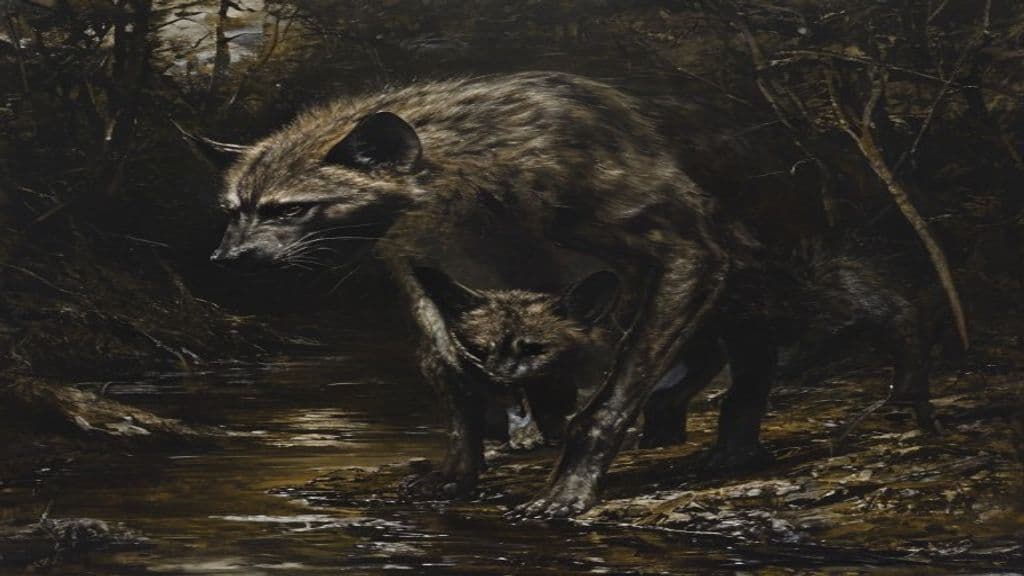
Unfortunately, the source material does not provide an origin story for the Werehyena.
The Werehyena can take on two forms: human and hyena. As a human, it disguises itself as a person.
The Werehyena possesses the ability to shapeshift between human and hyena forms, but its powers and behaviors are not specified in the source material.
Emela-ntouka
A cryptozoological animal from Central African tradition, feared for its deadly capabilities. (Note: 1. Power tier: Based on its name and association with elephants, it's likely a Greater entity, not Lesser. 2. Abilities: The source doesn't describe its powers beyond being an "elephant killer", imply)
Obambo
A supernatural being in Central African tradition with dual capacities for evil and good, capable of causing harm or sickness but also bringing positive change. (Note: 1. Power tier should be Primordial since it has dual capacities for evil and good, implying a much more powerful entity. 2. Sensory cues are missing from the draft. 3. The source material does not exp)
Wekufe
In Mapuche cosmology the wekufe (wekufü) is a class of harmful external force or spirit whose essential quality is to disturb or destroy the natural and social order. The term covers a range of beings and energies—from extracorporeal disruptive forces to material monstrous forms—and is tied to ritual order, sorcery (kalku), and healing practices (machi, machitún).
Wendigo
A malevolent spirit or being from Algonquian-language traditions associated with cannibalism, famine, winter, and insatiable greed. Tales describe humans transformed into wendigos or beings that possess humans, serving social and moral functions within affected communities.
Weneg (Weneg-Nebty)
Weneg, attested as Weneg or Weneg-Nebty, is the throne name of an early Egyptian king conventionally placed in the Second Dynasty. Scholarly sources identify Weneg as a historical/rulerial name, but specifics of his reign length and exact identification with archaeologically attested Horus-named kings remain unclear.
Wepset
Wepset (wps.t, "she who burns") is an ancient Egyptian goddess who personifies the royal uraeus cobra and functions as one of the Eyes of Ra. She appears in funerary literature (the Coffin Texts) as "the Eye" and in New Kingdom texts is said to destroy the enemies of Osiris; in the Greek and Roman periods she is also depicted in anthropomorphic composite forms.
Werecat
A werecat is a folkloric category of therianthropic beings or people associated with transformation between human and feline forms. The motif appears across Europe, Africa, South and Southeast Asia, and China, with locally specific explanations (witchcraft, hereditary curse, sorcery, ghostly influence, or divine/royal descent).
Werejaguar
The werejaguar is an Olmec iconographic motif and reconstructed supernatural found throughout the Olmec archaeological record; scholars treat it variously as a recurring visual type, a class of supernaturals, a possible rain-associated deity, or a spirit-helper used in elite ritual contexts.
Wererat
A gaming monster from tabletop role‑playing bestiaries presented as a humanoid shapechanger that can take human, rat‑humanoid hybrid, and giant rat forms. The wererat appears primarily in modern fantasy role‑playing game materials (Dungeons & Dragons, Pathfinder) and associated hobby media such as miniatures and adventure conversions.
Werethekau
Werethekau (Egyptian wrt-ḥk3w) is the personification of magical efficacy and protective potency in ancient Egyptian religion. She functions both as a goddess in some contexts and as an epithet applied to major goddesses and objects (crowns, funerary weapons, household charms) to endow them with safeguarding power.
Werewolf
A figure of European folklore of a human who can change into a wolf or wolf–human hybrid, variously portrayed as voluntary shapeshifter, cursed afflicted person, or clinical delusion (lycanthropy). Belief in werewolves was entwined with medieval and early modern witchcraft accusations and persisted into Gothic and popular fiction.
Wewe Gombel
Wewe Gombel is a female spirit or vengeful ghost in Javanese/Sundanese Indonesian folklore associated with the abduction and protective custody of children who are mistreated or left out at night; she is used pedagogically to warn children to stay home and to signal parental responsibility.
Community Record
- [1]