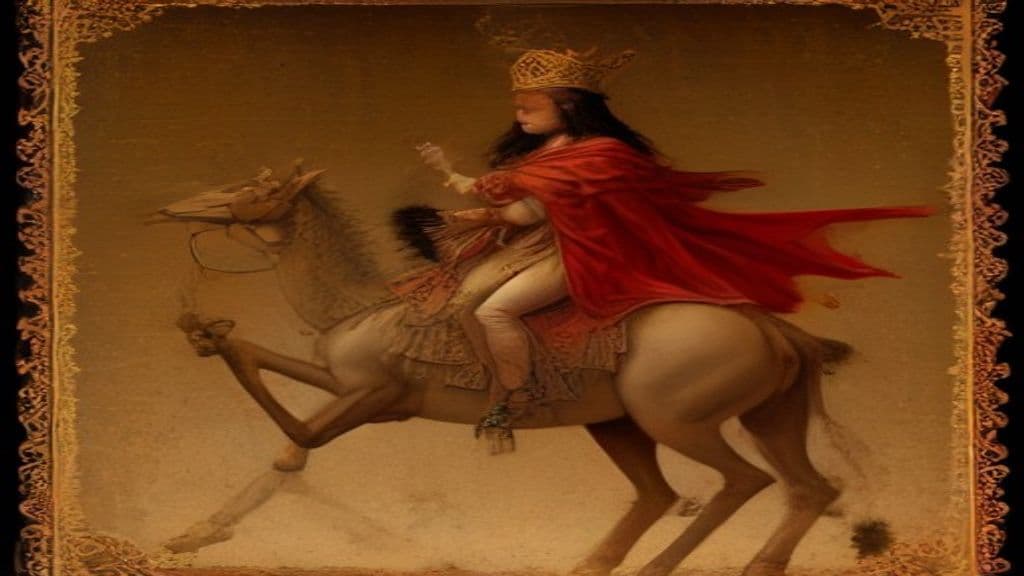
Paimon appears within a cluster of early-modern and medieval European magical and demonological sources (Ars Goetia section of The Lesser Key of Solomon; Johann Weyer's Pseudomonarchia Daemonum; Livre des Esperitz; Liber Officiorum Spirituum; Livre/Pope Honorius variants; Book of Abramelin; manuscript witnesses such as British Library Sloane MS 3824). These texts present him not as a folkloric origin-tale protagonist but as an operative entry in ritual manuals: a ranked, kingly spirit who can be summoned, commanded, and bound by ceremonial operators. Sources vary on certain points (his exact rank in different enumerations, the precise number of legions he commands, and his cardinal orientation when invoked), and later commentators (for example Mathers in editions of Abramelin) offer speculative etymologies linking his name to Hebrew roots — interpretive notes rather than claims found in the primary grimoire entries themselves.
Across multiple grimoire witnesses Paimon is typically described as a man riding a dromedary (camel) and preceded by musicians playing loud instruments—explicitly trumpets and cymbals in several sources. Some manuscripts specify a crowned camel or that Paimon himself wears a crown; other compilations remark on his face as 'beautiful' while the Ars Goetia proper does not specify facial features. Manuscripts such as Sloane MS 3824 and the Liber Officiorum Spirituum also record vocal qualities (a hoarse voice) and note that he may initially speak in his native tongue until commanded by the conjurer to use the summoner's language. Variants across the corpus account for differences in retinue detail and regalia.
Grimorial authorities consistently attribute to Paimon instruction and revelation functions: he 'teaches sciences and answers other questions' and is said to know 'all arts and secret things,' including knowledge concerning the earth, waters, and winds in some lists. Livre des Esperitz and Liber Officiorum Spirituum add capacities such as revealing hidden treasures. The Goetia, Weyer, and related texts also state he can bestow dignities, lordships, and familiars. He is described as ruling many legions of subordinate spirits (the reported numbers vary among sources) and as having subordinate kings (e.g., Lebal/Bebal/Babal/Beball/Labal and Abalam/Abalim) and officers (manuscripts note roles such as a bishop named Sperion). Ritually, operators must command him to speak and may compel language changes; if he appears without his expected retinue, conjurers are instructed to summon his under-kings or offer a sacrifice to rectify the manifestation.
Weaknesses
- conditionSubordination to higher divine authority (has no power over the 'lord above')
- ritualMust be commanded to speak and thereby can be bound or compelled by correct ritual formulae
Wards
- ritualInvocation of superior divine authority (appeal to the 'lord above' or angelic powers) — theological limitation cited as ultimate check
- ritualCorrect ceremonial protocol (face prescribed cardinal direction — West in several sources, Northwest in some manuscripts — and enforce commands to compel speech and obedience)
- ritualSummon subordinate kings (e.g., Lebal/Bebal and Abalam/Abalim) or offer sacrifice if Paimon appears without his retinue (procedural containment measure)

Djinn
The class of supernatural beings created from smokeless fire in Islamic cosmology — a parallel civilization to humanity, capable of belief or unbelief, with their own prophets, society, and judgment before God.

Belial
In Hebrew Bible usage Belial is originally a pejorative term for worthlessness; in Second Temple (Dead Sea Scrolls) literature it is personified as the malign leader of the 'Sons of Darkness', an angelic/oppositional figure who commands hostile spirits and features in Qumran dualist eschatology.
Asmodeus
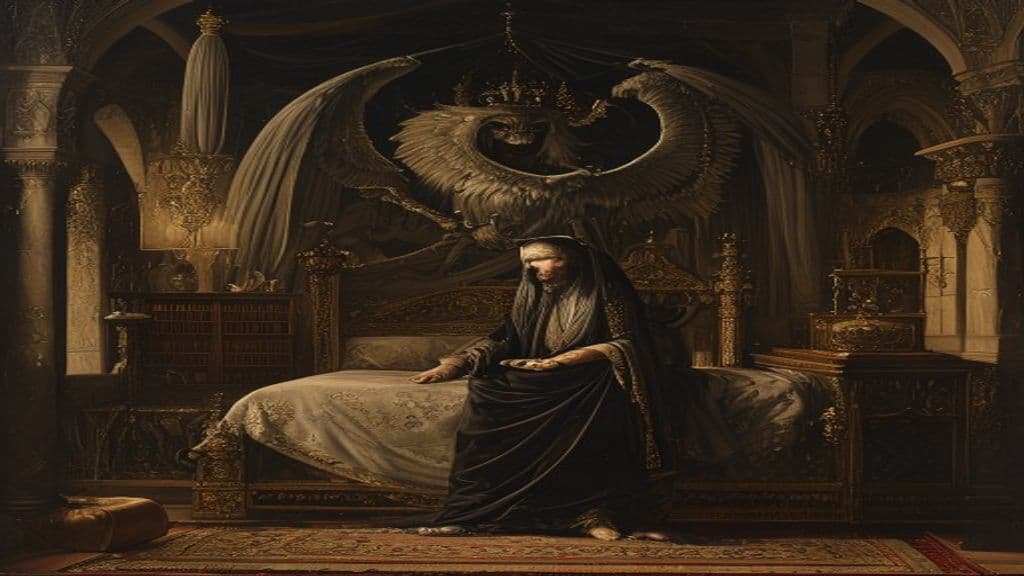
Asmodeus (Heb. Ashmedai/Ashmeday; Gr. Asmodaios; Arabic Sakhr in some accounts) is a named malignant spirit appearing in Near Eastern Jewish, Christian deuterocanonical, and later Islamic storytelling. Traditions portray him as a princely or kingly figure among malevolent spirits who intervenes in human affairs—notably hostile to marriages and in contest with King Solomon—and who can be driven off or bound by ritual fumigation and angelic agency.
Amdusias
Amdusias is a named spirit listed in the goetic corpus (the Ars Goetia / Lesser Key of Solomon) described as the sixty-seventh spirit who commands twenty-nine legions; sources note his true form as a unicorn and that his arrival is accompanied by trumpets and musical sounds, and that he may assume human shape when evoked.
Bael
Bael (also spelled Baal or Ba'al) is a named kingly spirit appearing in post‑medieval European demonological grimoires. He is listed as the opening or first spirit in some catalogs (notably the Pseudomonarchia Daemonum and The Lesser Key of Solomon) and is described in short summaries as a hoarsely voiced king; fuller ritual texts and attributes are not present in the supplied excerpts.
Botis
Botis is a named spirit from Renaissance and early modern ceremonial grimoires, variously ranked as a President, Earl, or Count. Appearing in sources such as the Ars Goetia (Lesser Key of Solomon), the Pseudomonarchia Daemonum, the Munich Manual of Demonic Magic (as Otius), and mentioned in the Grand Grimoire as subordinate to Agaliarept, he is summoned by ritual operators to answer questions, reveal knowledge, and reconcile allies and enemies.
Bune
Bune is a ducal spirit in European grimoire tradition, listed in works such as the Lesser Key of Solomon, Pseudomonarchia Daemonum, Dictionnaire Infernal, and the Livre des Esperitz. Described as commanding many legions and able to move the dead, confer wealth, and grant eloquence and wisdom, Bune functions as a summonable operant office within early modern ceremonial magic.
Gemory (Gremory)
Gemory (also Gremory, Gamori, Gomory, and variants) is a named Goetic spirit catalogued in medieval and early modern European grimoires. Described as a crowned woman riding a camel, she is attributed powers over hidden treasures, knowledge of past/present/future, and procuring love; her rank and legion counts vary between sources.
Padmāvatī
Padmāvatī is a polyvalent South Asian female name and identity applied across Hindu, Jain, and literary-legendary contexts — used for a Vaishnava consort (Alamelu Manga), a Jain yakṣiṇī (attendant goddess), and multiple legendary or historical queens and heroines (notably the Rani Padmini/Padmāvati of the Padmavat tradition). The figure functions variously as a devotional goddess, attendant protective figure in Jainism, and as a narrative heroine across classical and modern media.
Paeon (son of Endymion)
The supplied sources do not document Paeon (son of Endymion) as an attested mythological or supernatural figure. The materials instead show uses of the strings 'paean'/'paeon' and 'Paeonia' in lexical, musical, botanical, and archival contexts, but provide no narrative, genealogy, iconography, or ritual information that would support treating Paeon son of Endymion as a described entity in the provided corpus.
Pahá Sápa (Black Hills)
Sacred site and geographical feature in the Lakota tradition, comprising an isolated mountain range in western South Dakota. (Note: 1. Power tier: change to Ancient (the entity's formation and spiritual significance in Lakota tradition do not align with Primordial). 2. Appearance: add that the name "Pahá Sápa" translates to "Black)
Paikea
An important ancestor in Māori tradition, associated with a whale and significant to tribes such as Ngāti Porou and Ngāi Tahu. (Note: 1. Power tier: Reduce to Greater (powerful regional) as there's no indication of cosmic or deity-level powers. 2. Appearance: Add description from source material, e.g., "No specific appearance descri)
Palaechthon
In classical Greek literary context Palaechthon (Παλαίχθονος) is an earth-linked eponymous ancestor invoked to mark indigenous origin; attested only in Aeschylus' The Suppliants and discussed by later commentators and modern reference works. The name combines elements meaning 'old/long' (palai-) and 'earth' (chthon-) and functions as an aetiological device legitimizing Pelasgian claims to the land.
Palaemon
Palaemon (Παλαίμων), in the best-attested Greek tradition, is the deified form of the youth Melicertes who becomes a youthful sea-protector associated with sailors and fishermen; he is commonly depicted as a boy riding a dolphin and received local cultic honours in some places (notably linked in some traditions to the Isthmian games).
Paliuli
In Hawaiian mythology, Paliuli is a legendary paradise and the home of Princess Laieikawai, equivalent to the Garden of Eden. It serves as a symbol of spiritual guidance and inspiration. (Note: 1. Power tier: Primordial is incorrect; based on its description as an idyllic realm and paradise, it's more likely to be Ancient (deity-level). 2. Abilities: Add more specific details from the source)
Community Record
- [1]Paimon (Wikipedia). Wikipedia: 'Paimon' article (grimorial tradition summary)wiki
- [2]Paimon (Genshin Impact) (Wikipedia). Wikipedia: modern cultural reuse (distinct from grimoire entity)wiki
- [3]British Library Sloane MS 3824 (manuscript references summarized in corpus). Sloane MS 3824 cited in grimoire summaries (appearance, voice, orientation notes)other
- [4]Ars Goetia / The Lesser Key of Solomon (grimoire tradition). Ars Goetia entries summarized in the provided corpus (kingly status, camel-riding motif, knowledge, legions, command protocols)other
- [5]Pseudomonarchia Daemonum (Johann Weyer) / Liber Officiorum Spirituum / Livre des Esperitz (grimoire witnesses). Weyer and related grimoires as collated in the provided corpus (rank, abilities, retinue, directional and ritual instructions)other
- [6]Mathers etymology note (Book of the Sacred Magic of Abramelin edition). Mathers suggests a Hebrew etymology connecting the name to Paamon / פעמון 'tinkling sound' (speculative, later editorial gloss)other
- [7]Research notes and compiled manuscript summaries (provided corpus). Compiled research notes supplied to the encyclopedia entry (summary of multiple grimoire sources and manuscript variants)other