There is no single origin story for Philippine mythical creatures: rather, they are a class of beings produced by many local belief systems across the Philippine archipelago. As catalogued by compendia and lists, these creatures have been transmitted in oral folktales collected in works such as Philippine Folk-Tales and in ethnographic and popular sources (e.g., Maximo Ramos's collections consulted by contemporary creators). The category itself is described in reference works as a host of legendary beasts and supernatural beings tied to the cosmologies of numerous ethnic peoples, each with its own origin narratives and local etiologies.
Appearances vary widely across named creatures and local traditions. The collected sources describe the group collectively as including humanoid, bestial, and hybrid forms rather than a single morphology. Specific examples invoked in the sources (e.g., tikbalang, kapre, nuno) indicate a spectrum from humanlike spirits to monstrous hybrids; modern reimagining projects and media (Trese, MAGITA, VQGAN+CLIP visual experiments, Dayo) emphasize uncanny, surreal, and regionally inflected visualizations, underscoring diversity rather than a uniform physical description.
Abilities and behaviors are not uniform across the class. The sources portray these beings as agents in stories who interact with humans—sometimes antagonistically, sometimes ambivalently—and occupying roles in moral, social, and environmental storytelling. Individual creatures in the corpus are variously described in folklore (e.g., household or landscape spirits, tricksters, monsters) though the provided materials do not compile a single, sourced list of powers for the entire category. Contemporary adaptations (Trese, Dayo) reintroduce many of these beings as active characters with narrative agency.
Weaknesses
- otherVaries by creature and local tradition
Wards
- otherVaries by creature and local tradition

Tikbalang
A Philippine nature spirit/phantom associated with wild, liminal places; often depicted in later accounts as a tall, lanky half-horse, half-human trickster that can mislead travelers, guard trees or territories, and in some versions be tamed or domesticated by humans.

Kapre
A Philippine tree-dwelling humanoid spirit commonly described as a very tall, dark-skinned, tobacco-smoking being that inhabits large trees and wooded edges; kapres interact with humans as tricksters, companions, or retaliatory guardians of their trees. The modern folkloric figure is often linked in etymological accounts to Spanish/Arabic terms used in colonial discourse and so carries layered cultural meanings.
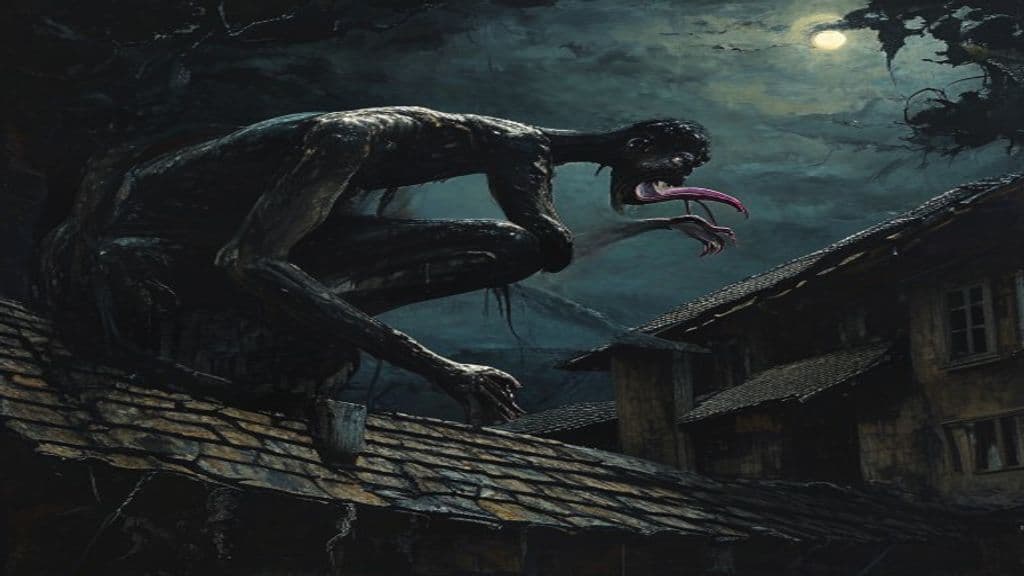
Aswang
The most feared supernatural being in Philippine folklore — a shape-shifting monster that appears human by day but transforms at night to prey on pregnant women and children.
Community Record
- [1]List of Philippine mythological creatures. "Philippine mythological creatures are the legendary beasts, monsters, and supernatural beings found in the folklore of more than 140 ethnic groups in the Philippines."wiki
- [2]Philippine Folk-Tales. Collections of folktales preserving many local narratives in which mythological creatures appear; used as exemplar of oral/folk transmission.folk
- [3]Dayo: Sa Mundo ng Elementalia (film) — production notes. Dayo's writers consulted local mythology resources (e.g., Maximo Ramos) in reintroducing mythical creatures for a modern audience.other
- [4]Philippine mythical creatures in Netflix's 'Trese'. Trese brings Philippine mythical creatures to global audiences through modern adaptation and storytelling.other
- [5]MAGITA — archive entry. Project explores combining pixel art and modern game design to present cultural narratives inspired by Philippine locales and myths.other
- [6]Reimagining Philippine mythical creatures using VQGAN+CLIP. Describes visual reimagining of Philippine mythical creatures (notes nuno and kapre among surprising outputs).other
- [7]The Amazing Beasts of Philippine Mythology (Tuttle Publishing). Modern compendium presenting a range of Philippine mythic creatures for contemporary readers.other
- [8]Mythical Creatures from Philippine Folklore and Mythology | Open Graves, Open Minds. Overview and commentary on a variety of Philippine mythic beings and their cultural roles.other