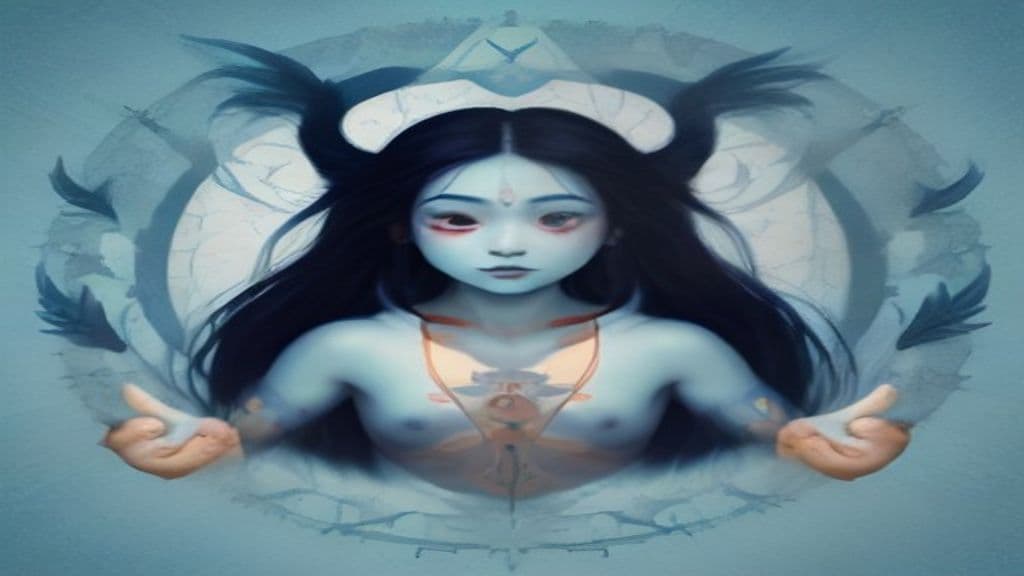
The provided sources do not record a single, detailed origin myth for Pinga. Ethnographic and modern summary accounts instead situate her within Inuit cosmology as a sky‑associated goddess who supervises the moral and ecological relations surrounding hunting and animal welfare. In these accounts her role arises from the cultural context in which deities regulate human‑animal relations and subsistence ethics; Pinga's authority over caribou herds in Caribou Inuit descriptions locates her functionally rather than narratively in origin myths available in the cited material.
The cited sources do not give a consistent physical description or iconography for Pinga. Modern summaries emphasize the semantic sense of her name — rendered as 'She Who is On High' or 'the one who is, up on, high' — which positions her conceptually in the sky and as an overseeing presence, but they do not provide authoritative details of human or animal form, clothing, symbols, or other visual markers.
Across the available summaries, Pinga is described as a sky‑associated overseer of animal welfare, a goddess of the hunt, and a medicine/healing figure. In Caribou Inuit contexts she is said to have some authority over caribou herds; sources indicate she could become angry at human behavior and that her disposition could affect hunters' success (for example, by withholding favor from those who offend proper hunting ethics). Some modern listings also associate her with fertility alongside hunt and healing, though fertility is attested unevenly across summaries.
A'akuluujjusi
A'akuluujjusi is an Inuit primordial creator mother who fashioned the non-human animals and adjusted their physical traits so they could be hunted by people.
Agloolik
Agloolik (Inuktitut: ᐊᒡᓗᓕᒃ) is an Inuit spirit that dwells beneath Arctic sea ice and functions as a tutelary guardian of seals. Hunters and fishermen petition Agloolik for success; prayers before fishing are said to bring blessings of prey.
Kigatilik
Kigatilik is an entity in Inuit religion commonly described in sources as a "demon" and reported as a fanged being that kills angakkuit (shamans). The available attestations are very brief and do not provide detailed mythology or rituals.
Kikituk
A kikituk is an Inuit shamanic animal effigy or carving that is invested with spirit-force by a shaman and used as a spiritual weapon; the shaman brings the effigy to life, casts it toward a target where it is said to destroy the opponent's heart, and then retrieves it. Sources present the kikituk as a spirit-infused object functioning as the material focal point of a shaman's animalistic power in Inuit practice.
Nanook
Nanook is the Inuit name applied to the polar bear and, in Inuit religious descriptions, the spiritual master associated with bears who regulates human–bear relations, deciding whether hunters deserve success and punishing violations of hunting taboos.
Nerrivik
Nerrivik (also Nerivik) is an Inuit sea-mother figure—an elder female supernatural who is the owner/provider of sea creatures and the patron of fishermen and hunters. She appears in Greenlandic and Canadian Inuit traditions as a principal sea goddess (regional equivalents include Sedna, Arnapkapfaaluk, and Arnakuagsak). Her origin myths explain her residence at the bottom of the sea and a mutilated condition (one-handed) resulting from being cast off a boat.
Pikne
Pikne is the Estonian supernatural figure associated with lightning and thunder; treated in tradition as a weather-personification who could be petitioned by priests and farmers for rain and whose name functioned as a taboo euphemism for the dangerous phenomenon of lightning.
Pillan
Powerful, respected male spirits in Mapuche cosmology associated with the realm of good (Wenumapu) and with volcanoes on Earth; they are moral enforcers and benefactors who receive communal ritual attention (ngillatun) and may punish (or allow the wekufe to punish) with drought, flood, earthquakes, or disease. Antü is named as the most powerful Pillan, and female counterparts called Wangulen accompany them.
Pillywiggin
Pillywiggins are very small faery or 'little people' in English and Irish folkloric compilations who function as guardians and personifications of spring flowers and small flora. Described in modern sources as trooping, winged flower-fairies, they are generally benign and largely indifferent to humans, associated with gardens, meadows and the seasonal rhythms of plants.
Pinikir
Pinikir is an ancient Near Eastern astral deity originating in Elamite religion and later incorporated into Hurrian and Hurro-Hittite contexts. Frequently associated with the planet Venus and with love/sexuality in Elam, she also appears with martial and horse-associated attributes in Hurrian/Hittite materials and is sometimes equated with Mesopotamian Venus/Ishtar figures in ritual texts.
Pinni (Punjabi dessert — no documented spirit)
The provided sources contain no evidence of a Punjabi supernatural entity called "Pinni" or "Preta." The only attested usage of the word "Pinni" in the supplied materials refers to a Punjabi winter dessert made from desi ghee, wheat flour, jaggery, and nuts; unrelated archival and technical documents in the materials do not describe any folkloric being by this name.
Pippalada
In Hindu tradition, Pippalada is a sage and philosopher who represents an incarnation of Shiva, guiding seekers of truth with deep knowledge. (Note: - Power tier should be Ancient, as being an incarnation of Shiva and attributed authorship of a key Upanishad suggests deity-level abilities. - Appearance and origin story are missing; add relevant in)
Community Record
- [1]Pinga (goddess) — Wikipedia. Wikipedia: 'Pinga, the one who is, up on, high, is a goddess of the hunt and medicine. She is heavily associated with the sky.'wiki
- [2]Pinga: Mythological Girls — Girl Museum. Girl Museum: 'Pinga is an Inuit goddess whose name means "She Who is On High." This references her place as goddess of the hunt and watcher of the well being of all animals.'folk
- [3]Pinga : Goddess of the Hunt — Mythlok. Mythlok summary listing Pinga among hunt/medicine/fertility deities and noting association with Caribou Inuit and broader Inuit contexts.other