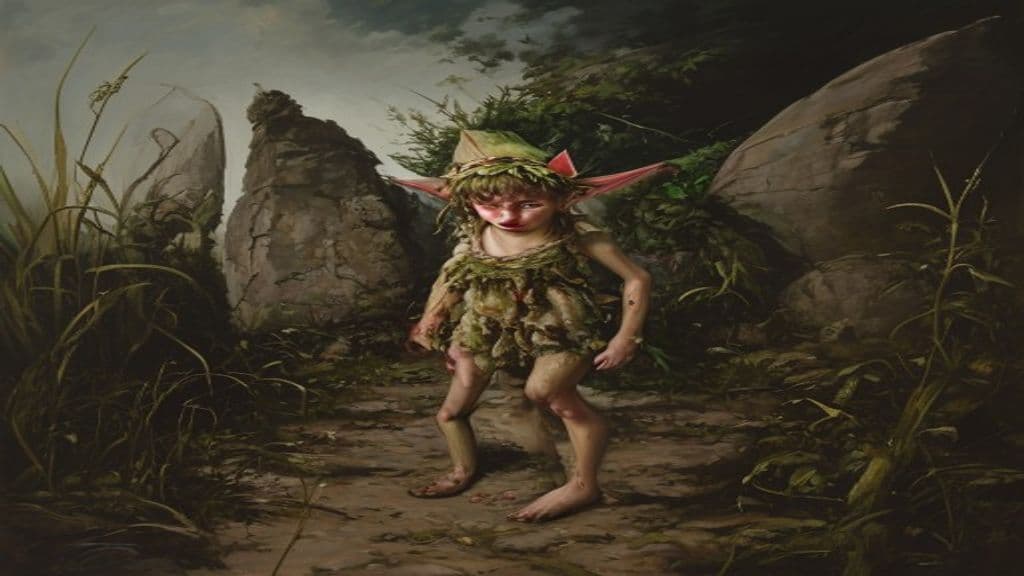
In local folklore pixies are presented as inhabitants of an older, animate landscape — the 'unseen' layer coexisting with humans — rather than as the product of a single codified origin myth. Scholarly and popular writers have variously proposed speculative antiquarian origins (for example, comparisons with Romano‑British hooded spirits genii cucullati or connections to broader Celtic 'little people' traditions), and some Christian‑era interpretations recast pixies as the souls of unbaptised children. The word's etymology is uncertain; hypotheses recorded include a possible Celtic root related to words for 'little' and an unlikely Swedish dialectal loan, but these remain debated in the sources.
Traditional regional accounts describe pixies as short of stature and childlike, often depicted in older tales wearing dirty, ragged bundles of cloth; some stories record them discarding rags when given new clothes. Modern popular imagery (pointed ears, green outfits, conical hats) is a later convention and not characteristic of older local descriptions. Local narratives allow variability in reported size and anthropomorphic behaviour (e.g., associations with 'pixie houses' and human sheltering in some tales).
Pixies are typically portrayed as locally powerful but limited supernatural beings: fond of music, dancing and outdoor wrestling (activities performed through the night), capable of domestic assistance (helping widows or doing housework in some stories), and prone to mischievous trickery such as misleading travellers ('pixy‑led') or luring children (Dartmoor tales of pixies disguising themselves as bundles of rags). They are integrated into place‑bound narratives rather than depicted as universal moral forces; nineteenth‑century and later authors sometimes layered speculative identifications (e.g., linking to Puck/Bucca) but the core folkloric behaviours are the community‑scale helpful/mischievous actions recorded in regional lore.
Weaknesses
- conditioncan be cured/repelled in pixy‑leading tales by turning a coat inside-out
Wards
- ritualturning a coat inside-out

Blunderbore
Blunderbore is a stock giant of English and Cornish folklore, appearing as a corporeal monstrous antagonist in tales such as Jack the Giant Killer and regional variants like Tom the Tinkeard. He is depicted through his actions—kidnapping, highway obstruction, and violent strength—and is typically overcome by a human folk-hero who frees captives and reasserts social order.
Bucca
A class of place‑bound supernatural beings attested in Cornish folklore, associated in surviving sources with coastal and mining landscapes and with local occupational culture; the surviving packet of sources is fragmentary and primarily cites an anthology excerpt (Mabel Quiller Couch).
Cormoran
Cormoran is a giant of Cornish folklore associated with St. Michael's Mount. In local tales he is credited etiologically with building the Mount and blamed for raiding cattle and people; he appears in chapbook versions of 'Jack the Giant Killer' and regional Cornish narratives such as the Tom the Tinkeard cycle.
Cruel Coppinger
Cruel Coppinger is a semi-legendary Cornish figure—remembered as a foreign, fearsome smuggler/wrecker whose biographical fragments were elaborated into a dramatic folk narrative. Collected in 19th-century sources (notably Rev. R. S. Hawker's account published in All the Year Round) the tale blends probable historical persons (members of the Coppinger family) with folklore motifs of seizure, wrecking, illicit wealth, and a mysterious maritime disappearance.
Knocker
A small mine-associated spirit from British and American mining folklore, known for producing knocking sounds in underground workings that miners interpreted as warnings or communications. Variants and cognates appear across Cornwall, Devon, Wales, Staffordshire and in American mining communities (Tommyknockers).
Pisidice
Pisidice (Ancient Greek Πεισιδίκη, Peisidíkē) is a personal name borne by multiple mortal women in ancient Greek myth. The bearers of the name appear as princesses, queens, daughters, and wives in distinct genealogical and heroic narratives (Aeolian, Pelian, Pylian, Methymnaean, Boeotian), rather than as a single supernatural entity.
Pisinoë
Pisinoë (also Peisinoe, Peisithoe) is attested in Greek mythographic sources as one of the Sirens, named among the daughters of the river-god Achelous and either the Muse Melpomene or Sterope. Surviving references are genealogical; no independent narratives, descriptions, rituals, or specific powers unique to her are preserved in the supplied sources.
Pitys
Pitys is an Oread (mountain) nymph from Greek myth who, pursued by the god Pan in classical accounts, was transformed into a mountain pine. Her story functions etiologically to explain the origin of a pine tree associated with rustic landscape and Pan.
Pitṛ (Pitris)
In Hindu religious tradition the pitṛs (Sanskrit: पितृ, pl. pitṛs or pitris) are the departed ancestors regarded as a class of beings whose welfare depends on ritual duties performed by living descendants. They occupy Pitrloka (and in some accounts Devaloka or other lokas), are sustained by offerings such as piṇḍa and śrāddha, and—when properly propitiated—are believed to confer blessings and social-religious benefits on the living.
Pleiades
The Pleiades is an asterism — the open star cluster Messier 45 — visible as a compact group of bright stars and, in many cultures, personified as a set of mythic figures (notably the Seven Sisters in Greek myth). It functions both as a concrete astronomical object and as a widespread cultural calendrical and mythic motif used to mark seasons, navigation, and genealogies.
Pleione
Pleione is a name applied to a figure in Greek myth (mother of the Pleiades), a star in the Pleiades cluster (Flamsteed 28 Tauri), and a genus of small orchids named after the mythic mother. Sources treat Pleione across mythic, astronomical, and botanical taxonomies rather than as a single active supernatural being.
Pleisthenes of Mycenae
Pleisthenes is a mytho-historical human figure in Greek genealogical tradition, presented as a son of Atreus and Aerope and in some accounts the father of Agamemnon, Menelaus, and Anaxibia. He functions primarily as a genealogical link within Mycenaean royal descent rather than as a character with a developed narrative or cult.
Community Record
- [1]Pixie. Wikipedia: Pixiewiki
- [2]Pixies (Wikidata). Wikidata entry Q188464other