Polybotes is one of the Gigantes, born of Gaia in the wake of Uranus's castration; as a member of the earth-born Giants he took part in the Gigantomachy, the primordial struggle in which the Giants rose against the Olympian gods. In the tradition preserved in Apollodorus and repeated by later authors, Poseidon chased Polybotes through the sea to the island of Cos and broke off a piece (Nisyrum) to hurl upon him, so that the Giant was crushed and lies beneath the island. Strabo records the same tradition and notes an alternative that Polybotes lies beneath Cos itself. Pausanias records Coan local versions and mentions an Athenian statue depicting Poseidon attacking Polybotes.
As a member of the Gigantes, descriptions applied to Polybotes follow general Gigantes traits: enormous bulk and invincible might, a terrible aspect with long locks, and (in Apollodorus's description of the race) dragon-like scales on the feet. Specific visual attestations identify Polybotes in vase-painting scenes from the sixth and fifth centuries BC showing him in combat with Poseidon or Zeus; one amphora depicts Poseidon bearing an island (Nisyros) on his shoulder ready to hurl it at the Giant, and a late fifth-century cup shows Poseidon attacking the Giant with his trident while Gaia rises from the earth.
The sources portray Polybotes primarily as a martial opponent in the Gigantomachy: a powerful Giant who fought the Olympian gods and was prominent enough to be singled out in literature and art. The tradition does not attribute independent geological or ritual powers to Polybotes; the island-underfoot motif is the result of Poseidon's action in pursuing and subduing him rather than an ability of the Giant himself.
Weaknesses
- othersubdual by Olympian gods (notably Poseidon)
- othercrushing/containment beneath an island (Nisyros or Cos) as attested etiological outcome
Wards
- othernone attested
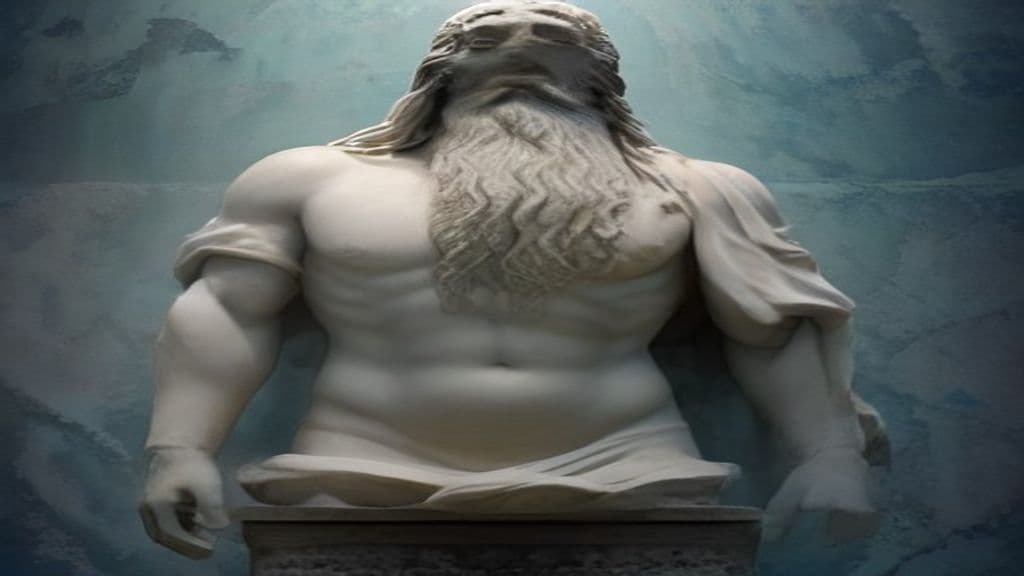
Poseidon
Poseidon is a principal deity of the ancient Greek pantheon, counted among the Twelve Olympians; he presides over the sea, storms, earthquakes and horses and functions as protector of seafarers and guardian of cities and colonies.
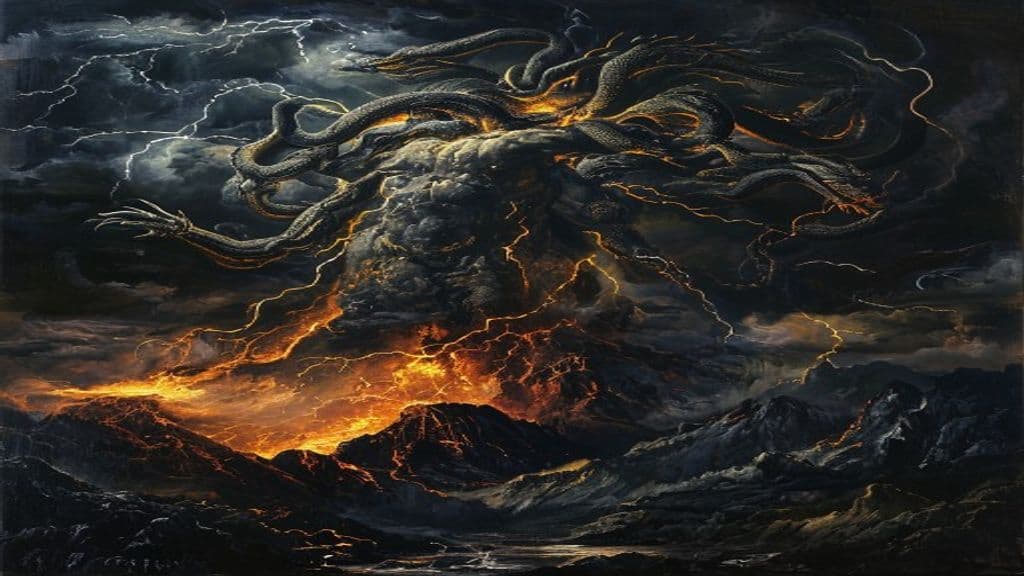
Typhon
The last great monster of Greek mythology — a vast, fire-breathing giant whose shoulders sprouted a hundred serpent heads, nearly toppling Zeus from Olympus.

Alcyoneus
Alcyoneus (Ancient Greek Alkyoneús, Ἀλκυονεύς) is a colossal monstrous figure in Greek myth, variably presented as one of the Gigantes (Giants) born of Gaia and as a singular enormous hostile herdsman/warrior opposed to Heracles. Noted for prodigious strength and for a peculiar invulnerability tied to his native land, he is defeated when Heracles drags him out of his homeland at Athena's counsel in one influential tradition.
Community Record
- [1]Polybotes — Wikipedia. Wikipedia entry 'Polybotes' (accessed via provided research notes)wiki
- [2]Wikidata: Polybotes. Wikidata item Q1233841 'Polybotes' (accessed via provided research notes)other
- [3]LP0026 The Gigantomachy (archive audio/text fragments). Archive recordings and summaries of Gigantomachy material referencing Polybotes and general Gigantes descriptions (as provided in research notes)other
- [4]Strabo (as cited in research notes). Summary citation of Strabo's report on the Nisyros/Cos tradition concerning Polybotes (as provided in research notes)literary
- [5]Pausanias (as cited in research notes). Summary citation of Pausanias noting an Athenian statue of Poseidon attacking Polybotes and Coan local tradition (as provided in research notes)literary
- [6]Museum vase attestations (Getty 81.AE.211; Louvre E732) — as cited. References in the provided material to archaic and classical vase-paintings naming or depicting Polybotes (Getty dinos, Louvre amphora) as summarized in research notesother