
In the mythic corpus Alcyoneus is presented in some sources as one of the Gigantes—offspring of Gaia born from the blood of the castrated Uranus—and thus a chthonic antagonist in the Gigantomachy against the Olympian gods. Other early testimonia (e.g., Pindar and related scholia) present him as an immense hostile herdsman/warrior encountered by Heracles, suggesting variant traditions in which he functions as an individual monstrous opponent rather than as an explicitly named Giant.
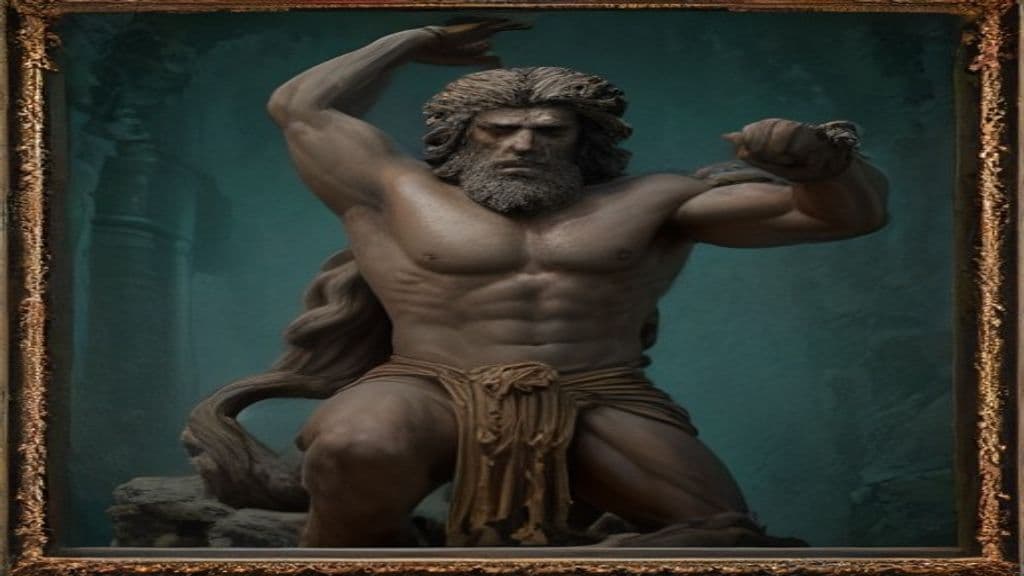
Accounts and iconography emphasize enormous size and the bulk typical of Giants: Pindar calls him 'huge as a mountain' and 'a great and terrible warrior.' Vase and relief imagery often show him as a very large reclining or sleeping figure; some artistic representations depict him with wings and classical descriptions note long locks and immense physical bulk. Certain Giant-typical features appear in mythographic summaries of the Gigantomachy (e.g., scaled feet are attested for Giants in some accounts of the cycle), though textual details vary across sources.
Alcyoneus is credited with prodigious physical strength and martial potency—capable of hurling rocks and overturning chariots and men in the traditions summarized by ancient authors. A distinctive trait in several accounts (notably Apollodorus' tradition) is that he is immortal or invulnerable while fighting on his native land and can revive after falling until removed from that ground. Some scholia report variants in which he stole or drove off cattle (including accounts that link his actions to the cattle of the Sun), but such theft is presented as a variant narrative element rather than a universal attribute. Gods alone cannot slay the Giants in these traditions; an oracle or condition requires a mortal-born hero (Heracles) to finish them, and Athena provides tactical counsel in the Heracles–Alcyoneus encounter.
Weaknesses
- conditionRemoval from native land (loss of invulnerability)
Wards
None recorded.
Admete (Admeta)
Admete (Ancient Greek: Ἀδμήτη) is a mortal princess of the house of Eurystheus in the Heraclean cycle and, in alternate local tradition, a priestess of Hera associated with the transfer and purification of a cult image to Samos. She functions in surviving accounts as a named requester whose wish prompts one of Heracles' labors and as the human custodian of a sacred image in a Samian foundation story.
Agriopas (werewolf account)
A classical account—attested via Agriopas as quoted by later compilers—relating that a Parrhasian named Demaenetus/Demnetus ate human viscera during the Arcadian sacrifice to Zeus (Jupiter) Lycaeus and was transformed into a wolf for a period (reported as ten years in some recensions) before reverting to human life.
Alcathous (son of Pelops)
Alcathous (Ancient Greek: Ἀλκάθοος) is a mortal heroic prince in Greek myth, son of King Pelops of Pisa and Hippodamia, associated with the Pelopid house and remembered as the reputed founder-eponym of the Megarian citadel called Alcathoe. He is credited in some local traditions with slaying the Cithaeronian lion and functions primarily as a genealogical and topographical founder-figure rather than a supernatural being.
Antiope
Antiope is a name applied to several distinct mortal women in Greek mythic tradition, most commonly an Amazon daughter of Ares and a Theban princess mother of Amphion (by Zeus). The figures named Antiope appear across variant local narratives rather than as a single, consistent supernatural type.
Cercopes
The Cercopes (Greek Κέρκωπες, 'tailed ones') are a pair (or more) of mischievous trickster woodland figures in Greek myth, proverbial as liars, thieves, and comic rascals. Best known for stealing Heracles' weapons during his servitude to Omphale and being bound and humiliated by him, they appear across literary fragments and vase imagery and are variously explained as primordial offspring, human tricksters, or etiological figures for monkeys.
Alcmeonis
A lost early Greek epic poem (Ancient Greek: Ἀλκμεωνίς / Ἀλκμαιωνίς) traditionally counted among the Theban cycle; known only from a small number of fragmentary references, it narrated the story of Alcmaeon’s killing of his mother Eriphyle in vengeance for the death of his father Amphiaraus.
Alcon
Alcon (Ancient Greek: Ἄλκων) is a personal name borne by several mortal figures in Greek mythic and genealogical traditions, typically noted as skilled hunters or archers and appearing in local dynastic or hunting narratives rather than as a distinct supernatural being.
Alcyone (daughter of Sciron)
Alcyone is a minor figure of ancient Greek myth who, in variant traditions, is transformed into the kingfisher (Greek ἀλκυών). Two main traditions survive: an Attic tale in which Sciron casts his daughter into the sea for sexual transgression (reported via Pseudo-Probus/Theodorus), and the better-known Alcyone-and-Ceyx couple-story (Ovid/Nicander tradition) in which divine pity results in metamorphosis and an etiological explanation for the "halcyon days."
Alcyone and Ceyx
A married pair from ancient Greek myth whose tragic fates and divine transformations into seabirds (especially the kingfisher) explain the naming of the halcyon birds and an associated brief winter calm known as the 'halcyon days.' Variants in classical authors present either punishment for hubris or compassionate metamorphosis after a shipwreck.
Alcyonides
In Greek myth the Alcyonides (Ancient Greek: Ἀλκυονίδες) are the seven daughters of the giant Alcyoneus who, in despair at their father's death at the hands of Heracles, threw themselves into the sea at Kanastraion (the peak of Pellene) and were transformed by the sea-goddess Amphitrite into halcyons (kingfishers). The name links them etymologically to the bird (alkyone) and to local place-names (the Alkyonides islets).
Aldroen
Aldroen is a legendary early medieval king of the Bretons of Armorica appearing in Geoffrey of Monmouth and later medieval chroniclers. Presented as a dynastic and martial founder-figure (son of Salomon) in pseudo-historical accounts, he is credited in tradition with military action in 5th-century Brittany and involvement in British-Breton affairs rather than any supernatural role.
Alebion
Alebion (Ancient Greek: Ἀλεβίων; also Albion, Ialebion) is a mythic Ligurian leader, son of Poseidon and brother of Dercynus (also called Bergion or Ligys), who with his brother attacked Heracles during the hero’s return from the Tenth Labour and was slain after Heracles prayed to Zeus and fought with the aegis.
Community Record
- [1]Alcyoneus - Wikipedia. Wikipedia entry summarizing literary and artistic attestations, including Apollodorus, Pindar, Nonnus, and iconographic evidence.wiki
- [2]Who's Who in Classical Mythology (archive). Reference summary of classical mythological figures and variants (archive edition).other
- [3]LP0026 The Gigantomachy (archive materials). Collected materials and summaries concerning the Gigantomachy cycle and associated iconography.other
- [4]Legendary Passages summary of Apollodorus on Alcyoneus (as cited in notes). Summary citation: Apollodorus' account describing Alcyoneus as immortal in his native land and defeated when dragged out of Pallene on Athena's advice (modern summaries of Apollodorus preserved in reference works).literary
- [5]Pindar summaries and scholia (as cited in notes). Summaries of Pindaric passages and scholia describing Alcyoneus as a 'herdsman ... huge as a mountain' and recounting encounters with Heracles and Telamon.literary
- [6]Iconographic notes on vase and relief imagery (as cited). Art-historical observations: sixth-century BC pots naming Alcyoneus, the Pergamon Altar identification of a winged Giant battling Athena, and terracotta frieze representations.other
- [7]Suda / Hegesander summary (Alkyonides daughters variant) (as cited). Summary noting that Alcyoneus' seven daughters (the Alkyonides) threw themselves into the sea at his death and became kingfishers in the Hegesander tradition cited by the Suda.literary