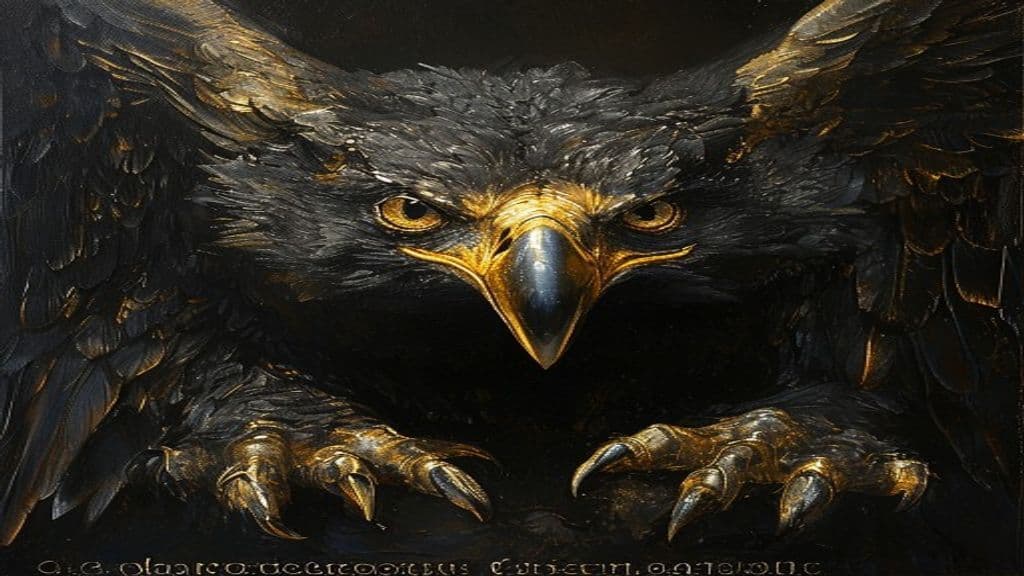
Q'ursha is a legendary dog associated with the culture hero Amirani in Georgian mythology.
Variable, sometimes depicted with eagle's wings, colossal paws, lips made of gold (uncertain), and eyes as big as sieves. Its defining characteristic is its physical appearance, specifically the coloration of its ears, which literally means 'black-ear' in Georgian.
Q'ursha has supernatural abilities, including a thunderous bark that likely has a significant impact on its surroundings, extraordinary agility and power, allowing it to leap 'as big as a great field', and an infallible ability to track prey.
Apsat
Male deity in Georgian mythology, associated with birds, animals, and possibly horses; connected to hunting, game provision, and thunder/lightning. (Note: - Power tier: Primordial (due to his association with cosmic forces like thunder/lightning) - Origin story: More specific information is needed, as the source material only mentions the possible etymo)
Caucas (Georgian)
An ancestral figure in medieval Georgian tradition, considered the ancestor of the Vainakh peoples. (Note: - Power tier: Primordial (not Ancient), as Caucas is considered an ancestor of the Vainakh peoples with no described powers or supernatural abilities. - Appearance: Add "No physical description mentio)
Kartlos
In Georgian mythology, Kartlos is the 'father of all Georgians' and a patriarchal figure, part of a war against giant Titan king Nebrot. (Note: - Power tier: Greater (controlled a large territory, but not described as a deity-level figure) - Appearance: Add that there is no physical description provided in the source material - Abilities: Spe)
Lamaria (Georgian Tradition)
In Georgian mythology, Lamaria is a goddess associated with the hearth, cattle, women, and fertility of grain fields. (Note: 1. The article states Lamaria is associated with cattle and women, but the source does not specify her association with women, only protecting them during childbirth. 2. Power tier: Less specific abil)
Mtskhetos
Epic hero and legendary founder of the city of Mtskheta in Georgian mythology, son of Kartlos. (Note: - Power tier: Minor Spirit (since there's no indication of deific or powerful regional abilities) - Abilities and behaviors: lack of specific information on his abilities and behaviors means they shou)
Ochokochi
Malevolent entity from Georgian mythology with a unique physical feature and violent tendencies towards humans. (Note: 1. Power tier should be Ancient (deity-level) as it's unclear if Ochokochi is considered cosmic in Georgian mythology. 2. Add sensory cues based on the source material description of his physical appe)
Płanetnik (Slavic Tradition)
A demonic creature embodying atmospheric phenomena, with potential control over or manipulation of weather patterns. (Note: - The power tier should be Primordial, as it has control over atmospheric phenomena. - There's no information about wards in the source material, so that section should be removed. - Weaknesses should)
Pūkas
The available sources do not document a Baltic supernatural being named Pūkas. References found in the provided material treat Pūkas as a modern Lithuanian proper name used for a privately owned broadcasting company (founded 1991; radio since 1996; television since 2001; based in Kaunas) and as a surname borne by contemporary individuals mentioned in news reports. No folkloric origin, appearance, powers, rituals, or cosmological placement are attested in the supplied sources.
Q'ero (tradition)
Q'ero (Q'iru) denotes a Quechua-speaking high-Andean people of the Paucartambo province, Cusco Region, Peru, whose living oral literature and ritual practice center on ayni (reciprocity), mountain deities (apus), Pachamama, and specialist practitioners called paqos. The term indexes a cultural-religious tradition rather than a single supernatural being.
Qaban
Qaban is not attested in the provided sources as a supernatural being. The string appears in the supplied corpus as a toponym (Iranian village names) and as an element of personal names in diverse documentary contexts; no myths, powers, appearance descriptions, rituals, or folkloric narratives for a supernatural 'Qaban' are present in these sources.
Qailertetang
Qailertetang is an Inuit sea-associated figure who functions both as a mythic caretaker of marine animals, fishers, and hunters and as a ritual persona enacted during Quviasukvik (the Inuit New Year). She is described as dwelling with Sedna at the bottom of the sea and in performance appears as gigantic masked figures who invoke winds, pair community members, and provide divinatory murmurs.
Qallupilluit
A shoreline-dwelling supernatural being in Inuit oral tradition that inhabits the liminal space between sea and ice. Presented primarily as a cautionary figure, the Qallupilluit lures and steals children who approach hazardous sea-ice edges.
Community Record
- [1]Wikipediawiki