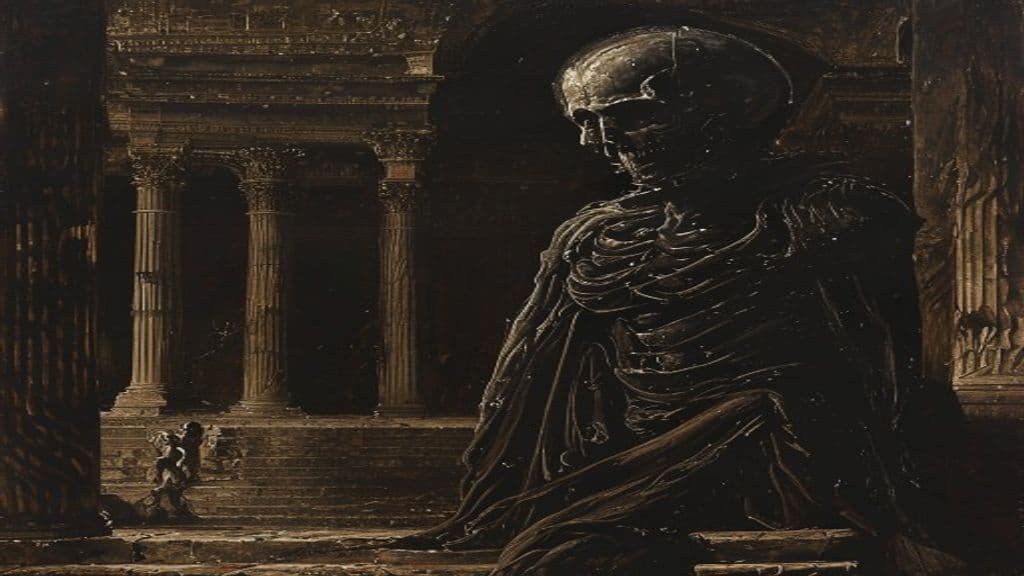
According to Roman legend, Remoria is connected to the twin brothers Romulus and Remus who founded Rome. The place is associated with auspicious events such as the landing of six birds.
There is no physical description of Remoria beyond its connection to Romulus and Remus.
Remoria does not have any abilities or behaviors, as it is simply a geographical site within Roman tradition.
Acron (King of the Caeninenses)
Historical figure and leader of the Caeninenses, a neighboring tribe to the Romans. Rejected the proposal of intermarriage with Romulus. (Note: 1. Power tier: Acron is described as a king, but no source material indicates his abilities or powers are deity-level (Ancient) or cosmic (Primordial). Greater seems plausible. 2. Origin story: The dr)
Avernus
In Roman tradition, Avernus is a volcanic crater near Cumae (Cuma) in Italy associated with the underworld. (Note: 1. Power tier: Given that there are no reported interactions or abilities associated with Avernus as an entity, it should be classified as a Minor Spirit. 2. Appearance: There is no distinct physical )
Carmen (Roman Tradition)
A carmen is a type of supernatural entity or force in Roman tradition, used for expiation and execration through verbal incantations and rituals. (Note: - Power tier should be Primordial (cosmic-level entity as described in source material) - Add sensory cues, weaknesses, and wards based on the abilities of a carmen (e.g., incantations and rituals may)
Corona Australis
A constellation in the Southern Celestial Hemisphere associated with various cultural interpretations. (Note: 1. Power tier should be "Primordial" as Corona Australis is an astronomical object and not a deity-level entity. 2. Abilities are not mentioned in the source material; delete this section entirely. 3.)
Founding of Rome
The collective process of gradual union and formation of settlements on hilltops in ancient Rome. (Note: - Power tier: Primordial (not Lesser, as it's a historical process rather than a supernatural entity) - Abilities: Remove "The exact nature of this process is unclear" and replace with something accur)
Interpretatio Slavica
A cultural practice among Slavic peoples to identify and equate their deities with those of neighboring cultures and Christian saints. (Note: - Power tier should be Ancient (deity-level), as it's a cultural practice rather than a supernatural being. - Sensory cues, weaknesses, and wards are not applicable to this entity, as it's an abstract)
Reine Tournay
No evidence for a supernatural or folkloric entity named Reine Tournay appears in the supplied source set. The provided materials contain no descriptions, narratives, rituals, or cultural attributions for an entity by this name.
Rekhyt
Rekhyt (Ancient Egyptian rḫyt) is a term attested from the Early Dynastic Period referring to a northern people of the Nile Delta and, from the Middle Kingdom onwards, is also attested as a bird-sign and as a deity or personified figure in Egyptian royal and religious iconography.
Rem
Rem (also Rem-Rem, Remi, Remi the Weeper) is an Egyptian fish god associated with weeping whose tears are said to fertilize the land, producing vegetation and reptiles; he is described in available sources as the personification of Ra's tears and as resident of a mythic place called Rem-Rem, the 'realm of weeping.'
Renuka (Reṇukā)
Renuka is a Hindu goddess venerated in several South and West Indian regional traditions. She is described in the supplied sources as the wife of the sage Jamadagni and the mother of Parashurama, and is regarded in those regional devotional contexts as a manifestation of the Mother Goddess (Shakti).
Rep-un-kamuy
An Ainu kamuy (spirit/deity) of the sea associated especially with orcas and whales; depicted sometimes as an orca and sometimes as a young man with a harpoon. He appears in myths as a provider of whale bounty to humans and in at least one story as the agent who pulls a monstrous spider into the sea and transforms it into Akkorokamui.
Rephaite (Rephaim)
A Northwest Semitic lexical and cultural cluster referring both to an ancient people of unusually great stature remembered in the landscape of Canaan and to the long-dead or netherworld inhabitants (shades) invoked in funerary and ritual contexts; the same root and related terms appear in Ugaritic and Hebrew texts and carry overlapping meanings of ancestral dead and legendary giants.
Community Record
- [1]Remoria. Wikipedia article on Remoriawiki