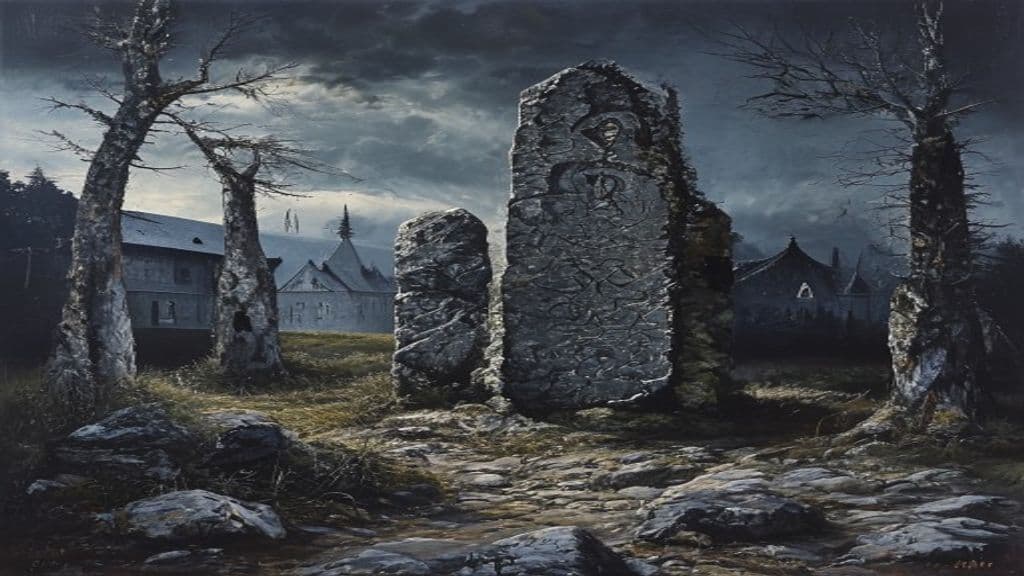
The physical description of the Rök runestone is not detailed in the source material. It can now be seen beside the church in Rök, Ödeshög Municipality, Östergötland, Sweden.
Norrœna Society
A publishing house that focused on Norse literature and culture, established in 1892. (Note: - Power tier: Remove (Primordial=cosmic) since the Norrœna Society was a publishing house, not a supernatural entity. - Abilities: Add "Publication of rare and expensive reprints" as an ability, suppo)
Norse Mythological Entities
A diverse range of beings, objects, and locations integral to the Norse cosmology, including gods, goddesses, giants, dwarves, and magical items. (Note: * Power tier: Change to "Ancient" is plausible given the described abilities, but it could be argued that some entities (gods) are even more powerful. Consider reevaluation. * Sensory cues: While ethe)
Rusalka
Water spirits in Slavic folklore — the spirits of young women who died by drowning or suicide, bound to rivers and lakes. Beautiful and dangerous, they can bewitch men to their deaths.
Ruti
No supplied sources document a supernatural or folkloric being named 'Ruti'. The term appears in the provided materials only as a modern given name, a surname, a place-name variant, an alternative spelling of the flatbread 'roti', and other non-mythic uses; therefore there is no evidence in these sources to describe a mythic entity called Ruti.
Ryūjin
Ryūjin (龍神, 'Dragon God') is a dragon-shaped water kami in Japanese myth who functions as a tutelary deity of the sea. Worshipped in strands of Shinto belief (Ryūjin shinkō), he is credited with control of tides, influence over rain and fisheries, and intervenes in human affairs from his undersea palace Ryūgū-jō.
Rán
Rán is an Old Norse sea-goddess who personifies the dangerous, engulfing aspect of the ocean; wife of the sea-jötunn Ægir and mother of nine wave-daughters, she is chiefly known for possessing a net with which she seizes those who go down to the sea.
Rõugutaja
Rõugutaja is a term referenced in some modern mentions of Estonian folklore contexts but is not attested or described in the provided source excerpt; the available excerpt on Estonian mythology does not mention or document any entity named Rõugutaja. The entity must therefore be treated as insufficiently attested in the cited material and requires consultation of primary Estonian folklore collections for verification.
Rübezahl
Rübezahl is a folkloric mountain spirit of the Giant Mountains (Riesengebirge/Krkonoše/Karkonosze). He appears in German, Czech and Polish traditions as a capricious mountain lord, weather-controller, treasure-guardian and tester of human behaviour, alternately depicted as giant, gnome, woodwose or disguised wanderer.
Rāhula
Historical figure and son of the Buddha Siddhartha Gautama, illustrating key Buddhist concepts through his story. (Note: 1. Remove "Primordial" power tier, as it implies cosmic-level abilities, which is not supported by source material. 2. Add sensory cues and weaknesses consistent with Rāhula's character in Buddhist te)
Rākaihautū
A Polynesian ancestor and captain of the Uruaokapuarangi canoe, revered by various iwi groups in Māori tradition. (Note: 1. Power tier: Based on the provided source material, there is no indication that Rākaihautū has supernatural abilities, so Greater power tier may be inaccurate. 2. Abilities: The draft states that it)
Rākei-hikuroa
Rākei-hikuroa was a fifteenth-century rangatira (chieftain) of Ngāti Kahungunu whose political ambition, involvement in inter‑kin violence, and eventual expulsion shaped tribal movement and settlement in eastern Aotearoa/New Zealand.
Rāma
Rāma is a major divine-hero in Hindu tradition, worshipped as the seventh avatar of Viṣṇu and the central protagonist of the Ramayana. He is portrayed both as the ideal man (maryāda puruṣottama) and, in Rama-centric sects, as the Supreme Being; his life-story (birth in Ayodhyā, 14-year exile, Sītā's abduction, and the defeat of Rāvaṇa) functions as a primary exemplar of dharma.
Community Record
- [1]