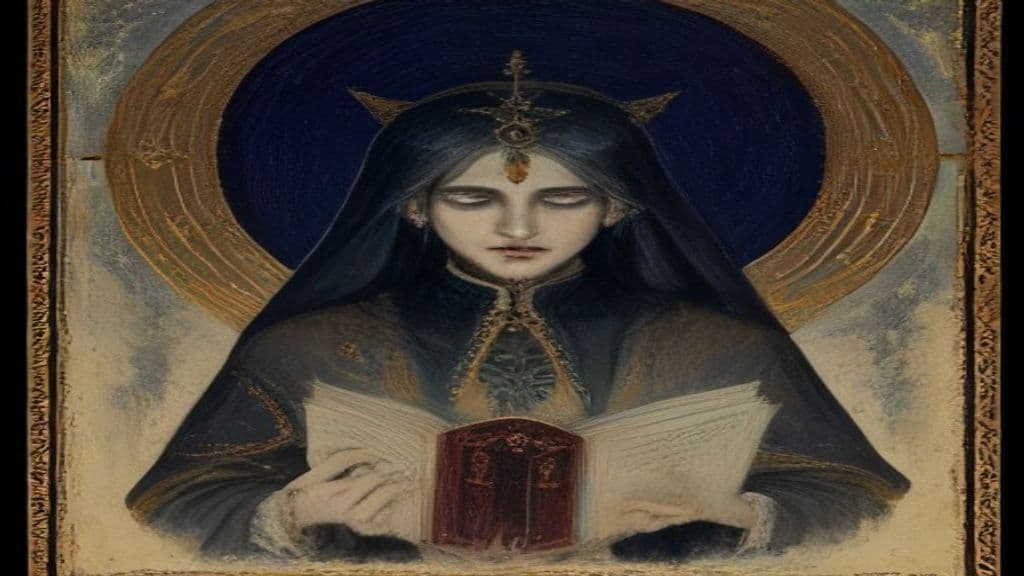
Sachiel emerges in medieval occult literature as a constructed angelic name produced by conflation and transmission among Jewish and later European magical texts. The Sefer Raziel HaMalakh (early 13th century) records multiple variant spellings (e.g., Satquel, Satquiel, Saquiel, Sachquiel) that reflect conflation of older angelic names traceable to the Jewish book 3 Enoch; one Sefer Raziel form, Sachquiel, derives from Sahaquiel, while other forms reflect influence from Zadkiel. The Heptameron and later Christian grimoire tradition crystallized the modern spelling 'Sachiel', and the name thereafter appears in talismanic and ceremonial contexts preserved in works such as The Complete Book of Magic Science and, later, Francis Barrett's The Magus.
Primary sources cited do not provide a consistent anthropomorphic or iconographic description for Sachiel. He is attested chiefly as a name and as a sigil in manuscript and grimoire contexts (e.g., Heptameron; sigils reproduced in The Complete Book of Magic Science and Francis Barrett's The Magus). No stable visionary or narrative portrait is recorded in the provided materials.
Across the cited occult and angelological materials Sachiel functions as a heavenly correspondent linked to the planet Jupiter and to the weekday Thursday; he is described as the archangel associated with wealth, abundance, success, prosperity, and charity. In later popular/New Age adaptations these correspondences are used to justify invoking Sachiel for matters involving money, finance, law, politics, and religion. Medieval manuscript evidence also shows his name used talismanically (for example, repeated three times on mid‑12th‑century Slavic birch‑bark charms to serve as talismans against disease). The sources frame him as an operative name/sigil for ritual appeal rather than as an agent in extended narrative accounts.
Weaknesses
None recorded.
Wards
- mantraRepetition of the angelic name (e.g., 'сихаїлъ' / 'сихаилъ' thrice)

Rōjinbi
Rōjinbi (老人火, rōjin no hi) is an Edo-period Japanese onibi — a supernatural luminous flame said to appear in mountain roads and provincial boundaries, often described as appearing in association with an elderly person. It is portrayed in period bestiaries as a hazardous spectral light encountered by travelers at night, especially on rainy nights along the Shinano–Tōtōmi boundary.
Rūaumoko
Rūaumoko (also Rūamoko) is an atua in Māori tradition associated with subterranean activity; his movements beneath or within Papatūānuku (the Earth Mother) are said to cause earthquakes, volcanic eruptions and seasonal change. He is described as a son of Rangi (the Sky Father) and Papatūānuku and occupies the under-earth domain of the primordial family.
Rūhi-te-rangi
Rūhi-te-rangi is a name for which no information appears in the single supplied source. The only provided reference is a Wikipedia article on the maramataka (the Māori lunar calendar), which does not mention or describe Rūhi-te-rangi.
Sabnak
Sabnak is a name attested in modern popular-media sources rather than a single traditional folkloric being. In the supplied material it appears as a human surname (Orga Sabnak) in Mobile Suit Gundam SEED and as the name of an enemy creature in the video game Wild Arms 3; the Wild Arms entry notes the name 'comes from a marquis in demonology' with several variant spellings.
Sabnock
Sabnock is a name attested in modern listings derived from the grimoire tradition of the Ars Goetia / The Lesser Key of Solomon. The provided sources identify the name as part of that corpus' roster of named spirits and note a contemporary fictional reuse of the name, but they do not supply descriptive or ritual details for the entity itself.
Sacca-kiriyā (Hindu tradition)
A solemn declaration or utterance in Hindu and Buddhist traditions with truth-empowering properties. (Note: 1. Remove "Primordial" power tier - while the Sacca-kiriyā has significant effects, they are described as depending on truthfulness, not necessarily being equivalent to cosmic-level powers. 2. Add sen)
Saci
Saci is an impish mythical character of Brazilian folk tales, identified in general reference sources as a named figure within Brazilian folklore.
Sacred Bull (Mesopotamian)
In Mesopotamian tradition, the Sacred Bull is a divine entity associated with Marduk and Utu, representing fertility, strength, and divinity. (Note: * Power tier: Primordial (its association with deities suggests a cosmic power level) * No sensory cues or weaknesses mentioned; add "None explicitly stated" to these sections * Wards: Add "None descr)
Sadyojata
Sadyojata (Sadyojāta) is one of the five primary faces or 'mouths' (pañcānana / pañcabrahma) of the Hindu deity Śiva. As an aspect within Śaiva theology and tantra, Sadyojata functions as one of Śiva's operative energies manifested in iconography (pancha-mukha liṅga), liturgy, and doctrinal schemata rather than as an independent being.
Sadāparibhūta (Bodhisattva Never Despising)
A bodhisattva figure appearing in Chapter 20 of the Lotus Sūtra whose defining practice is never to despise any person and to declare the future Buddhahood of those he meets; his story functions as an avadāna illustrating karmic consequences and the soteriological efficacy of reverent faith in the Lotus teaching.
Sagaan Ubgen (White Old Man)
Sagaan Ubgen (Tsagaan Ubgen / Tsagan Evgen) is an elder male guardian figure in Mongolian and Buryat shamanic and syncretic Buddhist contexts associated with longevity, fertility, wealth, and prosperity. He appears as a kindly white-bearded old man in ritual performance (tsam/cham), where he enacts renewal and blessing, and has been adapted into Tibetan cham repertoires.
Sagaritis
Sources for 'Sagaritis' conflict: a single Wikidata entry identifies Sagaritis as a hamadryad (a tree-bound nymph) in Greek mythology, while the supplied Wikipedia link refers instead to the moth Dichomeris punctipennella. No further mythological details for Sagaritis are provided in the available materials.
Community Record
- [1]Sachiel (Wikipedia). Wikipedia, 'Sachiel'.wiki
- [2]Wikidata: Sachiel. Wikidata entry for Sachiel.other
- [3]Neon Genesis Evangelion - 'Sachiel' (usage). Archive item referencing the use of 'Sachiel' as the name of a fictional Angel in Neon Genesis Evangelion.other
- [4]The Magus and Complete Book of Magic Science (sigil attestations referenced in secondary sources). Reference to grimoire material and sigil transmission (as noted in secondary summaries).other