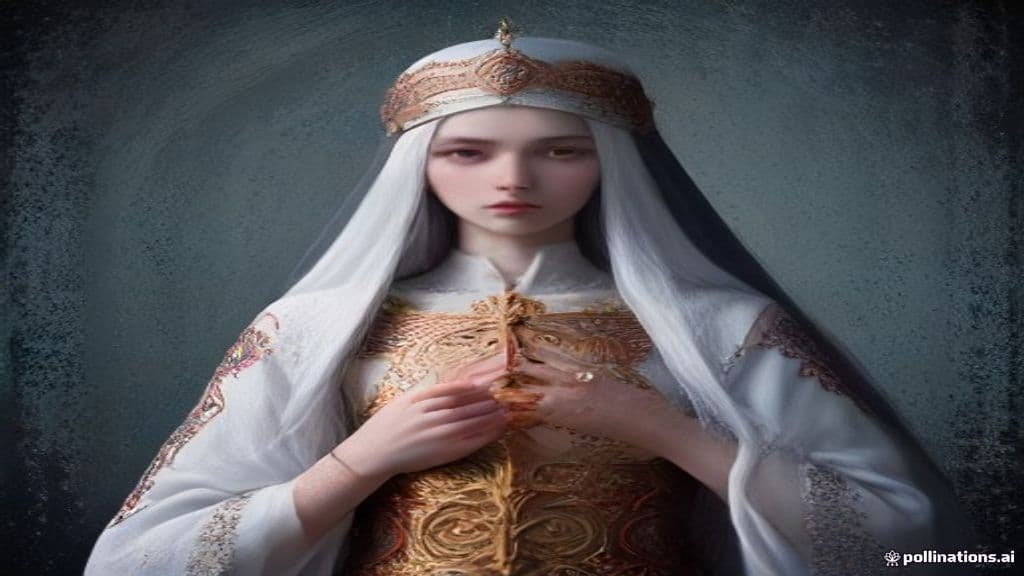
The popular cult of the Week derives from a syncretic folk‑Christian cosmology in which the calendrical Sunday (Slavic 'Nedelya') becomes personified and venerated as a saintly female figure. Sources indicate the cult was influenced by the association of saints such as Anastasia/Kyriakia (whose names and meanings link to 'resurrection' and Sunday) and by translated apocryphal texts (for example, the 'Epistle of Jesus on the Week'). Old Russian sermons and popular tales both reflect and respond to this formation, with ecclesiastical sources often admonishing popular veneration as misdirected image‑worship while folk practice maintained the personified Week as an agent enforcing Sunday observance.
Folk descriptions commonly portray Saint Nedelya as a woman, frequently dressed in white, gold, or silver, and often depicted with a wounded or maimed body. Legends emphasize textile imagery — she complains of being poked with spindles or having her hair spun, and narrative motifs describe cuts or wounds associated with violations of Sunday labor. Regional variants (e.g., West Belarusian) pair her visually and narratively with an ornate Sabbath (Saturday) personification.
In ethnographic and folkloric narratives Saint Nedelya functions as a moral‑regulatory agent who appears to and punishes those who work on Sunday. Tales attribute to her punishments such as inflicting long or fatal illnesses, maiming (e.g., tearing skin from the hands or body of weavers), killing (beating with a flax‑crushing roller), strangling or endangering life (overturning a cart), and terrifying households by tossing horse heads or dead bodies into dwellings. She also verbally accosts transgressors (complaining about spindles, etc.) and in some regional narratives figures in dialogic relationships with other personified days (notably Saturday/Sabbath figures and Friday/Paraskeva motifs). These actions are narrated as folkloric consequences for breaching Sunday prohibitions.
Weaknesses
- conditionobservance of Sunday (non‑working)
- otherredirection of veneration to Christ's Resurrection (ecclesiastical corrective)
Wards
- ritualobservance and veneration of Sunday / venerating Anastasia/Kyriakia
- ritualecclesiastical admonition: honor Christ's Resurrection rather than the image of the Week

Blud
Blud is a Slavic concept that functions both as a supernatural agent said to cause physical disorientation—leading people to wander "aimlessly around and round"—and as a lexical term in church discourse denoting illicit sexual desire or moral deviation, which clerics attributed to the Devil.
Bolotnik
A Slavic place‑spirit of swamps and bogs, regarded in popular tradition as the proprietor or guardian of marshy places who lures people and animals into the depths. Descriptions and names vary regionally; in Christianized accounts bolotniks are sometimes classed with fallen angels or demonic beings.
Likhoradka
A female spirit in Slavic (particularly Russian) popular belief who personifies fever and sickness. Traditionally portrayed as an agentive being that can possess people or bring disease by touch or kiss; the term likhoradka later lexicalized in modern Russian to mean 'fever'.
Nocnitsa
A Slavic night spirit or 'night hag' that torments sleepers—especially children—by visiting at night, producing nightmares or sensations of pressure on the chest, and in some accounts drawing life energy from victims.
Sailor Juno
Sailor Juno is a fictional Asteroid Senshi character from the Sailor Moon media franchise, presented as a member of the Dead Moon Circus antagonists in the Dream arc (manga), the Sailor Moon SuperS anime season, and the Sailor Moon Eternal films. Her name references the asteroid Juno and the Roman goddess Juno.
Sailor Venus (Minako Aino / Sailor V)
Sailor Venus is a fictional Sailor Guardian — a human adolescent (Minako Aino) who is also an awakened warrior-avatar associated with the planet/goddess Venus. Awakened by the white cat Artemis, she serves as a protector of Earth/the Solar System in the Sailor Moon/Codename: Sailor V narratives, wielding powers thematically tied to love, beauty, light, and golden imagery.
Saint Aventinus
Aventinus is a personal name borne by multiple historical and legendary figures recorded in late-antique, medieval, and later European sources. The name appears as an eponymous figure in Roman/Latinate legend (cited by Augustine), as medieval Christian holy men (a disciple of St. Loup ca. 537; a hermit of Tours associated with St. Thomas Becket, d. 1180), and later as a secular surname (e.g., the historian Johannes Aventinus). The provided sources do not present a single unified supernatural persona, cultic ritual corpus, or consistent iconography for a singular "Saint Aventinus."
Saint George
An early Christian martyr and soldier-saint traditionally said to have died in 303 CE, venerated across many Christian traditions and later portrayed in popular legend as the dragon‑slayer and protector of communities.
Saint Peter
Saint Peter (Simon bar Jonah; Cephas/Petros) is an early Christian apostle and leading disciple of Jesus who, in later Catholic and Orthodox tradition, is venerated as the foundational bishop of the church in Rome and a major saint. Tradition attributes to him a leadership role in the primitive Christian community, a renaming by Jesus signifying a "rock/foundation" role, and martyrdom in Rome under Nero. Relics and institutions (notably the Chair of Saint Peter) continue to anchor his symbolic authority.
Saint Pimenius
Saint Pimenius (variants: Pigmenius, Pigmentius, Pigmène, Pimenio) is presented in the supplied materials as a Christian holy man and martyr venerated in the Catholic tradition. He is remembered as a tutor to the future Emperor Julian and as a martyr reportedly drowned in the Tiber in 362 AD, with later local cultic remembrance at a monastery in Aquis (Talavera de la Reina).
Salacia
Salacia is the Roman divine personification of saltwater and the calm, sunlit aspect of the sea, frequently portrayed as the consort of Neptune and a sea-nymph attendant within Neptune's court. She functions both as a named deity/nymph and as an invoked attribute of Neptune (e.g., "Salacia Neptuni").
Saleos
Saleos is a named spirit appearing in modern treatments of the goetic grimoire corpus. Contemporary occult commentators list Saleos as a ranked duke/earl-class spirit associated with fertility, sexual influence, and a set of astrological and ritual correspondences used by modern practitioners.
Community Record
- [1]Saint Nedelya. Wikipedia: 'Saint Nedelya' entry (folk‑Orthodoxy and Slavic ethnographic summaries).wiki
- [2]Folk Orthodoxy — WIKI 2 (republished summary). WIKI 2 summary on folk Orthodox practices and syncretism relevant to the veneration of days.wiki