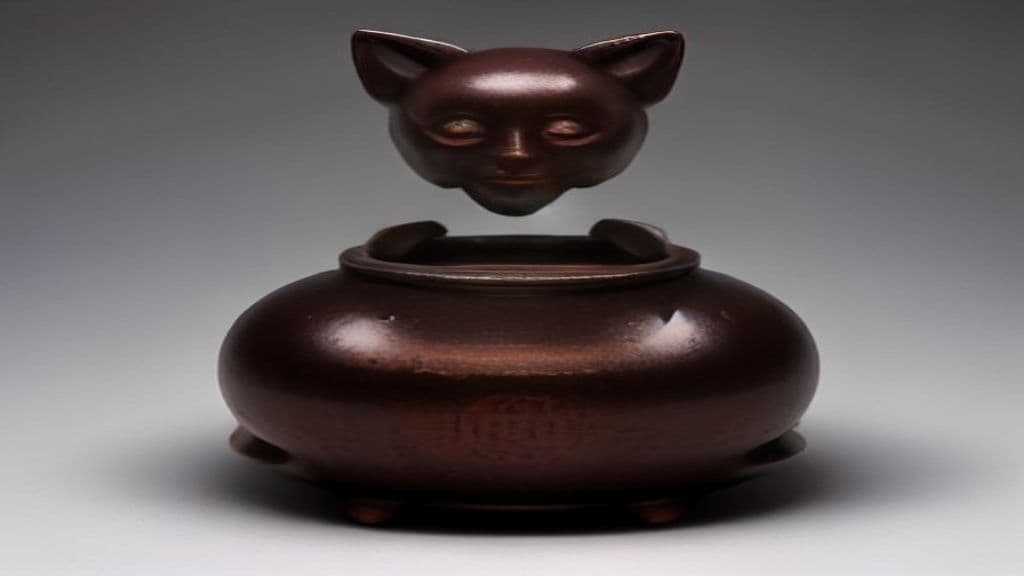
There is no documented mythological origin for a yokai named Shōgōrō in the provided source set. The majority of occurrences of the string “Shōgōrō / Shogoro” in the materials are personal names (for example, Kaionji Shogoro, the author credited in the Ten to Chi to volumes; film director Shōgorō Nishimura), publisher imprints (Hayashi-ya Shôgorô in Kuniyoshi prints), and kabuki stage-name usages. Only a single modern blog entry (Matthew Meyer’s “A-Yokai-A-Day: Shōgorō”) claims a folkloric identity for Shōgōrō, presenting it as an animated shōgō (a small temple gong). That blog post is the sole source in this dataset that proposes any origin for a Shōgōrō spirit; no primary yokai compendia, ethnographies, or classical texts in the provided list supply an origin narrative.
No consistent, corroborated physical description of a supernatural Shōgōrō exists in the supplied materials. The lone folkloric source links the name to a shōgō or kane — small metallic gongs used in Buddhist services — which implies a small bell- or gong-like object if one accepts the blog’s interpretation. Aside from this inferential association, the other occurrences of the name are human individuals or publishers and offer no depiction of an animate object or yokai form.
There are no documented powers or behaviors for a Shōgōrō in the provided sources. The modern blog’s characterization as an “animated shōgō” allows only a hypothetical and speculative inference that, if treated as an object-spirit, it would pertain to the sonic and liturgical role of a temple gong. Such inferences are explicitly not corroborated by academic or primary folkloric sources in the supplied set and should be treated as speculative.
Weaknesses
- othernone documented in provided sources
Wards
- othernone documented in provided sources
Shulgi
Shulgi was a historical king of Ur (Third Dynasty of Ur, reign c. 2094–c. 2046 BCE) who, during his lifetime, was ritually elevated and inscribed with the divine determinative (𒀭) and thereafter received cultic worship as a deified ruler integrated into Sumerian temple practice.
Shullat and Hanish
Shullat and Hanish are a paired, minor divine duo in Mesopotamian religion, treated as inseparable "twin gods" who function as heralds and agents of violent weather, storm and destruction. They appear in literary flood narratives and in ritual/divinatory contexts (oaths, taboos, temple records) and are sometimes placed in astral correspondences as twin stars.
Shulshaga
Shulshaga (Šulšaga / Shulsagana) is a named deity of the city-state of Lagash in ancient Mesopotamia, attested from Early Dynastic royal inscriptions and later lexical texts. He is presented as the eldest son of the city’s principal god Ningirsu and his consort Bau, received statuary cult (a statue built by Ur‑Nanshe) and temple dedications (Urukagina names a temple, (E-)tuš-akkil-li), and appears in later inscriptions such as Gudea’s where he is credited with providing the king with the ‘breath of life.’
Shumbha and Nishumbha
Shumbha (शुम्भ) and Nishumbha (निशुम्भ) are a pair of asura brothers in the Devi Māhātmya (Durga Saptashati) who, after long penance and a boon from Brahmā, usurp power over the three worlds until the Goddess (Devi/Kaushiki/Durga) manifests in martial form and destroys them. They function in the narrative as archetypal antagonists whose arrogance and domination precipitate the Goddess’s salvific martial intervention.
Shuten-dōji
Shuten-dōji is a legendary oni described in Japanese sources as the 'Demon King of Mt. Oe' who terrorized the region in folklore and was slain by the hero Minamoto no Raikō and his companions. In the best-known episode the demon is decapitated, yet the detached head remained animate and attempted to bite the hero, who survived by wearing multiple helmets stacked on his head.
Shuzianna
Shuzianna (Sumerian Šuzianna) is a Mesopotamian goddess chiefly worshiped at Nippur. She appears in god lists and myths as a minor divine household figure variously described as a secondary spouse/concubine of Enlil (in An = Anum) and once called concubine of Anu in an incantation; she is also one of the seven helper‑goddesses who assist in the activation of birthgiving in Enki and Ninmah.
Shōjō
A figure derived from the Chinese xing‑xing/shengsheng—an ape‑like marvelous creature—later adapted in Japanese culture as a red‑faced, sea‑associated spirit famed for its love of alcohol and its appearance in Noh drama.
Shōkera
A Japanese yōkai depicted in Edo-period emaki (illustrated scrolls) such as the Hyakkai Zukan and Toriyama Sekien's Gazu Hyakki Yagyō. In folk-religious contexts the shōkera is associated with the Kōshin-Machi custom and with the Three Corpses belief, functioning in tradition as a surveillant or harmful presence tied specifically to Kōshin night and to the moral cosmology of internal 'insects' that report misdeeds to heaven.
Si'lah
A female supernatural figure attested in Arabic poetic commentary, described in a scholion as "the most dangerous of the female demons called ghūl" and as an "enchantress of the Jinn." The term appears in classical poetry as a metaphor for perilous power, speed, or beguiling danger.
Sibylline Books
A collection of oracular utterances in Greek hexameter verses, consulted by the Romans at critical moments throughout history. (Note: - Power tier: Non-Spiritual Entity is incorrect; Sibylline Books are likely a Minor Spirit given their role in providing oracular guidance. - Origin story: Missing from draft, needs to be added based )
Sidaba Mapu
Sidaba Mapu (also cited as Salailel in the supplied source) is the supreme creator and sky god of the Meitei indigenous religion Sanamahism, presented in the sources as the origin-being responsible for creation of the universe. The deity is linked in the sources to Meitei mytho-philosophical frameworks named Leithak Leikharol Nongsemlon and Leisemlon.
Sidhe (Aos Sí / Aos Sídhe)
A Gaelic category of supernatural people tied to hills or mounds and closely associated with the Tuatha Dé Danann; rendered in English as 'the fairies' or 'elves' but culturally framed as an ancestral/divine parallel people with ambivalent relations to humans.
Community Record
- [1]A-Yokai-A-Day: Shōgorō | MatthewMeyer.net. Matthew Meyer, "A-Yokai-A-Day: Shōgorō," A-Yokai-A-Day blog, 10 Oct 2013.folk
- [2]Shōgorō Nishimura — Wikipedia. Wikipedia entry: "Shōgorō Nishimura" (film director).wiki
- [3]Heaven and Earth / Ten to Chi to (天と地と) Vols 1–3 (1987) — credits. Ten to Chi to (Heaven and Earth) Volumes 1–3 credits listing "Original Story: Kaionji Shogoro (海音寺 潮五郎)" (1987).literary
- [4]Kuniyoshi Project — publishers list (Hayashi-ya Shôgorô). Kuniyoshi Project — publisher listings include "Hayashi-ya Shôgorô."other
- [5]Kuniyoshi Project — Kisokaido II (Hayashi-ya Shôgorô). Kuniyoshi Project print listings referencing publisher name Hayashi-ya Shôgorô.other
- [6]HATANO Shogoro | Portraits of Modern Japanese Historical Figures | National Diet Library, Japan. National Diet Library portrait entry for Hatano Shogoro (biographical note).other
- [7]Torii Ryūzō — Wikipedia. Torii Ryūzō biography (listed among consulted sources; no link to Shōgōrō in provided excerpts).wiki
- [8]ICHIKAWA SÔZABURÔ II — kabuki21.com. Kabuki-related page mentioning stage names including Shōgorō (Ichikawa guild usages).other
- [9]LESSER KNOWN ACTORS - DEKISHIMA — kabuki21.com. Kabuki-related page referencing actors and stage-name practices that include Shōgorō components.other
- [10]Subterranea of Japan: Yoshimi Hyakuana (mentions Tsuboi Shogoro). ShowCaves page mentioning a Tsuboi Shogoro in a non-folkloric context.other
- [11]Matasuuri Shogoro | Forgotten Realms Wiki. Fictional wiki entry (Forgotten Realms fandom) for a namesake; unrelated to traditional yokai sources.wiki