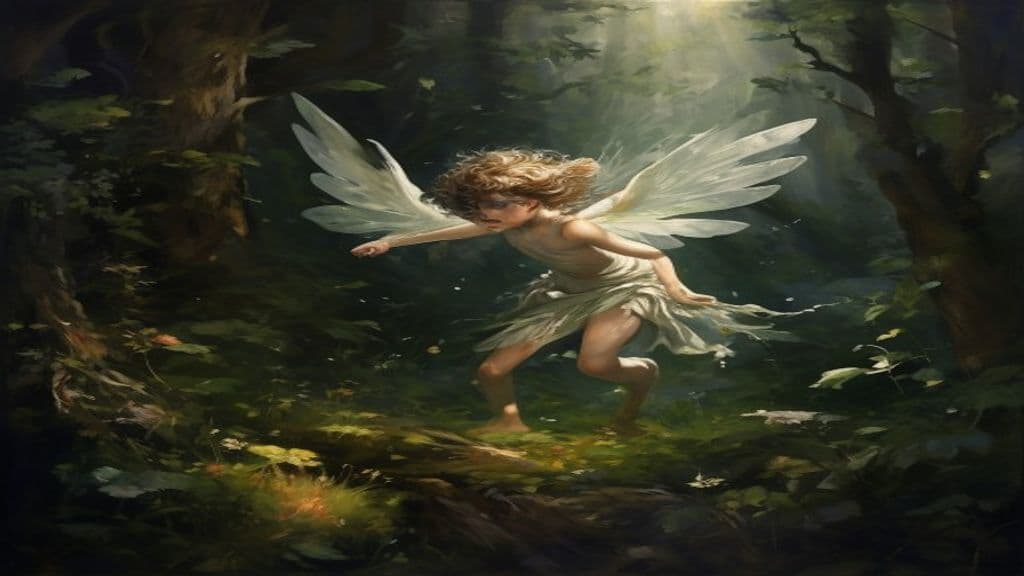
Sprites are described as light, airy beings with a possible connection to the natural world.
Unfortunately, this source does not provide specific information on the abilities or behaviors of sprites in Greek tradition.
Folklore, legends and myths in Dombey and Son
Literary influences from Greek folklore and mythology on the novel 'Dombey and Son' by Charles Dickens. (Note: 1. Summary: "Literary influences" is too vague; rephrase to specifically mention "Greek folklore and mythology". 2. Power tier: This entity doesn't exist in the source material; there's no indication )
Kallikantzaros
A malevolent goblin-like creature in Greek and related Balkan and Anatolian traditions that dwells underground sawing at the world‑supporting tree for most of the year and emerges during the Twelve Days of Christmas (25 December–6 January) to harass households and people.
Nymph (Naiad, Dryad, Oread)
In ancient Greek folklore a nymph is a minor female nature deity who personifies and inhabits particular natural features (springs, trees, mountains). Nymphs are divine yet not immortal and are typically depicted as maidens with localized powers such as healing, divination, and shapeshifting.
Spell of the Twelve Caves
An ancient Egyptian funerary text that guides and protects the deceased in their transition into the afterlife, warding against negative entities or influences. (Note: 1. Power tier should be Ancient (deity-level) rather than Primordial (cosmic). 2. No information provided about abilities, sensory cues, weaknesses, or wards in the source material. 3. The source ment)
Spercheus
Spercheus is a name attested in two distinct registers: (1) a zoological genus of small aquatic beetles (family Spercheidae) with about twenty described species found in most regions outside the Nearctic, and (2) Sperkheios/Spercheus, a river-god (potamos) of the Spercheus River in Malis in Greek mythology, with associated naiads called the Maliades or Spercheides.
Sphinx
A composite mythical figure with a human head and a lion's body known from Egyptian monumental guardianship and a distinct Greek monster tradition that riddles and kills those who fail to answer. In Egyptian contexts it functions as a benevolent royal and solar emblem carved as statuary; in Greek myth it is an animate, treacherous tester of humans.
Spirit Turtle (靈龜 / 霊亀)
An East Asian sacred turtle category originating in Chinese textual tradition and adopted into Japanese and Korean cultural contexts; the spirit turtle denotes extreme longevity and auspicious sacred status and appears chiefly as a symbolic or cultic emblem rather than an explicitly hostile supernatural agent.
Spirit of the Forest
In the supplied sources, 'Spirit of the Forest' is not a documented folkloric entity but the title of the 2003 debut studio album by Finnish folk metal band Korpiklaani. The available material supplies musical and publication information rather than ethnographic data about a supernatural being.
Sraosha
Sraosha (Avestan sraoṣ̌a; Middle Persian Srosh / S(a)rosh; New Persian Soroush) is a Zoroastrian yazata whose functions include propagation of conscience and observance, guardian of ritual and households, teacher of the religion of Ahura Mazda, psychopomp at death, and opponent of hostile daeva such as Aeshma.
Staphylus (son of Dionysus)
Staphylus is a mythic eponymous figure in Greek tradition whose name (Ancient Greek Στάφυλος, 'grape cluster') is tied to the origin of grapes, wine, and related practices. Multiple localized traditions present him as a son or companion of Dionysus, a host who entertained the god, a goatherd who discovered wild grapes, or an originator of wine customs; his role is etiological rather than as an active supernatural antagonist.
Star of Ishtar
The Star of Ishtar is a symbol and manifestation of the Mesopotamian goddess Inanna/Ishtar, associated with Venus (the morning star). (Note: 1. Power tier should be Primordial or at least Ancient is unclear since it only represents a divine presence/power. 2. Appearance description not supported by source material (should be stated as unkn)
Steller's sea ape
An 18th-century naturalist's report of an unfamiliar marine animal observed near the Shumagin Islands, Alaska, on 10 August 1741. Presented in primary sources as a zoological observation (Simia marina) and later treated variously as misidentified pinniped, extinct sirenian classification, or modern cryptid.
Community Record
- [1]