
The classificatory notion of a 'spirit turtle' appears in Chinese lexical and encyclopedic texts that grade turtles by age and sacred status. Erya annotations identify the highest category as most sacred (亀之最神明). The Shuyiji tradition records age thresholds—after one thousand years a turtle grows hair, a five‑thousand‑year‑old is called a 'divine turtle' (神龜), and a creature older than ten thousand years is a 'spiritual turtle' (靈龜) (Shuyiji summary as reported in Wikipedia). Baopuzi offers a variant tradition describing a spirit turtle as one thousand years old and attributing five colors to it (blue, red, yellow, white, black) that correspond to the Five Elements (Baopuzi summary as reported in Wikipedia). The concept spread into Japan and Korea retaining the same characters (Japanese 霊亀 Reiki appears in temple sangō and as an era name; Korean uses 靈龜 / 영귀) and became part of temple and shrine symbolism and local legends.
Descriptions vary by source rather than presenting a single standardized iconography. Classical Chinese texts emphasize extreme age (with Shuyiji and Baopuzi giving different age thresholds) and Baopuzi records a one‑thousand‑year spirit turtle having five colors (blue, red, yellow, white, black). Shuyiji records hair growth at one thousand years and staged categories at 1,000 / 5,000 / 10,000 years. Local Japanese anecdotes (e.g., a Hyakumonogatari Kaidankai fragment about Lake Shinobazu) describe a white‑shelled turtle with faint shell markings readable as kanji; this is a localized, fragmentary report rather than a universal trait. Overall, sources agree on rarity, advanced age, and occasional unusual coloration or markings.
Primary attributes recorded in the sources are longevity and auspicious/sacred status rather than active miraculous powers. Baopuzi's five‑color account situates the turtle in cosmological symbolism (mapping to the Five Elements). The spirit turtle functions as an omen or sacred sign in narrative contexts—appearing in stories connected to temple or shrine founding or as a motif in religious landscapes in Japan—and the term is also associated with turtle shells used in traditional divination practices (i.e., plastrons as divinatory materials). Sources do not ascribe explicit hostile powers, possession, or direct magical attacks to the spirit turtle in the provided material.

Bixi
Bixi (Bi Xi) is a named figure in Chinese mythological lists—traditionally counted among the nine sons of the dragon—and is the canonical form for tortoise-bodied, dragon-crowned stone mounts that bear commemorative stelae. The form functions primarily as an architectural and commemorative sculptural motif used in funerary complexes, imperial mausoleums, and public commemorations from at least the late Han dynasty through the Ming and Qing.
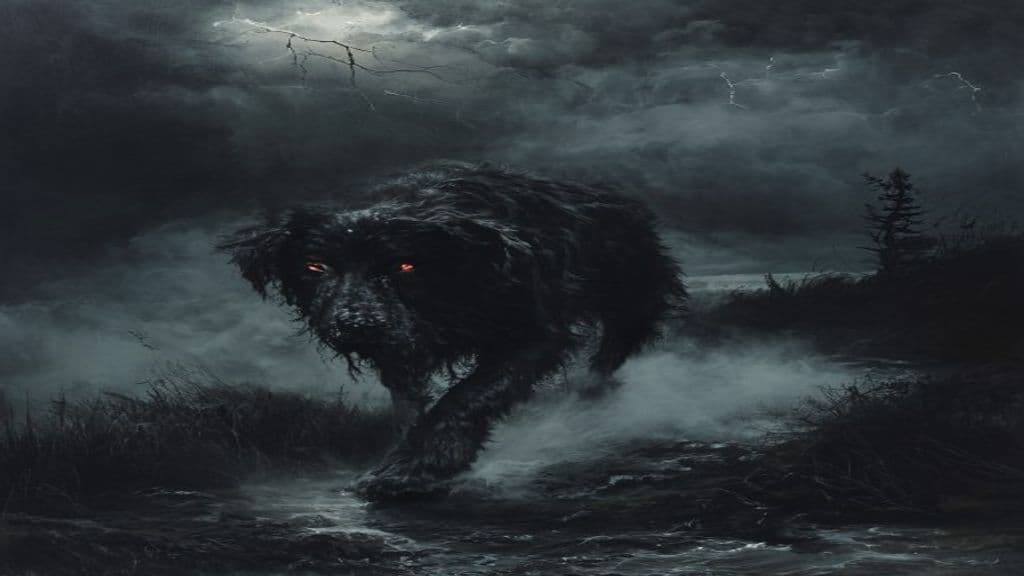
Black Shuck
A spectral black dog of East Anglian legend, with glowing red or green eyes. Its appearance is an omen of death. Its howl has been heard on clifftops during storms for centuries.
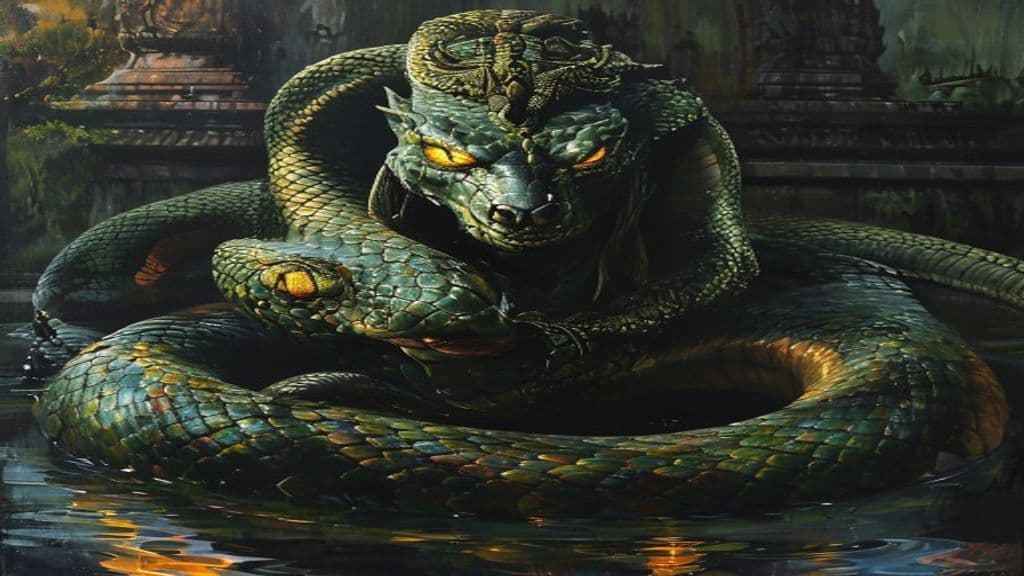
Naga
Divine serpent beings of Hindu, Buddhist, and Jain cosmology — powerful guardians of water, earth, and underground treasures. Revered as deities in South and Southeast Asia.

Buddha (Siddhartha Gautama)
Siddhartha Gautama, most commonly called the Buddha, is presented in the provided sources as a historical wandering ascetic and religious teacher of the 6th–5th century BCE who attained nirvana, taught Dharma, and founded the monastic community (sangha) that became Buddhism.
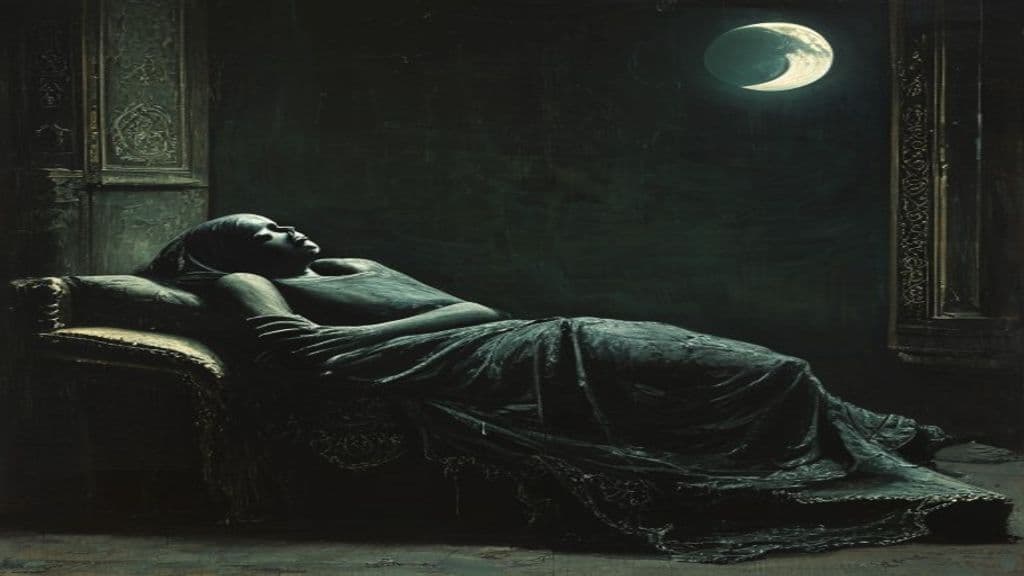
Qareen
The personal spirit companion assigned to every human being at birth in Islamic theology — a jinn double that knows all of a person's secrets and whispers toward sin throughout their life.

Dragon (Long)
Long (龍, "dragon") is a pervasive cultural and artistic motif that appears in Taoist sacred-geographical contexts, Chinese literature, and modern exhibitions; the provided sources treat it as part of the broader mythic imagery present around Taoist sites and ritual scenes rather than as a single, consistently described doctrinal entity.
Sovereignty Goddess (Celtic Tradition)
A Celtic mythology entity that personifies a territory and confers sovereignty upon a king through ritualistic union. (Note: - Power tier should be Greater, not Lesser, as she confers deity-level legitimacy and authority upon the king. - Summary needs to acknowledge that there are multiple sovereignty goddesses across diffe)
Speak, Bird, Speak Again
The book 'Speak, Bird, Speak Again' is a collection of Palestinian folk tales featuring stories that may include supernatural entities from Arabian tradition. (Note: 1. Remove "Hypothetical supernatural entity" as it implies the existence of an entity, which is not confirmed. 2. Change Power tier to Primordial (since it's a book featuring stories that may include )
Specter of Newby Church
An alleged photographic apparition captured in a 1963 interior photograph of the Church of Christ the Consoler on the grounds of Newby Hall, North Yorkshire. The image is circulated in popular paranormal media and skeptical analysis as a famous example of a purported ghost photograph rather than a figure embedded in traditional folklore.
Spell of the Twelve Caves
An ancient Egyptian funerary text that guides and protects the deceased in their transition into the afterlife, warding against negative entities or influences. (Note: 1. Power tier should be Ancient (deity-level) rather than Primordial (cosmic). 2. No information provided about abilities, sensory cues, weaknesses, or wards in the source material. 3. The source ment)
Spercheus
Spercheus is a name attested in two distinct registers: (1) a zoological genus of small aquatic beetles (family Spercheidae) with about twenty described species found in most regions outside the Nearctic, and (2) Sperkheios/Spercheus, a river-god (potamos) of the Spercheus River in Malis in Greek mythology, with associated naiads called the Maliades or Spercheides.
Sphinx
A composite mythical figure with a human head and a lion's body known from Egyptian monumental guardianship and a distinct Greek monster tradition that riddles and kills those who fail to answer. In Egyptian contexts it functions as a benevolent royal and solar emblem carved as statuary; in Greek myth it is an animate, treacherous tester of humans.
Spirit of the Forest
In the supplied sources, 'Spirit of the Forest' is not a documented folkloric entity but the title of the 2003 debut studio album by Finnish folk metal band Korpiklaani. The available material supplies musical and publication information rather than ethnographic data about a supernatural being.
Sprite (Greek Tradition)
Supernatural, ethereal entities often depicted as fairy-like creatures in Greek tradition. (Note: 1. Power tier should be changed to Lesser, as sprites being "fairy-like" suggests they are more like local spirits rather than powerful regional beings. 2. No information is provided on sensory cues, )
Sraosha
Sraosha (Avestan sraoṣ̌a; Middle Persian Srosh / S(a)rosh; New Persian Soroush) is a Zoroastrian yazata whose functions include propagation of conscience and observance, guardian of ritual and households, teacher of the religion of Ahura Mazda, psychopomp at death, and opponent of hostile daeva such as Aeshma.
Staphylus (son of Dionysus)
Staphylus is a mythic eponymous figure in Greek tradition whose name (Ancient Greek Στάφυλος, 'grape cluster') is tied to the origin of grapes, wine, and related practices. Multiple localized traditions present him as a son or companion of Dionysus, a host who entertained the god, a goatherd who discovered wild grapes, or an originator of wine customs; his role is etiological rather than as an active supernatural antagonist.
Star of Ishtar
The Star of Ishtar is a symbol and manifestation of the Mesopotamian goddess Inanna/Ishtar, associated with Venus (the morning star). (Note: 1. Power tier should be Primordial or at least Ancient is unclear since it only represents a divine presence/power. 2. Appearance description not supported by source material (should be stated as unkn)
Steller's sea ape
An 18th-century naturalist's report of an unfamiliar marine animal observed near the Shumagin Islands, Alaska, on 10 August 1741. Presented in primary sources as a zoological observation (Simia marina) and later treated variously as misidentified pinniped, extinct sirenian classification, or modern cryptid.
Community Record
- [1]Spirit turtle — Wikipedia. Wikipedia, 'Spirit turtle' (accessed via provided research notes)wiki
- [2]Hyakumonogatari Kaidankai — The Appearance of the Spirit Turtle. Hyakumonogatari Kaidankai, 'The Appearance of the Spirit Turtle' (local Japanese tale fragment; Lake Shinobazu anecdote)folk
- [3]Wikidata entry: Spirit turtle. Wikidata: Q5360122 (linked in research notes)other