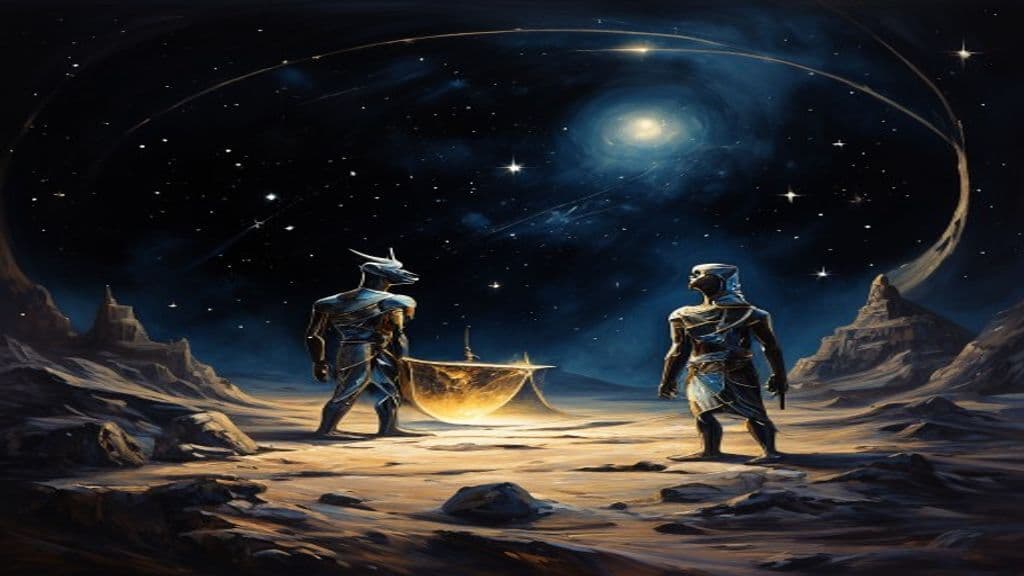
The Indestructibles are two stars visible in the night sky, Kochab located in the bowl of Ursa Minor and Mizar situated at the middle of the handle of the Big Dipper.
As celestial markers associated with eternity and the afterlife, they hold significant cultural importance for their association with these concepts.
Extinct Comet
A former cometary nucleus that has lost or sealed most of its near-surface volatile ices and therefore no longer displays a sustained coma or tail; observationally it can resemble a dark asteroid and is treated within planetary science as an end-state in cometary evolution.
Metis (name / label; disambiguation of uses)
The string 'Metis' (variants Métis, Metiş) appears across many domains — as an Indigenous ethnonym (Métis), place names (Metis Shoal, Metiş village, Metis Island), astronomical and biological names (9 Metis asteroid, Metis moon, genus names), a brief Wikipedia mention of a mythological Metis (Oceanid and wife of Zeus), and multiple modern institutional and cultural uses. The supplied sources do not document a single, coherent supernatural entity named 'Metis' with folkloric appearance, powers, or rituals.
Numbers in Egyptian Mythology
Sacred numbers with significant power and repeated appearances in Egyptian mythology, including 2, 3, 4, and 7. (Note: * Power tier: Downgrade to Ancient (deity-level), as the source material doesn't imply cosmic power but rather reverence for these numbers. * Abilities: Add a sentence that explicitly states that thes)
Spell of the Twelve Caves
An ancient Egyptian funerary text that guides and protects the deceased in their transition into the afterlife, warding against negative entities or influences. (Note: 1. Power tier should be Ancient (deity-level) rather than Primordial (cosmic). 2. No information provided about abilities, sensory cues, weaknesses, or wards in the source material. 3. The source ment)
The Book of the Faiyum
An ancient Egyptian literary work celebrating the Faiyum region and its patron deity, Sobek. (Note: - Power tier should be Lesser (since it's a written work with no supernatural powers). - Sensory cues, weaknesses, and wards need to be removed since they are not mentioned in the source material. - S)
The Great Renunciation
A pivotal event in Buddhist tradition, marking Gautama Buddha's transition from a life of luxury to one of asceticism. (Note: 1. Power tier: Minor Spirit is incorrect; The Great Renunciation is not an entity with powers or behaviors, so it should be classified as none or Primordial (since it's a pivotal event). 2. Sensory cu)
The Headmen
The Headmen are a team of supervillains appearing in American comic books published by Marvel Comics, created from earlier horror-story characters and first assembled as a team in The Defenders #21 (March 1975). They are human (or human-derived) antagonists who pursue schemes of scientific, political, and economic domination and are repeatedly opposed and defeated by superhero protagonists.
The Hook (the Hookman)
An American urban-legend figure, the Hook (or Hookman) is narrated as a violent outsider—commonly an escaped convict or patient—distinguished by a hook in place of a hand who attacks couples parked at lovers' lanes. The legend functions as a mid-20th-century cautionary tale warning against risky teenage behavior rather than as a documented supernatural being.
The Hulk
A modern fictional comic-book character from American popular culture created by Marvel Comics, the Hulk is the rage‑driven alter ego of scientist Dr. Robert Bruce Banner who transforms following exposure to gamma radiation; portrayals vary across media and continuities between a destructive, near‑mindless brute and more nuanced, intelligent personae.
The Love of the Nightingale (Philomela)
Adaptation of ancient Greek mythology, associated with transformation into a nightingale. Featured in the opera 'The Love of the Nightingale', reflecting the cultural values and worldview of ancient Greece. (Note: 1. The power tier should be Ancient (deity-level), as Philomela's transformation is a mythological event tied to divine intervention. 2. No source material mentions sensory_cues ("melancholic singing")
The Magic Jinn
A magical jinn from Arabian tradition with the ability to grant wishes, but at a cost. (Note: 1. Power tier: Primordial is not plausible given that granting wishes and providing assistance are abilities typically attributed to lower-tier entities (Greater or Lesser). 2. Origin story: Since The)
The Nine Diseases (Finnish)
The sons of Louhi, personifying various diseases and disasters. (Note: - Power tier: Primordial (as they are the sons of a goddess, their origins are more cosmic) - Appearance: Specify that there is no direct description in source material - Abilities: Clarify that they )
Community Record
- [1]