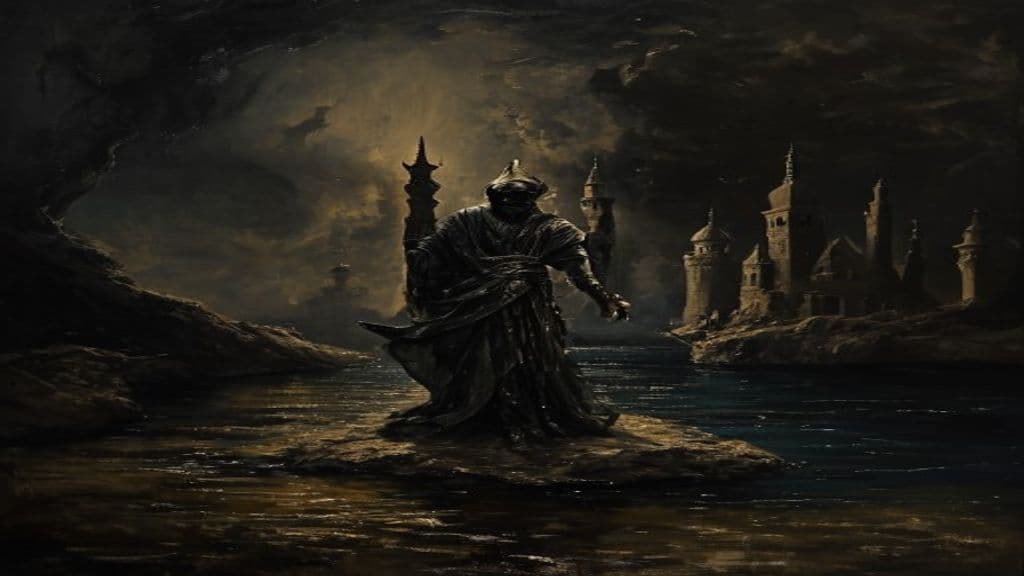
The source material does not provide information on the origin story of The Magic Jinn.
No physical description is provided in the source material.
The Magic Jinn has the ability to grant wishes or provide assistance, but this comes at a cost.
Al-Mi'raj
A mythical creature from medieval Arabic literature, described as a one-horned hare or rabbit. (Note: * Power tier: Given the lack of information on abilities and powers, it's too early to assign a power tier. However, considering its classification as a "mythical creature" in medieval Arabic literatu)
Ghoul
A ghoul is a demon-like or monstrous humanoid originating in pre-Islamic Arabian religion, traditionally associated with graveyards and the consumption of human flesh. The concept later entered broader folklore and has been widely reused and transformed in modern fiction and popular culture.
Hantu
Hantu is a Malay and Indonesian lexical and conceptual category for spirits and invisible beings that includes ancestral souls, animistic nature spirits, and, in modern usage, ghosts or demons. The term covers many named subtypes (e.g., Hantu Raya, Hantu Tinggi) whose forms and roles vary across local traditions.
Shamshir-e Zomorrodnegār
A sacred sword in the Persian legend Shahnameh, capable of piercing the invulnerability of Fulad-zereh, a demonic entity created by a witch mother's charm. (Note: 1. Remove Power tier: Primordial as it is likely Greater (powerful regional) given its ability to counter a demonic entity. 2. Add sensory cues from Source 1: mention of King Solomon's ownership could)
Sheshe
The Sheshe is a malevolent being in Persian mythology that targets newborn babies on their 6th day of life, strangling them during the night. (Note: * Power tier: Incorrect, should be "Ancient" as it demonstrates deity-level powers to kill newborns. * Abilities: Should mention the Sheshe's supernatural nature and connection to infant mortality fea)
Sila (Si'la, Si'lat)
A jinn-like, chiefly female shapeshifting spirit from Arabian folklore, the Sila (Si'la/Si'lat) is associated with desolate desert places where it misleads travellers, seduces men, and may intermarry with humans. Early sources equated it with the ghoul; later traditions treat it as the female counterpart of ghoul-type beings.
The Hulk
A modern fictional comic-book character from American popular culture created by Marvel Comics, the Hulk is the rage‑driven alter ego of scientist Dr. Robert Bruce Banner who transforms following exposure to gamma radiation; portrayals vary across media and continuities between a destructive, near‑mindless brute and more nuanced, intelligent personae.
The Indestructibles
In ancient Egyptian culture, The Indestructibles refer to two bright stars, Kochab and Mizar, associated with eternity and the afterlife. (Note: - The power tier should be Primordial. - Appearance: correct, but note that Kochab is actually located in Ursa Minor, not the "bowl of Ursa Minor", which seems to refer to the Little Dipper. Mizar is )
The Love of the Nightingale (Philomela)
Adaptation of ancient Greek mythology, associated with transformation into a nightingale. Featured in the opera 'The Love of the Nightingale', reflecting the cultural values and worldview of ancient Greece. (Note: 1. The power tier should be Ancient (deity-level), as Philomela's transformation is a mythological event tied to divine intervention. 2. No source material mentions sensory_cues ("melancholic singing")
The Nine Diseases (Finnish)
The sons of Louhi, personifying various diseases and disasters. (Note: - Power tier: Primordial (as they are the sons of a goddess, their origins are more cosmic) - Appearance: Specify that there is no direct description in source material - Abilities: Clarify that they )
The Nine Worlds
In Norse cosmology, the universe is composed of nine interconnected worlds that coexist and interact with one another. (Note: - Power tier: Primordial (The Nine Worlds are the fundamental structure of the universe, making them more primordial than deity-level) - Origin story and Appearance: missing, should be included based )
The Sacred Tree at Uppsala
A large, evergreen tree in Norse tradition, used as a focal point for spiritual practices and rituals. (Note: - Power tier should be Primordial, given that it's described as having a dark and ominous connotation and its "request" is granted only if no human sacrifices are near. - Appearance: Remove "evergreen)
Community Record
- [1]Juma and the Magic Jinn. Wikipedia articlewiki