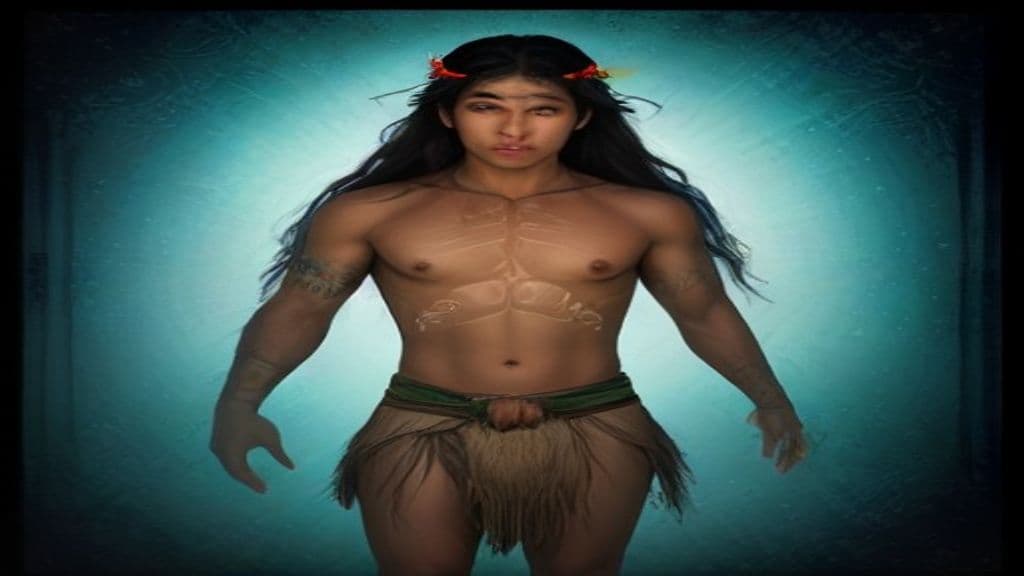
In Samoan mythic narrative Tiʻitiʻi appears as a culture-hero in the wider Polynesian pattern of Māui-type tales. The best-attested episode records Tiʻitiʻi's struggle with the earthquake god Mafuiʻe during which Tiʻitiʻi breaks off one of Mafuiʻe's arms and forces the god to reveal how fire had been concealed by the gods in certain trees during the making of the world. By extracting this knowledge Tiʻitiʻi brings fire to the people of Samoa; the story also provides an aetiological detail that, because Mafuiʻe lost an arm, he was thought less able to create large earthquakes. The account situates Tiʻitiʻi as an origin figure who secures crucial technology for humans rather than as the focus of regular cultic worship (a pattern explicitly compared in the sources to the Māui cycle). (Source: Wikipedia entry summarizing Samoan legend.)
The provided sources do not supply a physical description of Tiʻitiʻi (no details on age, dress, size, or other visible features are recorded). Traditional summaries emphasize his deeds and role in cosmogonic episodes (such as the acquisition of fire) rather than his outward appearance, and the surviving brief accounts focus on narrative action rather than iconographic detail. (Source: Wikipedia summary and related comparative notes.)
Tiʻitiʻi's chief attested capacities are heroic prowess and the ability to confront and overcome powerful supernatural beings. In the recorded episode he fights the earthquake god Mafuiʻe, breaks off one of Mafuiʻe's arms in combat, and compels Mafuiʻe to teach him the secret of how fire had been hidden in certain trees at the world's making; through this he brings fire to humans. The tradition thus presents him as able to physically overpower a god-like being and to extract cosmogonic/technical knowledge for the benefit of the human community. The narrative places Tiʻitiʻi within the Polynesian Māui-type repertoire of culture-hero exploits. (Source: Wikipedia summary of the Samoan legend.)
Tagaloa
In Samoan myth Tagaloa (also Tagaloa-Lagi or Tagaloa Lagi) is presented as the supreme ruler and creator who dwells in the heavens and is credited in various traditions with making the heavens, sky, land, seas, fresh water, trees, and people. Tagaloa functions as progenitor of other gods and figures in origin narratives that link divine actions to island formation and human genealogy.
Tangaroa
Tangaroa is a principal Polynesian atua of oceanic realms — in Māori tradition he is the great atua of the sea, lakes, rivers, and creatures within them, especially fish. Cognate figures (Tagaloa, Tangaloa, Taʻaroa, Kanaloa) appear across Polynesia with varying rank and functions from departmental sea-god to supreme creator in regional traditions.
Titania
Titania is the proper name used most prominently for the Queen of the Fairies in William Shakespeare's A Midsummer Night's Dream; the name also appears across astronomy, chemistry/mineralogy, and modern fiction as distinct, homonymous referents rather than a single folkloric entity. In the Shakespearean context she appears onstage as a sovereign fairy figure who enters accompanied by her retinue.
Titans
A generation of powerful primordial divine beings in Greek myth who preceded and were overthrown by the Olympian gods. They function as progenitors of many cosmic forces and later become chthonic powers confined beneath the earth (Tartarus) though some traditions allow certain Titans to remain free.
Titivillus
Titivillus is a medieval Christian demon associated with the collection of omitted, syncopated, or mispronounced syllables and fragments from liturgy and the errors of scribes and printers; he is depicted chiefly as an infernal agent who gathers these fragments in sacks to be counted against offenders.
Tiyanak
The tiyanak is a malevolent Philippine supernatural being typically depicted as an infant‑shaped spirit that lures people by imitating a baby’s cry and then attacks or abducts them. It is variously understood as the restless soul of an infant who died unnamed or unbaptized and, in older Spanish‑era accounts, as an obstetric spirit (patianac) that obstructs childbirth.
Tizheruk
A serpent‑like sea creature of Inuit oral tradition, reported in sources as inhabiting cold Alaskan waters (notably near Key Island / the Kenai Fjords). Traditional accounts describe it as a large, physical aquatic predator reported to seize people from piers and kayaks.
Tjilpa
In the supplied sources the term Tjilpa is not attested as a documented supernatural being; the only concrete referent in those materials is the western quoll (Dasyurus geoffroii, common name chuditch) discussed in an encyclopedic entry. No ethnographic or mythic descriptions of a 'Tjilpa' ancestral sand-goanna or paternal ancestral being appear in the provided documents.
Tlacolotl
Tlacolotl is an Aztec-associated term linked to owls—often rendered as the 'horned owl'—and in secondary sources is portrayed as a symbol or personification of evil, darkness, sorcery, and ill-omen in central Mexican thought. Surviving references are fragmentary and vary between treating Tlacolotl as an owl-sign, an emblem of malignant forces, or (in some modern summaries) a god of evil.
Tlaltecuhtli
Tlaltecuhtli (Classical Nahuatl Tlāltēuctli) is a Mexica (Aztec) primordial earth-being whose dismembered body became the material world. She functions as both the living substance of the earth and a demanding power that must be ritually fed—notably with human blood and hearts—to maintain cosmic order and terrestrial fertility.
Tlepolemus
Tlepolemus (Ancient Greek: Τληπόλεμος, Tlēpólemos, 'enduring war') is a mortal hero of Greek myth, a son of Heracles who leads the Rhodian contingent at Troy, wounds and is slain by Sarpedon, and—after killing Licymnius—founds the three Rhodian cities Cameirus, Ialysus, and Lindus.
Tlesimenes
Tlesimenes is a poorly attested mythic figure recorded in a modern database as related to the Greek figure Parthenopaeus. No primary literary or ritual material for Tlesimenes is provided in the available sources; any identification with the class of nymphs is tentative and inferred from database placement and general descriptions of nymphs in secondary reference material.
Community Record
- [1]Ti‘iti‘i. Wikipedia, 'Tiʻitiʻi' entry summarizing Samoan legend and comparative Polynesian notes.wiki
- [2]Māui. Wikipedia, 'Māui' entry used for comparative context about Māui-type culture-heroes and social role.wiki
- [3]Wikidata: Ti'iti'i. Wikidata entry for Ti'iti'i (identifier record).other