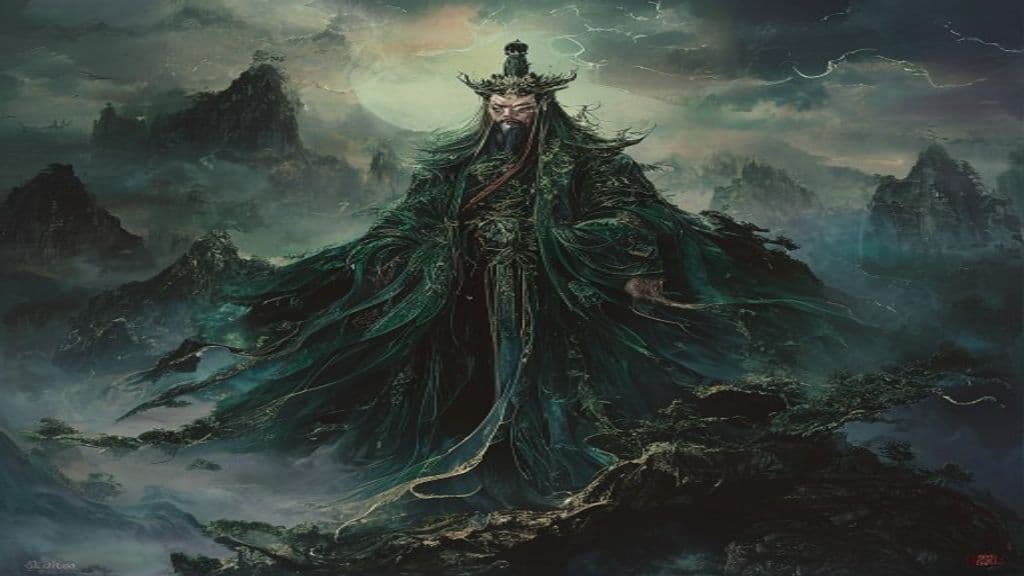
Tản Viên Sơn Thánh is one of The Four Immortals in traditional Vietnamese mythology, specifically associated with the Ba Vì mountain range.
As a god and one of The Four Immortals, Tản Viên Sơn Thánh's powers include control over natural phenomena or the environment, although the source material does not provide specific details on his abilities.
Weaknesses
None recorded.
Wards
- divine
Chông Tị (Four Immortals)
One of the Four Immortals in Vietnamese mythology, associated with immortality and appearing on a golden dragon. (Note: - Power tier: Greater (not Primordial) - Chông Tị is associated with longevity and appears on a divine entity (golden dragon), but not cosmic in scope. - Abilities: Remove "His immortality implies ext)
Four Holy Beasts
A set of four sacred animals in Chinese and broader East Asian cultural and astronomical tradition, mapped to the four cardinal directions and used as auspicious, protective, and cosmological symbols in literature, architecture, and material culture.
Lạc bird
A mythical creature in Vietnamese culture, considered the national bird of Vietnam. (Note: * Remove "national bird of Vietnam" from summary, as it only mentions the Lạc bird is considered one. * Power tier should be set to Unknown or Unspecified, as no information is available on its abilit)
Mụ bà (Mười hai Bà mụ)
A collective of twelve female tutelary figures in Vietnamese folk religion who act as midwives and household guardians of newborns, responsible for teaching infants early life skills and auspicious traits. They are ritually acknowledged in some regions at a special ceremony when a baby is one month old.
Thuận Thiên (sword)
Mythological sword imbued with magical power associated with Emperor Lê Lợi's liberation of Vietnam from Ming occupation. (Note: 1. Power tier: Reduce to Greater (powerful regional) as Thuận Thiên's abilities are tied to a specific ruler and region, rather than being on a deity-level. 2. Origin story: Clarify that Lê Lợi procla)
Thần Trụ Trời
A Primordial deity responsible for creating the world by establishing pillars in Vietnamese mythology. (Note: 1. Power tier: Primordial (consistent with being a creator deity) 2. Add sensory cues (e.g., description of pillars, sound, or other unique characteristics associated with Thần Trụ Trời's presence) 3)
Âu Cơ (Vietnamese Mountain Snow Goddess)
Immortal goddess associated with mountains, snow, and fertility in Vietnamese creation myth. (Note: - Power tier should be Ancient (deity-level) rather than Primordial (cosmic), as there's no indication she has cosmic powers. - Abilities: While fertility and creation are associated with Âu Cơ, stati)
Tūtāmure
Tūtāmure is presented in the sourced material as a human historical figure in Māori tradition: the nephew of the ariki Kahungunu who attacked Maunga-a-kāhia during Kahungunu's old age. The source treats Tūtāmure as an actor within genealogical and inter‑group conflict narratives rather than as a supernatural being.
Tūwhakararo
A chief in Māori mythology, significant figure in the migration myth of Hawaiki. (Note: 1. Power tier: Downgrade to Greater (he is not described as having supernatural abilities, but his significance lies in his leadership). 2. Sensory cues: Add "None mentioned" or "Unknown". 3. Weakness)
Tūwhenua
An ancestral ocean-going canoe in Māori mythology, associated with Tamatea and the migration of settlers to New Zealand. (Note: - Power tier should be Greater (as it facilitated regional travel and migration) rather than Ancient. - Appearance is incomplete; the source does not mention physical description, but states Tūwhenua )
U-28 creature
A modern-era cryptid reported by SM U-28's commander in a 1933 newspaper account of a 1915 naval incident; described as an enormous crocodile‑like aquatic reptile purportedly propelled from the sea during the sinking of the SS Iberian. Treated in sources as a cryptozoological claim rather than a folkloric or ritual entity, with subsequent debate over its physical plausibility.
UB-85 monster (hoax)
An alleged sea‑monster said to have attacked the German submarine SM UB‑85 in late April 1918; popularized in James B. Sweeney's 1977 compilation and later adopted by cryptozoology writers, but treated by naval historians as a fabricated or exaggerated post‑hoc explanation for the submarine's capture and mechanical problems.
Community Record
- [1]Wikipediawiki