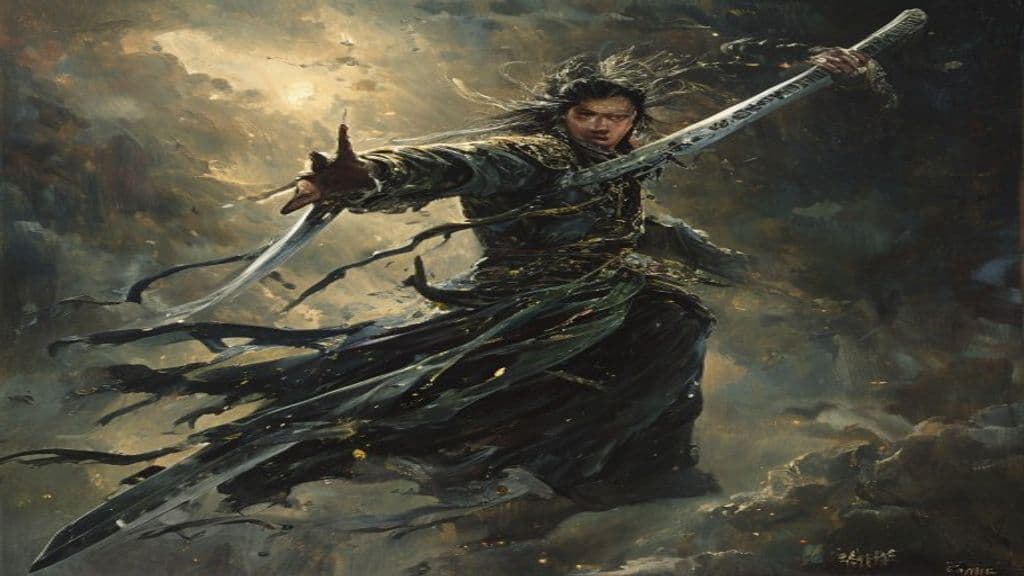
Thuận Thiên was associated with Emperor Lê Lợi during his reign (1428-1433) and is tied to the early phase of the Lê dynasty, reflecting Vietnam's history of struggle for independence.
Granting its wielder divine abilities, Thuận Thiên allows Lê Lợi to grow very tall and possess the strength of 10,000 men. However, it is unclear whether this growth and strength are literal or metaphorical, and if others can also wield Thuận Thiên with similar effects.
Chông Tị (Four Immortals)
One of the Four Immortals in Vietnamese mythology, associated with immortality and appearing on a golden dragon. (Note: - Power tier: Greater (not Primordial) - Chông Tị is associated with longevity and appears on a divine entity (golden dragon), but not cosmic in scope. - Abilities: Remove "His immortality implies ext)
Four Holy Beasts
A set of four sacred animals in Chinese and broader East Asian cultural and astronomical tradition, mapped to the four cardinal directions and used as auspicious, protective, and cosmological symbols in literature, architecture, and material culture.
Lạc bird
A mythical creature in Vietnamese culture, considered the national bird of Vietnam. (Note: * Remove "national bird of Vietnam" from summary, as it only mentions the Lạc bird is considered one. * Power tier should be set to Unknown or Unspecified, as no information is available on its abilit)
Mụ bà (Mười hai Bà mụ)
A collective of twelve female tutelary figures in Vietnamese folk religion who act as midwives and household guardians of newborns, responsible for teaching infants early life skills and auspicious traits. They are ritually acknowledged in some regions at a special ceremony when a baby is one month old.
Thần Trụ Trời
A Primordial deity responsible for creating the world by establishing pillars in Vietnamese mythology. (Note: 1. Power tier: Primordial (consistent with being a creator deity) 2. Add sensory cues (e.g., description of pillars, sound, or other unique characteristics associated with Thần Trụ Trời's presence) 3)
Tản Viên Sơn Thánh
One of The Four Immortals in Vietnamese mythology, associated with the Ba Vì mountain range and the romance of Sơn Tinh - Thủy Tinh. (Note: - Power tier should be Greater (Tản Viên Sơn Thánh is a regional deity, not on the level of a cosmic entity) - Appearance section needs to be added - Abilities need more specific details from source m)
Âu Cơ (Vietnamese Mountain Snow Goddess)
Immortal goddess associated with mountains, snow, and fertility in Vietnamese creation myth. (Note: - Power tier should be Ancient (deity-level) rather than Primordial (cosmic), as there's no indication she has cosmic powers. - Abilities: While fertility and creation are associated with Âu Cơ, stati)
Threefold Death
A cosmological concept in Celtic mythology, affecting grand figures such as kings and gods. (Note: 1. Power tier: Downgrade to Ancient (deity-level), as the threefold death affects grand figures like kings and gods but doesn't imply cosmic influence. 2. Abilities: Rewrite to clarify that it's not a)
Thunder Butte
A large, isolated hill with cultural significance in Lakota tradition. (Note: 1. Power tier is likely Greater (powerful regional) rather than Primordial (cosmic), as it has cultural significance but doesn't appear to possess supernatural abilities. 2. Abilities should be explic)
Thunderbird
Thunderbird is a legendary supernatural creature named in the histories and cultures of certain North American Indigenous peoples. The supplied sources identify Thunderbird by the English name and situate it broadly within North American Indigenous cultural histories but do not provide detailed ethnographic or linguistic information.
Thyestes
Thyestes is a mythic human king of the Pelopid/Atreid cycle in ancient Greek and Roman tradition, central to a notorious family curse and a sequence of intra-familial crimes (adultery, fratricide, incest, and a cannibalistic banquet). His story is recounted in classical summaries and dramatized in Roman tragedy (notably Seneca) and later adaptations, and functions as a paradigmatic tale of inherited pollution and revenge.
Thyia
Thyia (Ancient Greek Θυία) is attested in Greek mythic-cultic tradition as a naiad — a freshwater nymph of a spring on Mount Parnassos in Phokis — and as a local female figure connected with cult activity. Her name is derived from the verb θύω ('to sacrifice'), and some sources connect the name-form with Thyiad/’Bacchic’ terminology, suggesting a possible link to cultic or ecstatic contexts.
Community Record
- [1]