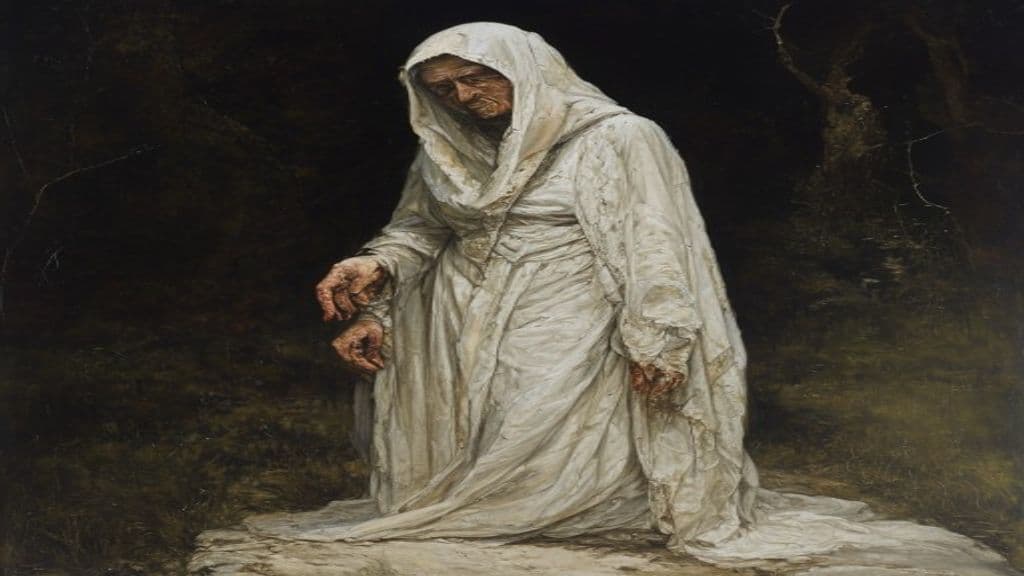
In Serbian popular belief Čuma is not an abstract illness but an individualized being. Čumas were believed to live in a far away land; from there they set out to infect people, arriving into the vicinity of communities to spread plague. The sources present her as an external invader of households rather than a native household spirit.
Attested descriptions imagine Čuma as an old woman (rarely young) dressed in white. No further stable physical features, measurements, or detailed apparel beyond 'dressed in white' are recorded in the cited sources.
Čuma's defining activity is to bring and spread plague to people and houses. She is said to particularly seek out dirty houses and is described as hating dirtiness; this behavioral preference is the principal trait ascribed to her. Beyond initiating contagion and showing preference for unclean homes, the sources do not record other supernatural powers, hierarchies, or technical magical abilities.
Weaknesses
- conditioncleanliness (thorough cleaning of house and occupants)
- otheravoidance of direct naming (use of euphemisms 'kuma' or 'teta')
Wards
- ritualthorough household and personal cleaning
- mantraeuphemistic reference: 'kuma' (godmother) or 'teta' (aunty)
- substanceofferings of food
- substanceclean water
- substancebasil
- othera comb (offered to Čuma)
Vampire (tradition)
A class of revenant beings in southeastern and eastern European folk belief that subsist by feeding on the vital essence (generally blood) of the living. Recorded chiefly in early modern to modern oral traditions, these vampires are typically described as reanimated corpses whose presence explains unexplained illness, death, and post-mortem disturbances in their communities.
Ülgen
Ülgen is a benevolent creator and high-sky deity in Turkic traditional belief (often discussed under Tengrism). He is credited with creating earth, heaven and living beings, promotes abundance and welfare, and functions as patron of shamans; in sources he is usually distinct from Tengri but in some accounts identified or conflated with Tengri.
Ādityas
The Ādityas are a Vedic/Hindu class of solar deities, described as offspring of the goddess Aditi (and in later lists of Aditi and the sage Kaśyapa) who function collectively as manifestations/aspects of the Sun and as guardians who uphold Dharma. Their number and individual names vary by textual period — from six–eight in the Rigveda to a canonical twelve in later Brāhmaṇas and Purāṇas — and in later usage many individual Ādityas are assimilated into the single sun-god Sūrya.
Ādi‑Buddha (tradition)
The Ādi‑Buddha is a tantric Mahāyāna concept of the primordial or 'first' Buddha that functions as the dharmakāya or ground of awakened mind. In Tibetan traditions it is variously personified (e.g., Samantabhadra, Vajradhāra, or the Kalachakra figure) and is principally a doctrinal and meditative focus rather than a theistic creator god.
Ākāśagarbha
A Mahāyāna bodhisattva personifying the element of space (ākāśa) revered across Chinese, Japanese, Korean and Tibetan esoteric traditions as a treasury of boundless wisdom; traditionally invoked by dhāraṇī, mantra and visualization practices—most famously in the Gumonjihō—for memory, learning, purification and the fulfillment of requests.
Āraiteuru
In Māori tradition, Āraiteuru is a canoe associated with Ngāi Tahu's ancestors, not a supernatural being or spirit. (Note: * Power tier should be changed to "Greater" or removed, as Āraiteuru is not a supernatural being. * Abilities statement should clarify that it doesn't have supernatural powers, but could mention its i)
Čihrdād nask
A lost nask (book/volume) of the Sasanian Avesta that functioned as an authoritative account of mythical origins and the legendary history of humankind from Gayomard to the revelation of Zarathustra; it survives only in later summaries and commentaries (notably the Denkard and the Rivayats).
İn Cin
İn Cin (also written İn jinn) is a Turkish folkloric phrase and folk concept used to indicate that a place is entirely abandoned; it refers to two kinds of unseen inhabitants—İn and jinn—believed to occupy forgotten or desolated locations and make them unfit for human habitation.
İye
İye are Turkic spiritual proprietors or tutelary spirits understood as the unseen 'owners' or guardians of particular places, natural phenomena, objects, animals, households, or concepts. They mediate human relations with domains of the world and respond to human conduct—offering blessing when respected and retribution when violated.
Ōkoki
A large ocean-going canoe used by Māori ancestors for migration and settlement, playing a significant role in early New Zealand history. (Note: - Power tier: Greater (regional power) would be more fitting given its significant historical impact on New Zealand settlement. - Abilities: None, but its role in facilitating travel and transportatio)
Ōkubi
Ōkubi (大首, おおくび) is a Japanese yōkai typically rendered as a monstrous, disproportionately large head — most often a huge female face with the painted-black teeth of a married woman — and is described in sources as both a discrete apparition and as an externalization of human obsession, vengeance, or sexual guilt. Classical anecdotes present localized harmful effects (for example, causing swelling or sickness after 'blowing' on a person), while modern literary and manga treatments expand the motif into psychologically charged visions and graphic supernatural powers.
Ōmukade
Ōmukade (大百足, おおむかで) is a yōkai of Japanese tradition depicted as a giant, man‑eating centipede that lives in mountains. In classical legend (notably the Tawara Tōda / Fujiwara no Hidesato tale) it preys on humans and on large serpents/dragons and is resistant to ordinary weapons but is killed when an arrow is smeared with a human's saliva.
Community Record
- [1]Čuma. Wikipedia, 'Čuma'wiki
- [2]Čuma (Wikidata). Wikidata entry Q109519566other
- [3]Archive materials referenced in notes. Archive: 210226_Turkiyede_Cuma_Namazi_Kilinir_Mi?other
- [4]Archive materials referenced in notes. Archive: Imajinasi di secarik kertasother
- [5]Archive materials referenced in notes. Archive: Salgının başında değil, yükseliş aşamasındayızother