
Local traditions vary. In some regional origin tales the ushi‑oni functions etiologically — e.g., an eight‑headed ox monster (Jinrinki) fought and was killed in legends tied to Empress Jingū, its body parts becoming islands (Ushimado, Okayama). Folklorists such as Kunio Yanagita have also interpreted certain ushi‑oni legends as reflecting formerly deified local mountain gods that became demonized in later narratives; this reading is reported in secondary summaries of regional material.
Depictions vary widely by locale. A common iconography (Edo‑period emaki and later summaries) presents an ox's head with upward‑curving horns, fanged mouth and slender tongue attached to a non‑bovine body — often a spider‑like torso with long singular claws. Other variants described in regional tales include an oni torso with an ox head, an oni head on an ox body, a catlike springy ball with a long tail (Wakayama), appearances wearing human clothing near temple gates, or flying with insect wings. Sources emphasize significant regional variation rather than a single fixed form.
Folklore attributes the ushi‑oni with violent, predatory behavior: killing and eating humans, spitting poison, and causing illness or curse. Wakayama accounts describe a gaze‑fixing, soul‑draining ability called kage wo kuu / kage wo nomu ('eating the shadow' or 'drinking the soul') in which victims cannot avert their gaze and are drained of life. Coastal tales often pair the ushi‑oni with shore women (nure‑onna, iso‑onna) in ambush narratives; some regional stories record limited shape‑shifting (e.g., appearing as a woman who asks a traveler to hold a baby) and, in rare instances, a tale of an ushi‑oni that accepted a boy's food and later sacrificed itself to save him. These powers and behaviors are reported variably across locales rather than presented as universal.
Weaknesses
- mantralocal formula of contraries (Wakayama) — e.g., saying opposites such as 'rocks flow, leaves sink, oxen neigh, and horses bellow'
- ritualannual offering of alcohol (Wado River legend) — providing its favorite thing each New Year to avert harm
Wards
- mantrasaying opposites (Wakayama verbal contraries) reported as a means to save one's life during an encounter
- ritualannual New Year alcohol offering at Wado River (propitiation to prevent disease/death)
- ritualUwajima Ushi‑oni Festival (宇和島牛鬼祭り) — communal parade and purification event featuring large ushi‑oni floats (civic ritualized management of threat)
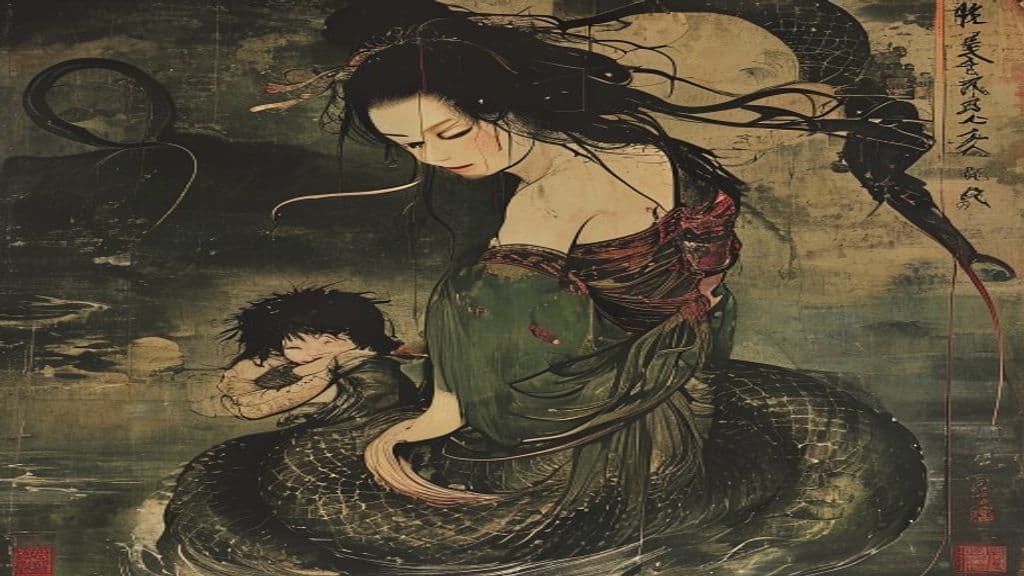
Nure-onna
A Japanese yōkai associated with seas, rivers, and shorelines, portrayed variably as a wet-haired woman, a snake-bodied female, or an ubume-like figure who lures victims with a childlike bundle. Regional tales alternate between depictions of a reclusive, territorial being and a predatory lure often linked with the ushi-oni.
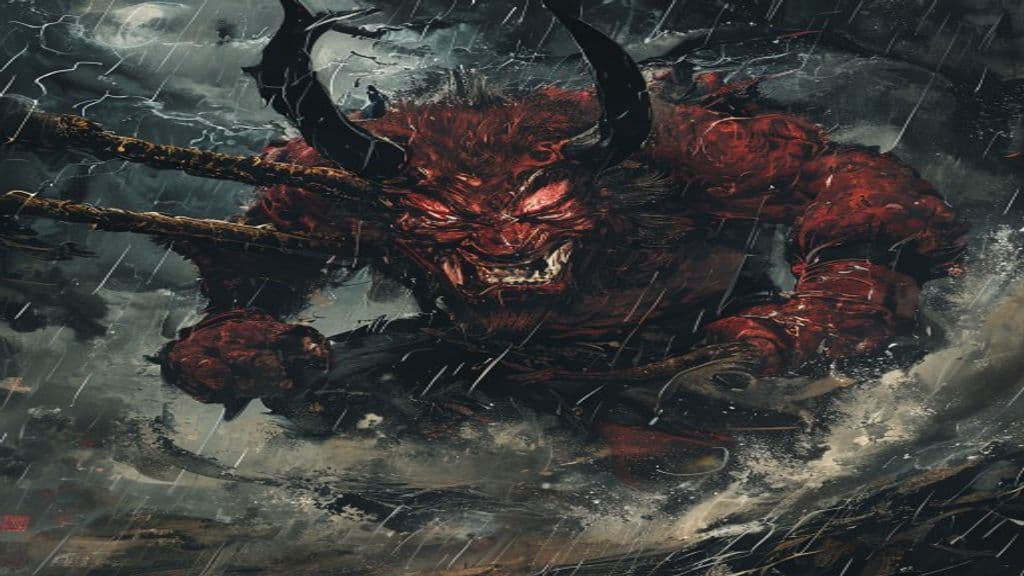
Oni
Powerful supernatural beings of Japanese folklore — associated with misfortune, disease, and the punishment of sinners in hell. Fearsome, often depicted as guardians of the underworld.
Ursa Minor
Ursa Minor is a northern constellation (the 'Lesser Bear' or Little Dipper) historically used as a north marker because its brightest star, Polaris, currently marks the north celestial pole. It appears in multiple cultural star-systems (Greek, Babylonian, Chinese, Inuit) with varying asterism identities and has been included in classical and modern astronomical catalogues.
Urtzi (Basque Tradition)
A pre-Christian sky deity or concept associated with the celestial realm in Basque tradition. (Note: 1. Power tier: Primordial (since it's a "pre-Christian sky deity" and likely on a cosmic level) 2. Abilities: Should be left as "Unknown" since no abilities are mentioned in the source 3. Sensory cues)
Uru (Uros)
An indigenous ethnolinguistic people of the Lake Titicaca region known for living on self-fashioned floating totora‑reed islands and for a material culture tightly bound to lacustrine resources. Their identity, subsistence technology, and social history are documented in ethnographic sources.
Uruaokapuarangi
A great ocean-going canoe used by Māori ancestors to migrate and settle the South Island. (Note: - Power tier: Primordial (since it's a canoe used for migrating and settling an entire island, implying significant influence and power) - Abilities: More detail is needed on how it transported people)
Urutengangana
In Māori mythology, Urutengangana is a god of light and the firstborn child of Ranginui (Sky father) and Papatūānuku (Earth mother). He plays a significant role in the creation myth and balance between light and darkness. (Note: 1. Power tier: Primordial does not necessarily imply Urutengangana has cosmic powers; consider reclassifying to Ancient or leaving unspecified. 2. Origin story: The article states "firstborn child" bu)
Urðr
Urðr is one of the three Norns in Norse mythic tradition, commonly interpreted as the figure associated with the past. She is attested in the Poetic Edda (Völuspá) and in Snorri Sturluson's Prose Edda (Gylfaginning) as one of the fate-determining women who sit at Urðarbrunnr beneath Yggdrasil and measure or mark the destinies of gods and humans.
Utu (Shamash)
Utu, known in Akkadian as Shamash, is the ancient Mesopotamian sun deity who functions as the personified sun, divine judge, protector of travelers, and a god associated with divination; he was especially venerated at Sippar and Larsa and figures in a family of major gods.
Utukku (Utukku Lemnu)
Utukku (Sumerian udug; Akkadian utukku) is an ambiguous class of underworld-born malignant spirits in ancient Mesopotamian tradition. Treated in ritual literature as agents of disease and affliction, they are distinct from the dingir (gods) and primarily addressed through exorcistic texts collectively known as the Udug Hul.
Uumarnituq and Aakulujjuusi
Uumarnituq and Aakulujjuusi are the pair of first human parents in a corpus of Inuit unipkaaqtuat (origin tales). In overlapping Netsilik, Iglulingmiut, Natsilingmiut, Cumberland Sound and Greenlandic variants they re‑populate the earth after a pre‑historical destruction and act as progenitors whose actions (including performance of magic songs called irinaliuti) explain childbirth, gender transformation in specific tellings, and certain social conditions in particular variants.
Uwan
A Japanese yōkai primarily attested in Edo-period illustrated compendia as a grotesque, teeth-blackened humanoid associated with a loud, startling cry rendered as "uwan." Primary evidence is visual; later folkloric accounts add speculative behaviors such as selective audibility and a mimicry-based countermeasure.
Ušum (Ushum)
Ušum (also written Ushum) is a named dragon‑ or serpent‑like monster in Sumerian/Akkadian mythic cycles. In the surviving summaries it appears as one of several monstrous 'warriors' slain by the warrior‑god Ninurta; its corpse is reported as being hung on the seat of his chariot as a demonstration of victory and restored order.
Vadavagni
A supernatural being embodying a submarine fire with the head of a mare in Hindu mythology, associated with destruction. (Note: - Power tier: Greater seems too high given the description as a "submarine fire" and its embodiment by a mare's head; Primordial would be more plausible. - Abilities: The text should clarify that ther)
Community Record
- [1]Ushi-oni. Wikipedia: Ushi-oniwiki
- [2]Uwajima Ushi-oni Festival. Wikipedia: Uwajima Ushi-oni Festival (宇和島牛鬼祭り)wiki
- [3]Keiichi.net Radio, Behind the Scenes [UshiOni Larger Versions] (Archive). Archive.org collection item referencing ushi‑oni visual materialsother
- [4]U is for Ushi‑oni (Oddments & Curiosities blog). Oddments & Curiosities: U is for Ushi‑oniother
- [5]The Terrifying Japanese Yokai "Ushioni": The Legend of Ushioni Fuchi. Kiri53: 'The Terrifying Japanese Yokai Ushioni' (secondary folkloric summary)folk
- [6]Frontiers of Zoology: Gyuki or Ushi‑Oni (blog). Frontiers of Zoology blog: 'Gyuki or Ushi‑Oni'other