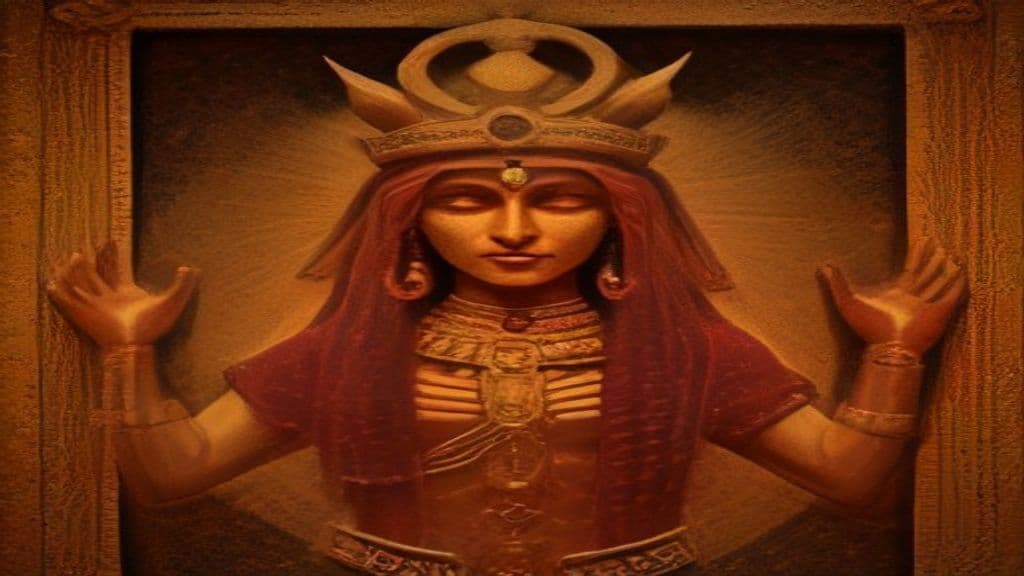
In Mesopotamian tradition Utu is presented as a principal god born to the moon god Nanna (Sin) and his wife Ningal. He is the twin of the goddess Inanna (Ishtar) and husband of the dawn goddess Aya (Sherida); multiple texts describe daily reunions of Utu and Aya on a mountain where the sun was believed to set. Among their offspring are Kittum (personification of truth), dream deities such as Mamu, and the god Ishum. Utu occupies a central place in the divine genealogy and cult network, with particular cultic importance in the cities of Sippar and Larsa.
The supplied sources do not provide a detailed iconographic description of Utu/Shamash. The summaries identify him functionally as the sun-personification and a major male deity of the Mesopotamian pantheon, but specific visual attributes, garments, emblems, or standard iconography are not recorded in the provided material.
Texts depict Utu as the deity who 'was believed to see everything that happened in the world every day,' a quality that underwrites his role as divine judge and guarantor of justice. He is credited with protecting travelers and is associated in some texts with the underworld in his judicial capacity. Utu is also invoked in divinatory contexts, often alongside the weather god Adad, and his name was used logographically to denote foreign solar deities, indicating functional equivalence with other sun-gods in cuneiform practice.
Adad
Adad (also Hadad, Haddad; Sumerian Iškur) is the storm- and rain-deity attested in ancient Mesopotamian and Canaanite religious contexts. Sources identify him as a principal weather god whose domain is storms and rainfall and whose name appears across multiple Near Eastern languages and sites, including Ebla (as Hadda, c. 2500 BCE).
Ama-arḫuš
Ama-arḫuš is attested in Mesopotamian sources as a divine figure associated with compassion and healing. She is presented both as an independent goddess and as an epithet applied to other goddesses (notably as a title designating them compassionate, for example in association with Gula).
Anunītu (Annunitum / Anunitu)
Anunītu (Annunitum / Anunitu) is a Mesopotamian goddess associated with warfare who began as an epithet of Ishtar of Akkad emphasizing a warlike aspect and by the late third millennium BCE came to be treated as a distinct tutelary deity, attested as patron of cities such as Akkad and Sippar-Amnanum and worshiped elsewhere in Mesopotamia.
Belet-ekalli (Ninegal)
Belet-ekalli, also rendered Ninegal, is a Mesopotamian palace tutelary deity whose name means 'lady of the palace.' She appears in canonical god lists and in interstate treaty enumerations, indicating a recognized role in palace cult and state-level ritual contexts.
Bunene
Bunene is an attendant deity (sukkal) of the Mesopotamian sun-god Šamaš (Utu), described as the charioteer who conveyed the sun from the eastern horizon to the western doorway of heaven and as a cultic intercessor included in offerings and temple inventories, especially at Sippar.
Haya
Haya is attested as a theonym in ancient Mesopotamian religion. Some modern scholars have characterized Haya as a grain or agricultural deity on etymological grounds, a reading that other scholars treat as tentative or unreliable given the limited evidence.
Ili-mīšar
Ili-mīšar (Mīšaru, Misharu) is a Mesopotamian deity who functions as the personification of justice and is sometimes portrayed as a divine judge. He is attested from the Ur III period onward and was worshiped in multiple Mesopotamian cities with at least one attested local tutelary role.
Irnina
Irnina (dir-ni-na / dir-ni-ni) is a Mesopotamian divine personification of victory attested both as an independent goddess and as an epithet applied to other deities (notably Ishtar). She appears in god lists, royal campaign literature, and syncretistic hymnody and is placed in some sources near underworld deities.
Ištaran
Ištaran is the tutelary deity and divine judge of the Mesopotamian city of Der. He is attested from the Early Dynastic period through the Middle Babylonian period, associated with serpents (especially the snake god Nirah), and was politically important in legitimizing local rulers; his cult statue was at times seized by Assyrians to secure the city's loyalty.
Kusibanda
Kusibanda (also spelled Kusigbanda; older disputed reading Guškinbanda) is a Mesopotamian deity who functions as the tutelary god of goldsmiths and silversmiths. He is associated with the preparation of statues and is attested in temple contexts (notably the temple of Ninimma in Nippur) and in documents from Seleucid-period Uruk.
Laguda
Laguda is an ancient Mesopotamian local deity associated with maritime/coastal waters of the Persian Gulf and a named cult-place (Nēmed-Laguda). He appears in god lists, ritual/incantation corpora, literary compositions, and inophoric personal names from the Kassite and first-millennium periods, where he functions as a named maritime figure within Mesopotamian theological geography.
Latarak
Latarak (Lātarāk) is a Mesopotamian apotropaic deity chiefly invoked as a guardian of doorways and thresholds, a subduer of hostile powers, and a protector against disease and witchcraft. He appears in ritual corpora (Maqlû, Bīt mēseri, Šēp lemutti) and in cult contexts across Mesopotamian cities, frequently paired or equated with Lulal and allied apotropaic figures.
Community Record
- [1]Shamash (Utu) — Wikipedia summary. Wikipedia, 'Shamash' (summary used in provided research notes)wiki