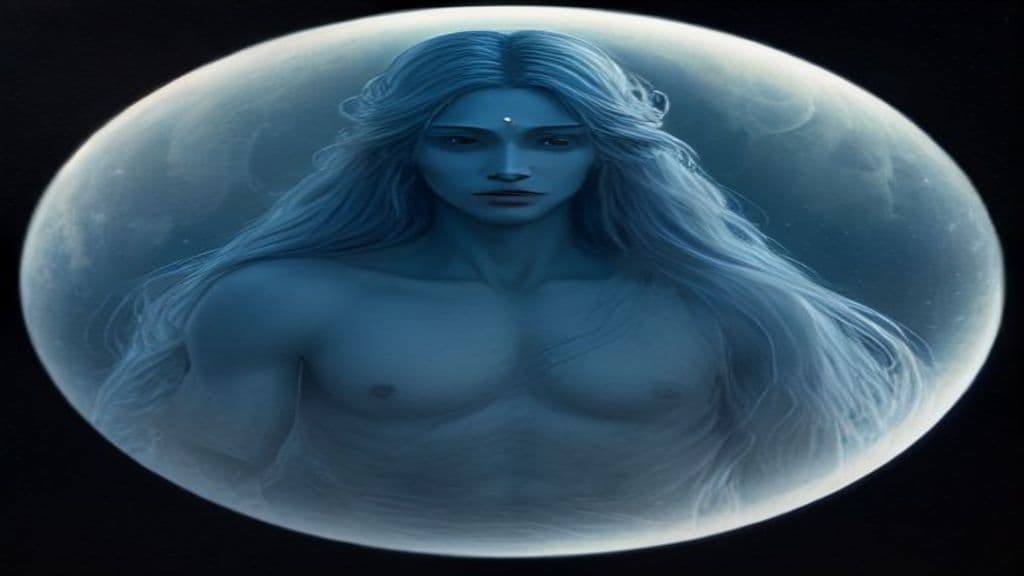
Within Mangaian myth of origin Avatea occupies a primordial position as the father of gods and men. Sources present him as an origin-stage, ancestral being who links human lineage and the pantheon: his role in the cosmogony is to stand as progenitor of both divine and human descendants and to embody aspects of the heavens through his person.
The primary descriptive motif recorded is cosmological: Avatea's eyes were thought to be the Sun and the Moon. He is characterized symbolically as a god of light and a lunar deity; beyond this ocular identification with the principal luminaries, the supplied sources do not provide further consistent physical description.
Source material attributes to Avatea the status of a lunar deity and god of light and names him explicitly the father of gods and men. These descriptions identify him with the Sun and Moon (through his eyes) and with generative parentage in the origin narrative. The sources do not record specific acts, feats, or intervening behaviors beyond these ascriptions.
Weaknesses
- otherNo weaknesses recorded in provided sources
Wards
- otherNo wards or protective practices recorded in provided sources
Auðumbla
Auðumbla is the primeval cow of Old Norse cosmogony attested in the Prose Edda: she nourishes the primordial jötunn Ymir with rivers of milk and by licking salty rime-stones reveals Búri, an ancestor of the gods. Her name and role link fertility, nourishment, and the emergence of key lineages in the Norse origin narrative.
Aušrinė
Aušrinė is the Lithuanian personification and deity of the morning star (planet Venus) in traditional Baltic cosmology. She is a feminine liminal figure associated with dawn, beauty, youth, love, health and renewal who appears each morning to prepare the way for Saulė (the Sun).
Avalokiteśvara
A central Mahāyāna and Vajrayāna bodhisattva who embodies great compassion (mahākaruṇā), Avalokiteśvara hears the cries of sentient beings and manifests in many forms to relieve suffering. Venerated across South, Central, and East Asia, the figure functions devotionally (mantra and sutra recitation) and iconographically in multiple gendered and regional guises.
Avandra
Avandra is a deity-name employed within modern Dungeons & Dragons tabletop gaming and related media. In the supplied sources Avandra appears in player and podcast discourse as a referent for randomness or luck and as a fictional proper name used in campaign material.
Avari (Middle-earth)
The Avari are identified in the provided sources as a subgroup of Elves in J. R. R. Tolkien's fictional legendarium. The supplied materials (Wikipedia and Wikidata entries) classify them as fictional Elven people but contain no extended narrative, descriptive, or ritual detail about them.
Avatar (avatāra)
In classical Hindu theology, an avatāra is a divine 'descent' — the event or fact of a superhuman being or deity making a material appearance in the temporal world to accomplish a purpose (commonly to restore dharma). The term (Sanskrit अवतार, avatāra) emphasizes crossing down from the unconditioned into conditioned existence and is central to Vaishnava theology of Vishnu's incarnations while also appearing in other Indian religious contexts.
Avengelyne
Avengelyne is a comic-book character depicted as an angelic warrior who fights demons and monsters on Earth. In the character biography she is described as formerly the most feared warrior in Heaven's Warhost who broke into Pandemonium to confront the Devil and was later banished from Heaven.
Avengers A.I.
A Marvel Comics series and in-universe Avengers team (July 2013–April 2014) centering on artificial intelligences — synthezoids, life-model decoys, Doombots, evolved viruses and cyborgs — and their political and ethical place after the Age of Ultron event.
Aventine Triad
A collective cultic grouping of three Roman deities—Ceres, Liber (Liber Pater) and Libera—venerated from the early Republic in a temple-temenos on or near the Aventine Hill. The label 'Aventine Triad' is modern scholarly shorthand for a plebeian, agricultural and fertility-focused set of cults that functioned as a communal religious and political focus for Rome's plebs.
Aventinus
Aventinus is a mytho-historical Roman figure presented in sources as a minor heroic/eponymous personage associated with the Aventine Hill and appearing in traditions surrounding Aeneas' Italian wars. He is variously described in brief accounts as a son of Hercules and the priestess Rhea (in Virgilian citation) and in alternate traditions as an early Latin/Alban king whose name explains the toponym Aventine.
Aventinus of Alba Longa
Aventinus of Alba Longa is a legendary king in the Alban/Latial regnal tradition, presented in ancient commentators and later summaries as an eponymous figure whose burial or shrine on the Aventine Hill provided an etiological explanation for that place-name. He appears in king-lists as a successor in the line purportedly descending from Aeneas and is variously dated in later regnal chronologies to the 9th–8th centuries BC.
Averis
Averis is documented in the provided sources as an English-language surname and proper name used by real people and organizations; there is no evidence in these materials that Averis refers to a supernatural or folkloric being.
Community Record
- [1]Avatea. "In Cook Islands mythology, Avatea was a lunar deity and the father of gods and men in Mangaian myth of origin. His eyes were thought to be the Sun and the Moon; he was also known as the god of light." — Wikipedia (Avatea)wiki