
Etymologically the Sanskrit avatāra (अवतार) derives from ava- 'down' + the root tṛ 'to cross over', literally meaning 'descent' or 'to make one's appearance'. As a doctrinal noun and the systematic listing of incarnations develop chiefly in post‑Vedic and Puranic literature (after the sixth century CE), the avatāra concept builds on earlier Upanishadic imagery of Saguna Brahman (the manifest aspect of the Absolute). Scholarly commentators characterize the avatāra as the divine crossing from eternity into the temporal realm — from unconditioned infinitude into finitude — a theological move used especially in Vaishnava texts to explain Vishnu's periodic interventions in the world.
Sources do not provide a single, fixed physical template for avatāras because the term designates the act of divine descent into material form rather than one uniform body. Avatars may appear in human form and are described as saguna (having form and attributes) embodiments of the divine; Puranic lists illustrate variety — for example, the Dashavatara tradition enumerates Vishnu's principal forms that include animal and human‑like manifestations (an example of variety attested in Puranic lore). The doctrine also recognizes partial manifestations (ansha‑avatāra) and fully embodied descents, so appearance ranges from fully human to hybrid or animal forms depending on the scriptural narrative.
Doctrinal sources frame avatāras as divine embodiments who descend to accomplish specific, morally and cosmically significant tasks, most typically the restoration or establishment of dharma. Avatāras are presented as embodiments of spiritual perfection in many traditions and are often described as possessing divine capacity to act within the temporal world; Puranic accounts give named lists of incarnations (e.g., Dashavatara, longer lists in the Bhagavata Purana) and acknowledge that incarnations may be numerous or even innumerable. While specific miraculous powers vary by individual avatāra narrative, the consistent behavioral motif is purposeful divine action in the world to correct disorder and uphold cosmic and moral order.
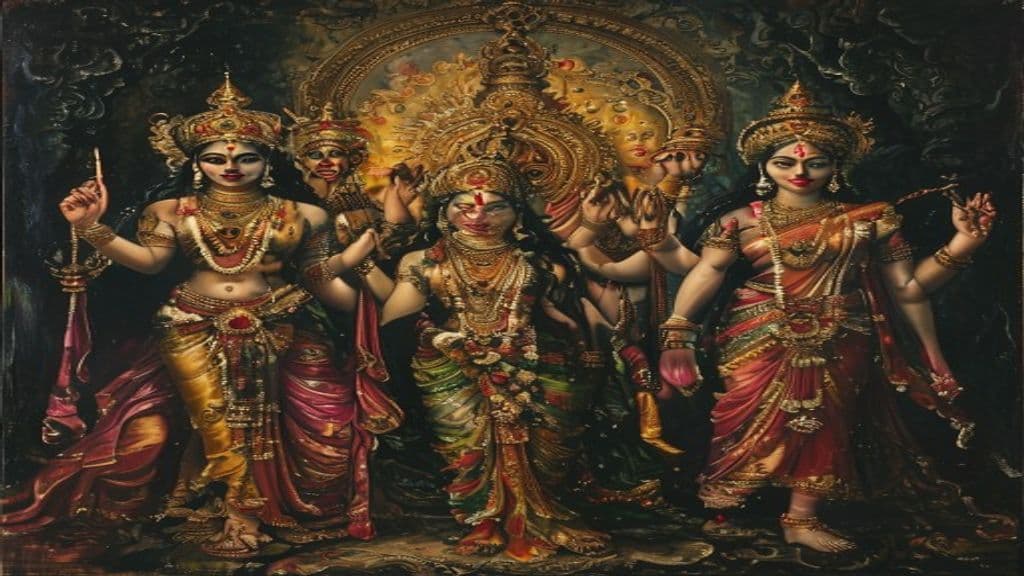
Achyuta
Achyuta (Sanskrit: अच्युत, acyuta) is primarily an epithet/theonym in Vaishnava Hindu tradition applied to Vishnu and Krishna, signifying the divine quality of being 'not fallen' — immutable, infallible, and imperishable. It functions as a devotional name in scripture, liturgy, and Pancharatra lists of divine emanations rather than as an autonomous folkloric spirit.
Adi (asura)
Adi is attested in modern reference works as the name of an Asura who 'appears in the Matsya Purāṇa.' Beyond this single-line citation in secondary sources, no descriptive material about the figure is provided in the supplied research notes.
Adi Shakti
Adi Shakti (also Adi Parashakti, Mahadevi, Adya Shakti) is the primordial feminine power in Hindu/Shakta theology, regarded as the ultimate reality (Para Brahman) and the source from which all goddesses and gods manifest. She is both an impersonal cosmic principle (Mulaprakriti) and a focus of devotional invocation in temples, mantras, and pilgrimage sites such as Shakti Peethas.
Adi Vinayaka
Adi Vinayaka (Ādi Vināyaka; also called Nara Mukha Vinayaka) is a named iconographic and devotional form of the Hindu god Ganesha portraying the deity with a human head, described in sources as the form before the episode of decapitation by Shiva. It is rarely worshipped and appears in a small number of South Indian shrines and in devotional/musical repertoires.
Aditi
Aditi is a major Vedic goddess in Hindu tradition who personifies the boundless, infinite cosmic principle and functions as the maternal matrix from which many celestial deities (the Ādityas and other groups) are born. In the Vedic hymns she is invoked as a protective liberator who guards petitioners, provides wealth and safety, and frees devotees from hindrances such as sin and sickness.
Agni
Agni is the Vedic personification of fire in Hindu tradition: a sacred, mediating principle that manifests as terrestrial fire, atmospheric lightning, and celestial sun, and that receives and conveys sacrificial offerings. Prominent in the Rigvedic corpus, Agni functions as sanctifier, witness of rites of passage, and a transformational inner principle in later Upanishadic literature.
Ahalya
Ahalya is a mytho-legendary woman of South Asian (primarily Hindu) narrative tradition, described as created by the god Brahma, married to the sage Gautama, seduced (or tricked) by Indra, cursed by her husband, and ultimately redeemed by Rama. Her tale is a locus for themes of creation, desire, curse/penance, and redemption and she is counted among the ritual-mnemonic panchakanya.
Aindri (Indrani / Shachi / Paulomi)
Aindri (commonly rendered in sources as Indrani, also called Shachi or Paulomi) is a Hindu goddess presented as the queen-consort of Indra. She is depicted in the available material as a courtly queen associated with beauty, pride and kindness who also appears in at least one account as an active martial participant in the devas' battles with asuras.
Akhilandeswari
Akhilandeswari (Akhilandeshwari) is a major South Indian manifestation of the Hindu Goddess Adi Parashakti/Parvati, venerated as the presiding goddess of the Jambukeswarar Temple in Thiruvanaikaval. In temple tradition she is portrayed as a penitent/student of Shiva and figures in local legends, ritual schedules, and festivals that emphasize both maternal and fierce aspects.
Akshayavata
In Hindu mythology, Akshayavata is a sacred banyan tree and/or lake that symbolizes eternal life. It is mentioned in both Hindu and Jain traditions and associated with the Puranas. (Note: - The power tier should be "Greater" or at least "Ancient", as it is associated with the Puranas, which are considered ancient texts. - No specific physical description is provided, but that doesn't m)
Alakshmi
Alakshmi is an inauspicious female supernatural figure in Hindu tradition, presented as the negation or shadow-counterpart of the prosperity-goddess Lakshmi. She personifies poverty, grief, jealousy and social discord and is managed in domestic ritual and festival practice.
Alamelu
Alamelu (also Alamelu Manga / Alarmel Mangai) is a South Indian devotional name for the goddess Padmavati, identified in sources as an avatar of Lakshmi and the consort of Venkateswara; the name is also used widely as a female personal name and in titles of cultural works in Tamil and Telugu contexts.
Community Record
- [1]Avatar. Wikipedia, 'Avatar' (overview of avatāra: meaning, etymology, association with Vishnu, Puranic development, and uses in Vaishnavism and Shaktism).wiki