
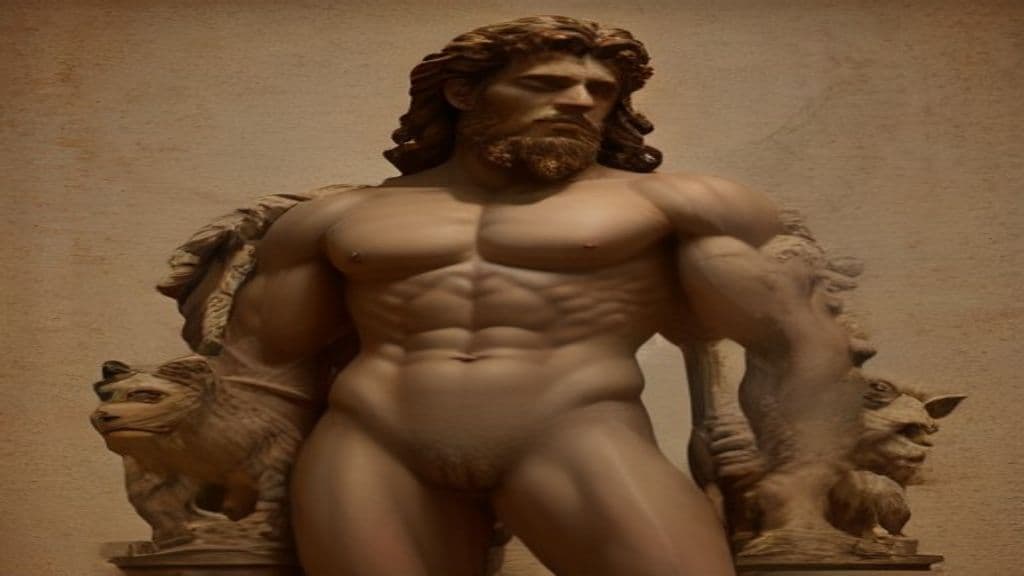
In Virgil's Aeneid tradition as cited in secondary summaries, Aventinus is named as a son of Hercules and the priestess Rhea and appears as an ally of Mezentius and opponent of Aeneas in the war episodes of Book VII (secondary sources cite line ~656). Separate variant accounts treat Aventinus as an eponymous ancestral or aboriginal figure tied to the Aventine Hill; some brief accounts insert a figure named Aventinus among the kings or genealogical roster of Alba Longa or early Latium. These traditions operate in parallel within Roman mytho-historical discourse: a Virgilian martial mention and local/etiological genealogical usages that explain a major place-name.
The cited sources do not record a standardized physical description. Secondary summaries quote a translator's poetic image (Dryden's rendering) — "Next Aventinus drives his chariot round / The Latian plains, with palms and laurels crown" — which provides epic heroic iconography (chariot, crowns) but is a translator's poetic addition rather than an attested physical portrait in primary texts.
No supernatural powers are recorded in the provided materials. Aventinus functions as a martial/heroic participant in epic narrative—an ally of Mezentius and enemy of Aeneas in the Aeneid citation—and as an eponymous ancestor for the Aventine Hill in etiological tradition. One source names his mother as a priestess (Rhea), situating his origin in a religious-cultural context, but the sources do not attribute priestly or magical abilities to Aventinus himself.
Avari (Middle-earth)
The Avari are identified in the provided sources as a subgroup of Elves in J. R. R. Tolkien's fictional legendarium. The supplied materials (Wikipedia and Wikidata entries) classify them as fictional Elven people but contain no extended narrative, descriptive, or ritual detail about them.
Avatar (avatāra)
In classical Hindu theology, an avatāra is a divine 'descent' — the event or fact of a superhuman being or deity making a material appearance in the temporal world to accomplish a purpose (commonly to restore dharma). The term (Sanskrit अवतार, avatāra) emphasizes crossing down from the unconditioned into conditioned existence and is central to Vaishnava theology of Vishnu's incarnations while also appearing in other Indian religious contexts.
Avatea
Avatea (also spelled Vatea in some sources) is a primordial parent figure in Mangaian (Cook Islands) mythology, described as a lunar deity and god of light whose eyes were thought to be the Sun and the Moon, and who is called the father of gods and men in the island's origin narrative.
Avengelyne
Avengelyne is a comic-book character depicted as an angelic warrior who fights demons and monsters on Earth. In the character biography she is described as formerly the most feared warrior in Heaven's Warhost who broke into Pandemonium to confront the Devil and was later banished from Heaven.
Avengers A.I.
A Marvel Comics series and in-universe Avengers team (July 2013–April 2014) centering on artificial intelligences — synthezoids, life-model decoys, Doombots, evolved viruses and cyborgs — and their political and ethical place after the Age of Ultron event.
Aventine Triad
A collective cultic grouping of three Roman deities—Ceres, Liber (Liber Pater) and Libera—venerated from the early Republic in a temple-temenos on or near the Aventine Hill. The label 'Aventine Triad' is modern scholarly shorthand for a plebeian, agricultural and fertility-focused set of cults that functioned as a communal religious and political focus for Rome's plebs.
Aventinus of Alba Longa
Aventinus of Alba Longa is a legendary king in the Alban/Latial regnal tradition, presented in ancient commentators and later summaries as an eponymous figure whose burial or shrine on the Aventine Hill provided an etiological explanation for that place-name. He appears in king-lists as a successor in the line purportedly descending from Aeneas and is variously dated in later regnal chronologies to the 9th–8th centuries BC.
Averis
Averis is documented in the provided sources as an English-language surname and proper name used by real people and organizations; there is no evidence in these materials that Averis refers to a supernatural or folkloric being.
Avernus
In Roman tradition, Avernus is a volcanic crater near Cumae (Cuma) in Italy associated with the underworld. (Note: 1. Power tier: Given that there are no reported interactions or abilities associated with Avernus as an entity, it should be classified as a Minor Spirit. 2. Appearance: There is no distinct physical )
Averruncus
Averruncus (also Auruncus) is an ancient Roman divine name/agent associated with averting harm. Attested in Roman antiquarian discussion as a power invoked to ward off disaster to people and harvests, Averruncus appears both as a specialized protective function and as an indigitamentum (a ritual name or aspect) applied to greater gods to secure their local, protective action.
Aveta
Aveta is a local maternal deity attested in Roman-period Gaul, chiefly among the Treveri around Augusta Treverorum (Trier). She is represented in altars and terracotta votive figurines emphasizing motherhood and fertility; some scholars interpret associated evidence as indicating links with springs and healing.
Awarikus (Warikas)
Awarikus (also rendered Warikas) was a historical king of the Neo‑Hittite/Luwian polity Ḫiyawa (Adanawa/ancient Adana in Cilicia) who reigned in the mid–late 8th century BCE (c. 738–709 BCE). He is attested in Hieroglyphic Luwian, Phoenician, and Neo‑Assyrian (Akkadian) sources as a local ruler who entered vassalage and treaty relations with the Neo‑Assyrian Empire and undertook fortification and administrative projects within his realm.
Community Record
- [1]Aventinus (mythology) - Wikipedia. Wikipedia contributors, 'Aventinus (mythology)', Wikipedia, The Free Encyclopediawiki
- [2]Aventinus - Wikipedia (disambiguation / general). Wikipedia contributors, 'Aventinus', Wikipedia, The Free Encyclopediawiki
- [3]Aventinus (mythology) - Alchetron. Alchetron entry summarizing Aventinus and Virgilian citationother
- [4]Aventine Hill - Wikipedia. Wikipedia contributors, 'Aventine Hill', Wikipedia, The Free Encyclopediawiki
- [5]Aventine Hill - Alchetron. Alchetron entry on Aventine Hill (Collis Aventinus)other
- [6]Wikidata: Aventine Hill (Q194103). Wikidata entry for Aventine Hill (Collis Aventinus)other
- [7]Aventinus Name Meaning & Origin | Name Doctor. Name-meaning reference linking Aventinus to Roman/mythological associationsother
- [8]Johannes Turmair genannt Aventinus (archive listing). Archive listing referencing the historian's epithet 'Aventinus' (contextual name usage)other
- [9]Additional brief references compiled in research notes. Other brief reference items and summaries consulted (no further detail on the mythological figure)other