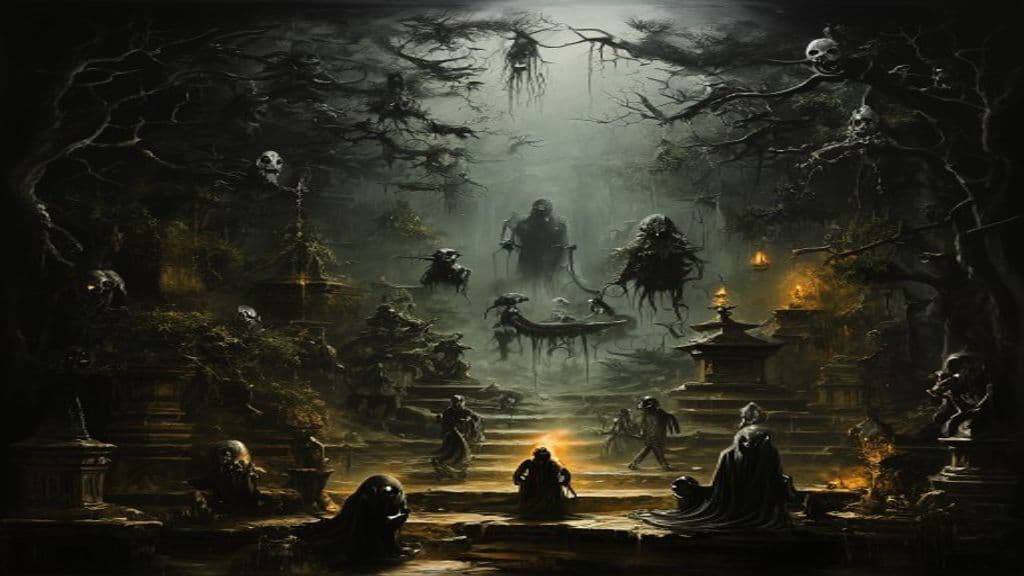
The concept of supernatural entities in Vietnamese mythology is rooted in the country's cultural heritage, influenced by historical contact with neighboring populations and Greater China.
Spirits are believed to inhabit a realm between heaven and earth and can take on various forms, such as animals or human-like apparitions. Ghosts are the restless souls of the dead who have not found peace.
Supernatural entities in Vietnamese mythology interact with humans in complex ways. Spirits can be benevolent, while demons cause harm and chaos. Ghosts are often restless and seek closure.
Cáo (Hồ ly tinh)
This entry documents the absence of information on the Vietnamese fox spirit "cáo" or "hồ ly tinh" in the supplied source set. The provided materials do not describe this supernatural figure; they instead refer to unrelated entries (the historical Cao Cao, the Chinese surname Cao, and unrelated archived web pages).
Krasue
A nocturnal Southeast Asian female spirit typically depicted as a floating, disembodied woman's head with internal organs trailing beneath the neck. The figure forms part of a regional cluster of related body-detaching female spirits and is presented in local traditions as a transformed or cursed human who leaves the living body by night to seek food.
Lạc bird
A mythical creature in Vietnamese culture, considered the national bird of Vietnam. (Note: * Remove "national bird of Vietnam" from summary, as it only mentions the Lạc bird is considered one. * Power tier should be set to Unknown or Unspecified, as no information is available on its abilit)
Nine-tailed Fox
A long-lived fox-spirit figure from Chinese myth (九尾狐) that appears across East Asia (e.g., kitsune, kumiho). Associated with age-linked transformation, shapeshifting into humans, ambiguous morality (trickster/seducer or occasionally honorable), and in some doctrinal sources a celestial/ritual role with talismans and jiao rites.
Thánh Tông di thảo
A collection of 19 tales in the truyền kỳ (traditional Vietnamese folktales) genre, written by Emperor Lê Thánh Tông during his reign in 15th-century Vietnam. (Note: 1. Power tier: Lowered to Greater, as there's no indication of Primordial-level powers. 2. Origin story: Simplified to focus on Lê Thánh Tông's promotion of Confucian learning and his writing in Liter)
Sunekosuri
A Japanese yōkai from Okayama Prefecture described in folkloric sources as a small roadside spirit that rubs against the lower legs (the space between the legs) of pedestrians at night, causing brief difficulty walking but no lasting harm. Regional variants describe similar leg-catching behavior that can cause falls.
Suparṇākhyāna (Hindu tradition)
The Suparṇākhyāna is an ancient Hindu epic poem that tells the story of Garuda, a divine bird. (Note: 1. Power tier should be Primordial (as it's an ancient Hindu epic poem, but it describes a divine bird, which is more akin to a cosmic being) 2. No appearance description provided in the source excerp)
Supay
Supay is an ambivalent subterranean spirit and regent of the Incan underworld (Uku Pacha / Hurin Pacha). In Quechua and Aymara tradition he embodies aspects of shadow, death, and chaos, functioning both as lord of the dead and as the archetype or progenitor of many dangerous local spirits; Spanish colonial sources later equated him with the Christian Devil.
Supernatural Beings in Slavic Tradition
In the Slavic tradition, supernatural beings are a part of the natural world, existing alongside humans and other entities. They have a unique relationship with nature, reflecting an interconnected worldview. (Note: 1. The power tier should be Primordial, as it is implied that these supernatural beings are a fundamental part of the natural world and not limited by human regional boundaries. 2. Remove "Their abili)
Superstition in Judaism
Credulous beliefs in the supernatural that deviate from God's will, often leading people away from monotheistic worship. (Note: 1. Power tier should be Ancient (as superstition is not on a cosmic level, but rather deity-level in its influence and condemnation within Judaism). 2. Sensory cues are missing. 3. Weaknesses could in)
Supārśvanātha
Supārśvanātha (also Suparshvanatha, Suparśva) is the seventh Tīrthaṅkara of the present age (avasarpini) in Jainism, venerated as a Jina who attained moksha and whose life figures in the canonical lineage of twenty-four Tīrthaṅkaras.
Surma
Surma is a Finnish mythic beast associated with the boundary of the dead (Tuonela) and a personification or synonym of death; in popular and literary summaries it is described as a terrible beast linked to being mauled or devoured and to the gates of the Underworld.
Community Record
- [1]Vietnamese Mythology. Wikipediawiki