
In the indigenous Inca/Quechua-Aymara framework Supay is presented as a primordial denizen and regent of Uku Pacha (Hurin Pacha), the inner/underworld. Some chronicler-derived accounts place him in creator genealogies — reports record that Viracocha created Supay and made him a brother to principal deities such as Inti, Illapa and Mama Quilla — and other traditions portray him as the ancestor or archetype of many abyssal or dangerous spirits that inhabit roads, mountains, waters, caves and jungle. Under Spanish Christian influence Supay and the plural 'supays' were reinterpreted by evangelists and chroniclers as evil angels or the Devil, a redescription that overlays but does not entirely replace indigenous ambivalent meanings.
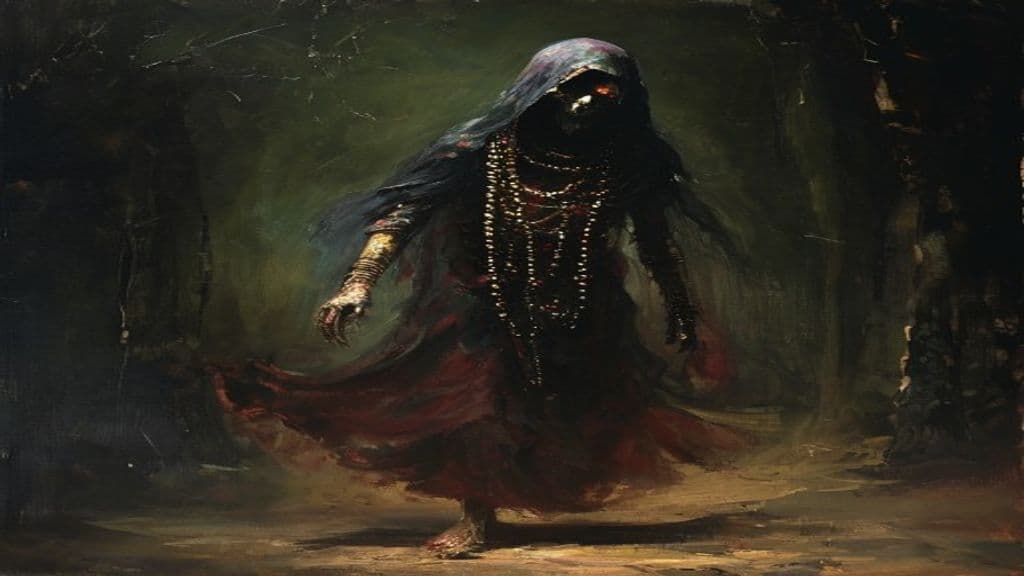
Indigenous conceptions emphasize Supay's multiform nature — capable of manifesting in many shapes — while post-contact descriptions and Christianized iconography often portray him in demonic terms: long horns, glassy or star-like eyes, a feline face with long fangs and prominent ears. Sources stress that fixed physical appearance is not absolute and that later demonizing images reflect colonial reinterpretation.
Supay rules the underworld and is described as able to move between Uku Pacha, the earth, and heaven at will. He is ambivalent: capable of protecting and guiding certain dead and favoring some living worshippers, while also spreading terror, misfortune, despair, corrupting minds, and turning the wise into madmen. He is presented as the source or progenitor of a race of abyssal spirits and as a trickster-like force able to deceive, mock human solemnity, and alter ideas or thoughts; chronicler sources further reframed groups of supays as fallen angels in Christian terms.
Weaknesses
None recorded.
Wards
- ritualofferings and altars
- otherrespectful treatment / propitiation
Bhoot (bhoota)
A bhoot (also bhoota, bhoot, bhut) is the culturally specific term across parts of the Indian subcontinent for a perturbed, restless spirit generally understood to be the ghost of a deceased person. Sources describe bhoots as arising when a person's death or post-death circumstances prevent them from moving on — for example violent death, unresolved affairs, or failures in funerary rites — and the term appears frequently in modern South Asian media and discussions.

Huacas (Mountain Deities)
In the Quechua mythology, Huacas are mountain deities revered as protectors of regional ethnicities and central figures in myths. (Note: 1. Power tier: Primordial seems too high given that Huacas are mountain deities and not cosmic entities. 2. Appearance: Should be added that there is no physical description provided for the Huacas, b)
Apu
In Andean (Inca-era and continuing) belief, an apu is the spirit of a mountain or a solitary rock, conceived as a localized, often anthropomorphic guardian presence associated with a particular peak or notable stone in Peru, Ecuador, and Bolivia.
Aymara people (tradition)
Aymara cultural and ritual traditions of the high Andean Altiplano centering on long-term place-based continuity (Lake Titicaca, Tiwanaku), ancestor mortuary practices (chullpas), oral and musical repertoires, and distinctive linguistic cosmologies that shape how the community apprehends time, space, and relations with powerful places. The supplied sources do not record a single named supernatural entity; this entry documents the ethnographic and cosmological context relevant to Aymara beliefs about ancestors, sacred places, and ritual practice.
Ciqui Ollco
Ciqui Ollco is not documented in the supplied sources as a supernatural being; the materials reference historical Inca royals (notably Topa Inca Yupanqui and Mama Ocllo Coya). Any supernatural characterization of 'Ciqui Ollco' is unsupported by the provided research notes.
Huanca
Huanca refers to two related Andean referents in the supplied sources: (A) an ethnonym for a Quechua people of the Junín region of central Peru, and (B) huanca/wanka, a sacred elongated vertical standing stone (monolith) in Andean ritual practice that is worshipped and given offerings and is believed to represent chiefs and ancestors.
Inca Human Sacrifice Entity
A supernatural force in Inca tradition believed to demand human sacrifice, particularly children, as a form of placation. (Note: 1. The summary should mention that the entity demands appeasement, not just placation. 2. Power tier should be Ancient (deity-level) instead of Primordial (cosmic). 3. The source material does not sup)
Mama Huaco
Mama Huaco is an ancestral female figure in Inca origin narratives who emerges from the cave of Paqariq Tampu/Pacaritambo among the founding siblings; sources describe her as strong and skillful and record an act in which she hurled two golden staffs northward, an action tied to territorial marking in the origin cycle.
Mama Qucha
Mama Qucha (Mama Cocha) is an Inca water mother deity, personifying the sea and other bodies of water. She functions as guardian of sailors and fishermen, provider of fish and calm seas, and is counted among the principal female elemental mothers in Inca cosmology.
Manco Cápac
Manco Cápac is the foundational ancestral figure and culture‑founder of the Inca (Quechua) tradition: remembered as the first ruler (Sapa Inca) and progenitor who, according to origin legends, established Cusco after emerging with Mama Ocllo from Lake Titicaca. Sources treat him variably as mythic ancestor, legitimizing founder, and a possibly historical early ruler.
Pacha Mama
Pacha Mama is an Andean/Inca mother-deity representing 'space-time' and a universal, life-sustaining principle tied to earth, fertility, and the totality of the cosmos. Revered across the Andes, she functions as a foundational generative presence from which major cosmological principles are said to trace their origin.
Pishtaco
An Andean folkloric slayer-figure (also called ñaqaq or kharisiri) associated with attacks on indigenous people to extract human fat for commercial, ritual, or practical ends. The figure straddles human and supernatural traits, frequently imagined as outsider professionals (soldiers, hacendados, doctors) and is used as an explanatory focus for wasting illnesses and violent deaths in Peru and Bolivia.
Sinchi Roca
Sinchi Roca (Sinchi Ruq'a) is presented in colonial-era and modern summaries as the second Sapa Inca of the Kingdom of Cuzco (mid-13th century). In the sources he appears as an early, possibly legendary, human ruler associated in tradition with administrative reforms, markers of nobility, and the early investiture trappings of imperial power.
Ukhu Pacha
Ukhu Pacha is the under- or inner-world layer in Andean (Quechua/Inca) tripartite cosmology. As a pacha it functions as a position in an integrated space–time ordering rather than as a single personal spirit or deity.
Community Record
- [1]Supay — Wikipedia. Wikipedia contributors, 'Supay,' Wikipedia, The Free Encyclopediawiki
- [2]Supay — Wikidata Q1659436. Wikidata, 'Supay' (Q1659436)wiki
- [3]Archive mention: 02 DIC 16 ZULU NATION. Archive.org item where the name appears in passingother
- [4]Archive mention: La Realidad De Palestina En Primera Perspectiva. Archive.org item with incidental occurrence of the nameother
- [5]Archive mention: CIA Reading Room document. Archive.org CIA Reading Room item with incidental textual occurrenceother