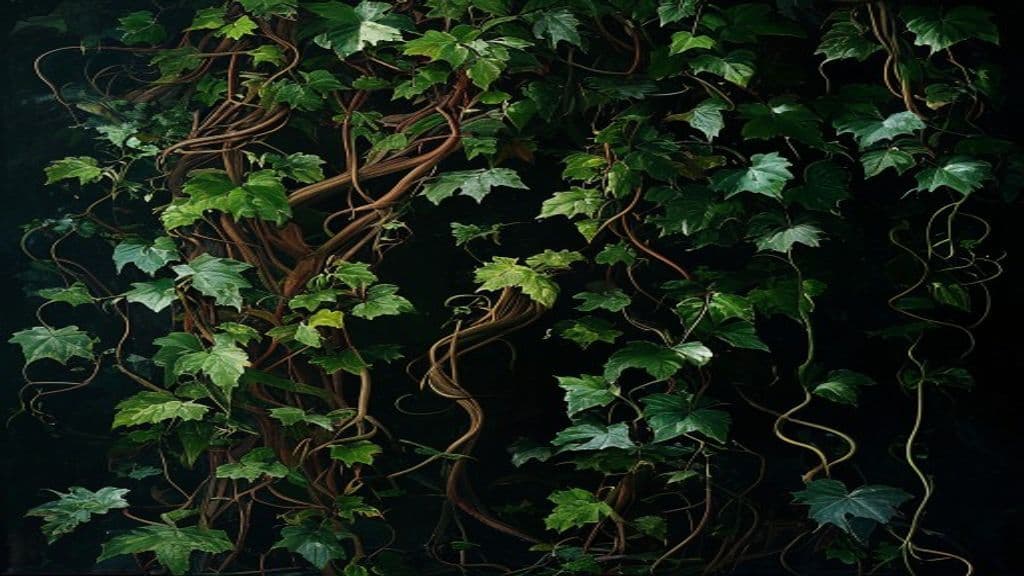
Not a mythological origin: the vine growth form evolved multiple times across diverse plant lineages as an ecological strategy permitting plants to reach light while minimizing investment in supportive tissue. This functional habit is a key innovation in many habitats, particularly in the tropics where competition for canopy light favors climbing strategies; different lineages developed twining stems, tendrils, adhesive pads, adventitious rooting, or hooked structures independently to exploit supports such as other plants, rocks, or man-made structures.
As a category, vines vary widely rather than sharing a single fixed form. Forms include long trailing or climbing stems that may be herbaceous or woody (lianas); twining stems (bines); plants that climb by tendrils (specialized shoots, leaves, or inflorescences); species with adhesive pads (e.g., Parthenocissus); climbers that use adventitious clinging roots (ivy); and those that use thorns or hooked branches (climbing rose). Some ferns (e.g., Lygodium) produce fronds that unroll and act as climbing organs. Twining direction and specific structural details differ by species.
Botanical behaviors attributed to vines in the sources include rapid lateral and vertical extension using other objects for support, the capacity to colonize large areas quickly (examples cited include invasive species such as kudzu and Japanese honeysuckle), and development of multiple mechanical climbing strategies (twining helixes, tendrils, adhesive pads, rooting). Some vines show skototropism — growth away from light to locate tree trunks — and many species alter growth form depending on support availability (remaining shrub-like without support but becoming climbing when support is present). Twining rotation direction is species-specific and autonomous.
Weaknesses
- conditionabsence of support (limits climbing potential; many vines remain low or shrub-like without structures to climb)
- otherhorticultural control (pruning, containment, removal reduces spread)
Wards
- othertraining and containment (trellis, ties, pruning to direct or limit growth)
- othermechanical removal and management to control invasive species
Vetala / Vetal (unsupported in supplied source)
The supplied source (a general article on ghosts in Bengali culture) does not mention or describe Vetala/Vetal. No information about a Vetala's nature, appearance, powers, rituals, or Maharashtrian variants is present in the provided material, so a Vetala entry cannot be reconstructed from that source alone.
Vichama
In Inca mythic accounts Vichama is described as a god of death who, according to available summaries, destroyed an earlier human race created by Pacha Kamaq and then caused a new human race to be born from three eggs. A short alternative attestation describes Vichama as a god who "personifies the day."
Vidyārāja (Myō-ō / Wisdom King)
A class of wrathful, protective figures in East Asian Esoteric (Vajrayāna/mikkyō) Buddhism identified by the Sanskrit term Vidyārāja ("knowledge/spell-king") and commonly rendered in Japanese as Myō-ō. They function as fierce guardians, ritual enforcers of esoteric doctrine, and mandalic emanations tied to buddhas and tantric functions.
Viking (Norse mythology)
A male figure in Norse mythology, son of Vífil and Eimyrja, mentioned in Thorsteins saga Víkingssonar and Frithiof's Saga. (Note: - Power tier: Lower to Lesser (given the lack of information on abilities and behaviors beyond familial relationships) - Weaknesses, Wards: Should be listed as "Unknown" since no specific information )
Vimalanātha
Vimalanātha (also Vimalnatha) is the thirteenth Tīrthaṅkara of the present age (Avasarpini) in Jain tradition. He is described in the supplied sources as having attained liberation (Siddha) after destroying all karma; he was born to King Kṛtavarman and Queen Śyāmā at Kampilya/Kaṃpilapura.
Vinayaki
Vinayaki (Vināyakī) is an elephant-headed female divine figure found across South Asian traditions. She appears variably as the feminine shakti or counterpart of Ganesha, as one of the Matrikas or as a yogini in Tantric lists, and in some Buddhist and Jain contexts as an autonomous goddess; surviving texts and images present multiple, sometimes conflicting identities.
Vināyaka / Ganapati (Ganesha in Buddhism)
A Buddhist tantric deity known variously as Vināyaka, Vighnāntaka, Gaṇapati, tshogs bdag (Tibetan) and Kangiten/Shōten (Japanese). Integrated into Mahāyāna and Esoteric Buddhist cosmologies, he functions as a remover and subjugator of obstacles, protector, and occasional wealth/pleasure‑granting figure and is often treated as an emanation of bodhisattvas such as Avalokiteśvara or of Vairocana.
Virabhadra
Virabhadra is a fierce martial emanation of the Hindu god Śiva, created in wrath to punish those responsible for the self-immolation of Śatī at the Dakṣa yajña. Presented in Purāṇic narratives as a powerful warrior commanding heterogeneous troops, he carries out destructive missions but is ultimately subordinate to Śiva and can be pacified.
Viracocha
Viracocha (Quechua Wiraqucha, Huiracocha) is the principal creator and civilizing deity in pre-Inca and Inca mythology, portrayed as the originator of the universe, time, and human society who emerges from watery places to bring light, order, and knowledge.
Virankannos
Virankannos is a figure in Finnish and Karelian runic-song tradition associated with fertility and the wellbeing of crops and is treated in sources as a sky-associated, culture-level divine actor. Attested in Mikael Agricola's 1551 list as a protector of oats and in Kalevala runes (20 and 50), he appears in saga-level scenes such as the attempt to slay the great ox and the baptism/naming of Marjatta's child.
Virgin Mary (Marian devotion and apparitional tradition)
A central historical and devotional figure — Mary of Nazareth — whose veneration across Christian communions and other religions has produced a widespread corpus of devotional practices, shrine cults, and reported apparitional phenomena. The sources treat her primarily as the first‑century Jewish mother of Jesus and as an object of liturgical and popular devotion rather than as a hostile supernatural monster.
Vis and Rāmin
Vis and Rāmin are the protagonists of a classical Persian romantic tale composed by Fakhruddin As'ad Gurgani in the 11th century. The narrative reflects the traditions and customs of ancient Persia. (Note: 1. Power tier should be "Minor Spirit" given that no supernatural abilities or behaviors are described. 2. Origin story is incorrect; source material states Parthian origin and not likely to have Part)
Community Record
- [1]Vine — Wikipedia. Wikipedia contributors. "Vine." Wikipedia, The Free Encyclopedia.wiki
- [2]Vine — Wikidata entry (short-form-video-hosting service). Wikidata: Q3700238 (Vine)other
- [3]Episode 7: Intermittent Fasting with Tarryn Vine (archive entry). Archive.org item: Episode 7: Intermittent Fasting with Tarryn Vineother
- [4]The Vine, Pt. 3 - Remain In Word, Prayer, & Love (archive entry). Archive.org item: The Vine, Pt. 3 - Remain In Word, Prayer, & Loveother
- [5]Tue. 11/01 - Twilight Of The Blue-Checks? (archive entry). Archive.org item: Tue. 11/01 - Twilight Of The Blue-Checks?other