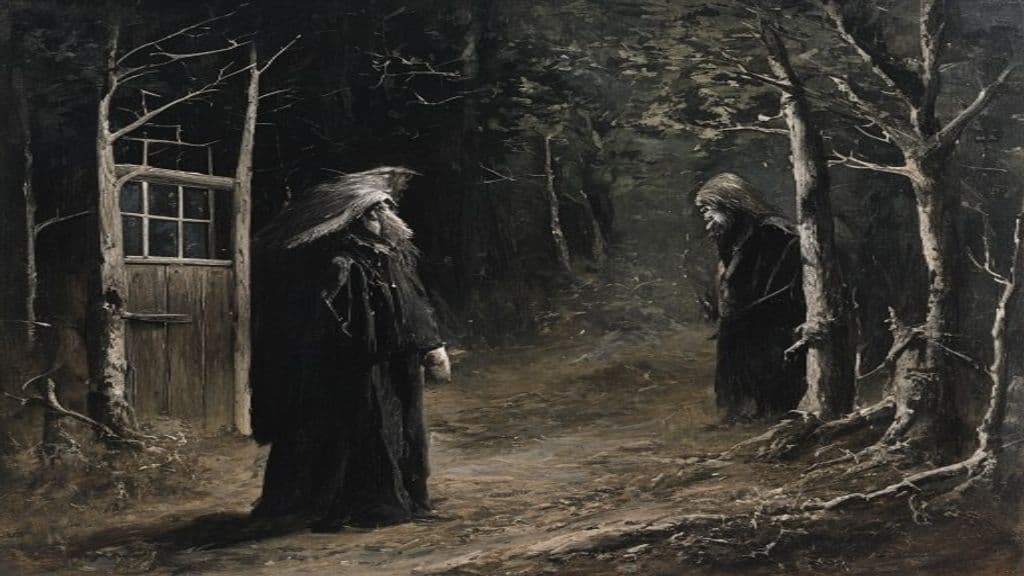
The vǫrðr is presented in Scandinavian popular belief as a non-theological, personal guardian spirit tied to an individual's soul (Old Norse: hugr) and believed to follow that person from birth to death. The concept is rooted in folk cosmology and appears alongside other personal fate-spirits such as the fylgja and hamingja; under later Christian influence some people reinterpreted the vǫrðr in moralized or Christianized terms (for example, compared to conscience or a guardian angel).
Sources report variable manifestations: the vǫrðr can reveal itself as a small light or as the shape of the person it accompanies (cross-referenced with the Norse hamr/shape concept). It is therefore sometimes experienced as an apparition or a perceptible luminous sign rather than as a fixed corporeal form.
The vǫrðr accompanies an individual's hugr throughout life and may be perceived by those with keen senses before the person it guards arrives. Perception of a vǫrðr can produce somatic sensations (itching of the hand or nose) and feelings of foreboding. After death, the warden of a dead person could become a revenant haunting particular spots or people; such revenant wardens are described as distinct from more conscious undead like draugar. Christian-era reinterpretations reframed the vǫrðr's role in moral and doctrinal language without altering the older folk descriptions in the cited sources.
Weaknesses
None recorded.
Wards
- ritualRespect for warden trees / offerings to yard-wights (vättar)
- conditionSocial reverence and taboo (do not break leaves or twigs from warden trees)

Fylgja
A supernatural accompanying spirit in Old Norse tradition tied to a person's or family's fate and fortune. The fylgja appears most often as a female human figure or as an animal, commonly in dreams, and functions as an omen-bearing presence connected to destiny rather than an agent that alters fate.
Fylgja
A supernatural accompanying spirit in Old Norse tradition tied to a person's or family's fate and fortune. The fylgja appears most often as a female human figure or as an animal, commonly in dreams, and functions as an omen-bearing presence connected to destiny rather than an agent that alters fate.

Draugr
In Nordic folklore the draugr (plural draugar; anglicized draug) is an archaic term for a malevolent revenant — a dead person who returns and remains active in the world of the living. Accounts emphasize variability: traits, behaviours, and descriptions change between stories and across regions, especially in early medieval Icelandic sagas and surviving Norwegian folklore.
Väinämöinen
Väinämöinen is the central heroic and sacred figure of Finnish oral tradition and the national epic Kalevala, depicted as an ancient, bearded wise man, master of song and rune‑speech, a tietäjä (seer/shaman) and culture‑hero whose authority expresses itself in magical singing, craft and foundational cosmogenic acts.
Väinämöinen's Blood
A manifestation of Väinämöinen's power and wound, bringing about a catastrophic flood in Finnish mythology. (Note: * Power tier: Reduce to Primordial is unclear based on source material; it implies catastrophic flood, which may be more consistent with Ancient or Greater. * Abilities: Specify that flood is not a co)
Väki (Finnish Tradition)
An impersonal, supernatural power in Finnish mythology associated with the natural world. (Note: - The source material does not explicitly state the origin story of Väki. - No physical description of Väki is provided in the source, but it's mentioned that its presence is felt through impact on na)
Vættir (Germanic)
A vague term in Germanic tradition encompassing various beings or things that exist. (Note: 1. Power tier: Should be "Primordial" as the source material does not provide any information about their abilities or interactions with humans, implying a vague and potentially cosmic scope. 2. Appea)
Völsung Cycle
The Völsung Cycle is a series of Norse legends and stories that form part of the larger mythological tapestry, focusing on the heroic clan Völsungs. It has had significant influence on Western literature and reflects the worldview of medieval Icelandic culture. (Note: 1. Remove "Primordial" power tier as the Völsung Cycle is not a supernatural entity but a collection of Norse legends. 2. Clarify the origin story to specify that it was recorded in medieval Iceland, )
Völva (Norse seer)
Female seer or prophetess in Norse mythology, possessing mystical knowledge and power to see into the future. (Note: 1. The power tier should be Primordial, as Ancient typically refers to deities and Völva are mortal beings with mystical abilities. 2. Sensory cues should include dreams, which is a common way for Völ)
Vāhana
In Hindu iconography and theology, a vāhana (Sanskrit वाहन, vāhana; variant vāhanam) is the animal or mythical being that serves as a deity's vehicle or mount. Vāhanas function as emblematic companions—sometimes acting independently in myth yet usually treated as an extension or accoutrement of their rider—and appear widely in temple sculpture, festival processions, and narrative lore.
Vāmadeva
Vāmadeva is a Vedic rṣi (seer) attested as the author of Mandala 4 of the Rigveda and later as a teacher, priest, and moral-ritual authority in Upanishadic, epic, and Purāṇic narratives. Texts record him composing hymns, advising kings, issuing curses and boons, and acting within hermitage and court settings.
Wa-nyūdō
Wa-nyūdō is a named yōkai in Japanese folklore attested in illustrated compendia and modern field guides. It appears in Toriyama Sekien's Konjaku Gazu Zoku Hyakki and is described in secondary sources with English renderings such as "Firewheel" and "Soultaker." Earliest reports are said to date to the Heian period.
Wade's Causeway
An archaeological site of uncertain origin and purpose located in the North York Moors national park, England. (Note: 1. The power tier should be set as "Minor Spirit" or even lower since it's an archaeological site with unknown origin and purpose. 2. The summary needs correction: it currently says the site is of "un)
Wadj-wer
Wadj-wer is an ancient Egyptian deity-personification of large northern waters called the "great green," associated with fertility and the productive richness of the Nile Delta. Modern descriptions often equate him with the Mediterranean Sea, while primary evidence and some scholarly readings emphasize lagoons and lakes of the northernmost Delta; his earliest attestation is on a 5th Dynasty mortuary temple of Sahure.
Wadjet
Wadjet is an ancient Egyptian local goddess of Dep/Buto (Per-Wadjet) in the Nile Delta who became the patron and protector of Lower Egypt and, alongside Nekhbet, a joint protector of united Egypt. She appears as a cobra (uraeus), the 'Eye' (Wedjat-eye), and as a nursing maternal figure for kings; she served protective, royal, oracular, and cultic functions in Pharaonic religion.
Community Record
- [1]Vörðr. Wikipedia: 'Vörðr' article — descriptions of vǫrðr as warden spirit, appearance, somatic effects, revenant form, and warden trees.wiki
- [2]Wikidata: Vörðr. Wikidata entry for Vörðr (guardian spirit of Norse religion).wiki