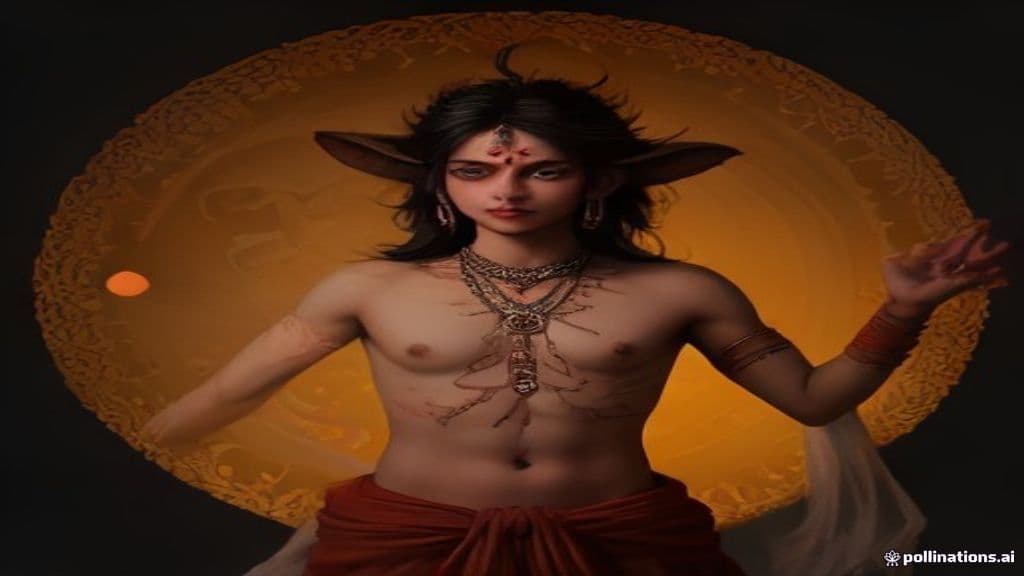
In the devotional-narrative corpus (notably the Srimad Bhāgavatam and its retellings), Vyomasura is named as a son of Mayasura and appears during Krishna's childhood pastimes. He joins the cowherd boys during play, disguised as one of them, and uses that cover to abduct those playing the roles of goats and other creatures, carrying them to mountain caves. The episode functions within the Bhagavata devotional frame as one of several childhood confrontations between Krishna and hostile asuras. (Sources: Srimad Bhāgavatam Canto 10; Vedabase commentary; multiple retellings.)
Narrative accounts describe Vyomasura taking the form of a youth in order to impersonate a cowherd boy and join their game; sources also call him an asura and 'magically-gifted.' Specific, consistent physical details of a true, unmasked form are not given in the supplied sources beyond his identification as the son of Mayasura and his capacity for disguise. Some modern retellings render him with epithets such as 'the demon in the sky' (reflecting an interpretation of the name vyoma), but primary narrative excerpts do not provide a formal etymological gloss. (Sources: Srimad Bhāgavatam episode summaries; ISKCON/Hare Kṛṣṇa retellings; Wikipedia summary.)
Sources portray Vyomasura as magically skilled in disguise (able to assume the appearance of a cowherd youth) and capable of abducting and enclosing many boys by carrying them to mountain caves and shutting them within; retellings speak of him 'sealing the mouths of the caves' or 'shutting the boys within.' He is not invulnerable to divine force: Krishna overtakes, captures, and kills him and breaks the cave seals to free the boys. Vyomasura's parentage (son of Mayasura) situates him in a lineage associated with magical craftsmanship and shapeshifting in other narratives. (Sources: Srimad Bhāgavatam Canto 10 / Vedabase; ISKCON/retellings; Wikipedia.)
Weaknesses
- conditionvulnerable to divine force (Krishna's direct physical intervention)
Wards
- otherdivine protection (narrative model of immediate intervention by Krishna)

Vohu Manah
Vohu Manah is the Avestan concept of the 'Good Mind' personified in later Zoroastrian tradition as one of the Amesha Spentas, divine emanations of Ahura Mazda representing the benevolent, properly directed mental disposition that enables right action and upholds creation.
Volga Svyatoslavich
Epic hero from medieval Russian folklore, a legendary warrior and bogatyr in Slavic mythology. (Note: * Power tier: Lower to "Greater" (deity-level powers are associated with Ancient entities, and bogatyrs are typically considered powerful regional beings) * Appearance: Remove statement about lack of )
Vrykolakas
A harmful undead revenant in Greek folklore that returns from the grave to harm the living. Described as a reanimated corpse associated with poltergeist activity, epidemics, nocturnal roaming, and cannibalistic eating of flesh (especially livers); practices to prevent or destroy it are tied to burial rites and community action.
Vual
Vual is a named spirit attested in modern listings of the goetic grimoire tradition (the Ars Goetia/Lesser Key of Solomon corpus). The supplied materials record Vual only as an entry in such catalogues and do not provide descriptive, ritual, or etymological detail.
Vulcan
Vulcan is the Roman deity of fire, volcanoes, metalworking, and the forge, embodying both the constructive and destructive dimensions of fire — as a patron of craftsmen and as the force behind volcanic and conflagratory disaster. Sources characterize him succinctly as the god of both beneficial and hindering fire (forge and volcano).
Vyaghrapada
A revered sage and figure of spiritual authority in Hindu tradition, known for his great wisdom and guidance. (Note: * Summary: Add more context, e.g., "A revered sage and figure of spiritual authority in Hindu tradition, known for his great wisdom and guidance in ancient Indian texts." * Power tier: Downgrade to Gr)
Väinämöinen
Väinämöinen is the central heroic and sacred figure of Finnish oral tradition and the national epic Kalevala, depicted as an ancient, bearded wise man, master of song and rune‑speech, a tietäjä (seer/shaman) and culture‑hero whose authority expresses itself in magical singing, craft and foundational cosmogenic acts.
Väinämöinen's Blood
A manifestation of Väinämöinen's power and wound, bringing about a catastrophic flood in Finnish mythology. (Note: * Power tier: Reduce to Primordial is unclear based on source material; it implies catastrophic flood, which may be more consistent with Ancient or Greater. * Abilities: Specify that flood is not a co)
Väki (Finnish Tradition)
An impersonal, supernatural power in Finnish mythology associated with the natural world. (Note: - The source material does not explicitly state the origin story of Väki. - No physical description of Väki is provided in the source, but it's mentioned that its presence is felt through impact on na)
Vættir (Germanic)
A vague term in Germanic tradition encompassing various beings or things that exist. (Note: 1. Power tier: Should be "Primordial" as the source material does not provide any information about their abilities or interactions with humans, implying a vague and potentially cosmic scope. 2. Appea)
Völsung Cycle
The Völsung Cycle is a series of Norse legends and stories that form part of the larger mythological tapestry, focusing on the heroic clan Völsungs. It has had significant influence on Western literature and reflects the worldview of medieval Icelandic culture. (Note: 1. Remove "Primordial" power tier as the Völsung Cycle is not a supernatural entity but a collection of Norse legends. 2. Clarify the origin story to specify that it was recorded in medieval Iceland, )
Völva (Norse seer)
Female seer or prophetess in Norse mythology, possessing mystical knowledge and power to see into the future. (Note: 1. The power tier should be Primordial, as Ancient typically refers to deities and Völva are mortal beings with mystical abilities. 2. Sensory cues should include dreams, which is a common way for Völ)
Community Record
- [1]Vyomasura — Wikipedia. Wikipedia, 'Vyomasura' article summary (accessed via provided research notes).wiki
- [2]Srimad Bhāgavatam (Bhagavata Purana), Canto 10, Chapter 31 / Chapter 37 summaries and Vedabase commentary. Srimad Bhāgavatam Canto 10 (chapter passages and commentary) as cited in Vedabase; narrative account of Vyomasura's abduction and Krishna's slaying.literary
- [3]Krsna's Vrindaban Pastimes - Vyomasura Demon (Hare Kṛṣṇa site). Hare Kṛṣṇa religion/ISKCON summary retelling of Vyomasura episode.folk
- [4]Demons Killed by Krishna - Part 3 (Official Blog of ISKCON Bangalore). ISKCON Bangalore blog summarizing Krishna's slaying of Vyomasura and liberation of the boys.folk
- [5]Vyomasura — Vedantu children's story summary. Modern retelling summarizing the episode of Krishna defeating Vyomasura and freeing the boys.folk