
Sources present Mayasura as a scion of non‑Vedic supernatural lineages associated with Danu and Kashyapa (i.e., the Danavas) while other texts classify him among Daityas or more generally as an asura/rākṣasa figure; this variation is attested in textual summaries and discussion (see Wikipedia and StackExchange summary of classification). He is repeatedly named Maya/Mayāsura or Maya Danava, the compound indicating both his identity as a maker/craftsman (maya: artifice/illusion) and his affiliation with asura/Danava lineages (Wikipedia; Wikidata; StackExchange discussion).
The supplied sources do not offer a consistent physical description (height, complexion, dress). Narrative markers identify him as a king and master‑craftsman: he appears in courtly or architectual contexts (builder of palaces and cities), as husband (e.g., to the apsara Hema in the Uttara Kanda account) and father (sons Mayavi and Dundubhi; daughter Mandodari). The absence of an explicit anthropological portrait is noted in the available summaries (Wikipedia).
Mayasura is credited primarily with extraordinary architectural and technical skill: constructing the Mayasabha (Hall of Illusions) for the Pandavas (Mahabharata episode) and building the Tripura three cities for the sons of Tarakasura (Tripura mythology) — the latter feat is consequential enough that Shiva (Tripurantaka) destroys those cities in the mythic cycle. The Surya Siddhanta describes Mayāsura as a Daitya who received divine astronomical knowledge from the Sun God near the end of Satya Yuga, indicating transmitted scientific/astronomical lore. In narrative behavior he can shift political alignment: in the Mahabharata he surrenders to the victorious Pandavas after the burning of Khandava forest and then serves them by building a grand palace; elsewhere his constructions become objects of divine contest and destruction. He is also linked by kinship and alliance to other supernatural actors — friend of the nāga Takshaka; father‑in‑law of Ravana via daughter Mandodari — embedding him in wider mythic politics (Wikipedia; Surya Siddhanta summary; Ramayana Uttara Kanda summary).
Weaknesses
- conditionsubject to divine retribution (Tripura destroyed by Shiva / Tripurantaka)
Wards
None recorded.
Naga
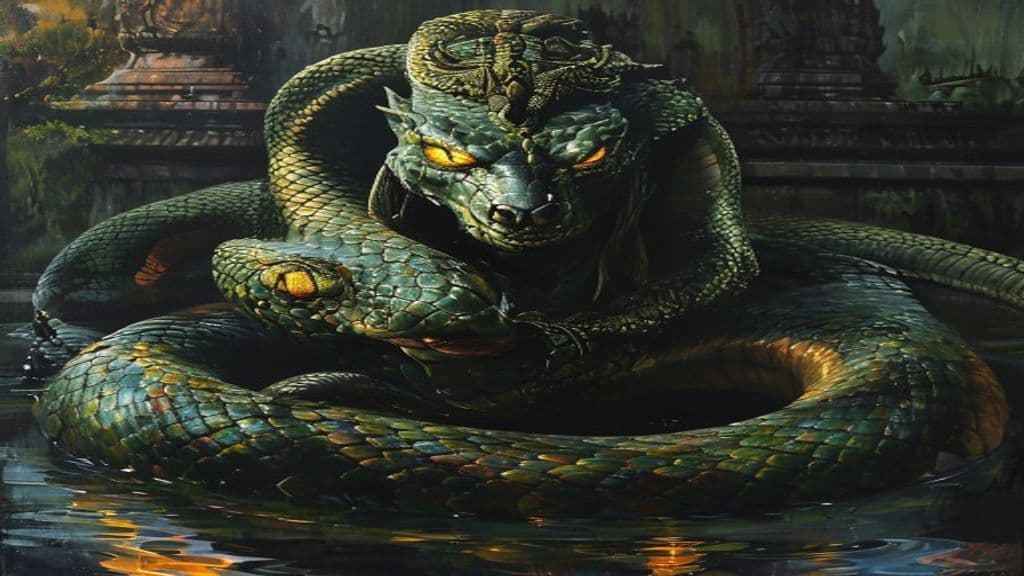
Divine serpent beings of Hindu, Buddhist, and Jain cosmology — powerful guardians of water, earth, and underground treasures. Revered as deities in South and Southeast Asia.

Rakshasa (Himalayan variants)
A Himalayan reception of the pan-Indian rakshasa motif: hostile or disruptive non‑human beings known from Sanskrit epic and Puranic literature, here noted where Himalayan sources and discussions intersect with the broader epic tradition. The supplied sources do not document distinct, well‑attested Himalayan folklore variants; the entry therefore presents primarily the epic/legendary profile as transmitted into Himalayan contexts in general references.
Mavka (Nyavka)
A female forest spirit in Ukrainian folklore, the mavka (also nyavka) represents the soul of a girl who died prematurely or unnaturally. Mavkas are ambivalent: various accounts portray them as alluring, dangerous seductresses who may lure men to death, while other local beliefs credit them with tending cattle and protecting flocks.
Mavroneri
A metaphorical entity associated with the River Styx, serving as a boundary between the mortal world and the underworld. (Note: 1. Power tier is incorrect; Primordial is typically associated with cosmic entities, but Mavroneri's abilities are related to a specific geographical location (the River Styx) rather than cosmological)
Mavuika
Mavuika is a fictional, in‑world divine figure in the video game Genshin Impact who functions as Natlan's Pyro Archon. Presented as a formerly mortal warrior who gained the Archon office, she drew on the power of the Ruler of Death to sacrifice herself to postpone a war for 500 years and is later resurrected in the game's current timeline.
Maximón (San Simón)
Maximón is a syncretic Maya folk deity and folk saint venerated in the Guatemalan Highlands (notably Santiago Atitlán and Zunil). He is an ambivalent, worldly figure—commonly represented by household or community effigies—that receives offerings (cigars, liquor, flowers, bread) and serves as a local mediator for petitions and favors. His identity and stories vary by town and combine pre-Hispanic Maya elements with Christian saint imagery, sometimes including associations with Judas Iscariot or Saint Simon.
Maya Hero Twins (Hunahpu and Xbalanque)
Central culture-hero brothers of the Kʼicheʼ Popol Vuh and Classic Maya iconography, Hunahpu and Xbalanque undergo trials, avenge earlier wrongs, defeat the lords of Xibalba by trickery and a ballgame, transform other beings, and are finally transformed into celestial bodies associated with sun and moon. They mediate between human society, the maize cosmos, and the underworld and appear in both colonial textual tradition and Classic Maya art.
Mayari
Mayari is a Kapampangan moon goddess in Philippine mythology who, after a quarrel with her brother Apolaki, shares rulership of the world by governing the night; she is associated with the moon, beauty, war, revolution, strength, weaponry, and the hunt, and is said to have lost sight in one eye during the fight.
Maymun
Maymun (Maymun Abanuch / Maymun al‑Shahabi / Abu Nuh) is presented in Islamic folkloric and occult sources as the last of the seven kings of the jinn, a powerful wind‑jinn king associated in those traditions with Saturday, the planet Saturn, the color black, and gold. He appears both as a fearsome, martial, abducing jinn in manuscript imaginaire and as a venerated saintly figure in North African local cults (Sidi Mimun / Lalla Mimuna).
Mayūrabhaṭṭa
Mayūrabhaṭṭa (Sanskrit: मयूरभट्ट) is a 7th‑century Sanskrit poet and Hindu scholar traditionally credited with composing the Sūryaśataka, a one‑hundred‑verse hymn to the Sun (Sūrya). In the narrative preserved in later tradition he performed a vowlike penance at the Sūrya temple in Deo, tied one hundred threads to a peepal tree and composed one verse per day; according to the account, this devotional composition is said to have cured his leprosy and liberated a Brahmarākṣasa that haunted the tree.
Mazu
Mazu (媽祖) is a deified female protector of seafarers originating in Fujianese popular religion as the historical/legendary Lin Moniang. Venerated across Chinese folk religion, Taoist and Buddhist registers, and in coastal and diasporic Chinese communities (notably Taiwan), she functions as a tutelary sea goddess whose cult includes temples, imperial honorific titles, and large popular pilgrimages.
Mazzikin
In Jewish mythology, mazzikin are described as invisible demons that can cause harm or danger to individuals. (Note: - Power tier: change to Lesser (mazzikin cause "minor annoyances") - Weaknesses & Wards: list should be more specific, e.g., "Incantation bowls made by Aramaic-speaking inhabitants of Mesopotamia and )
Mañjuśrī
Mañjuśrī is a central Mahāyāna bodhisattva who personifies transcendent wisdom (prajñā). He appears as an authoritative figure in sutras, in esoteric mantra/dharani collections, and widely in Buddhist art and temple ritual contexts across South, Central and East Asia.
Mbielu-mbielu-mbielu
A mysterious animal reportedly seen in the Likouala River, Central African Republic/Democratic Republic of the Congo border. (Note: * Power tier: Not specified; needs to be determined based on available information. * Origin story: Omitted entirely; needs to be included if known. * Abilities: No information provided; needs to be e)
Community Record
- [1]Mayasura — Wikipedia. Wikipedia, 'Mayasura' (summary of mythic roles, Mayasabha, family ties, Khandavaprastha episode, Uttara Kanda marriage)wiki
- [2]Mayasura — Wikidata entry Q2723049. Wikidata entry for Mayasura (classification as ancient king associated with asuras/daityas/rākṣasas)other
- [3]Surya Siddhanta reference (as reported in secondary summaries). As noted in the Wikipedia summary citing Surya Siddhanta 1.02: Mayāsura described as a Daitya who received astronomical knowledge from the Sun God around the end of Satya Yugaliterary
- [4]Tripura (mythology) — Wikipedia. Wikipedia, 'Tripura (mythology)' (description of the three cities and their destruction by Shiva)wiki
- [5]StackExchange: Is Mayasura a Daitya or Danava?. Hinduism StackExchange discussion noting variance in sources about Danava vs Daitya classificationother
- [6]Vedantu: Story of Arjuna and Mayasura (popular retelling). Popular retelling summarising the Mahabharata episode in which Mayasura surrenders to the Pandavas and builds Mayasabhafolk