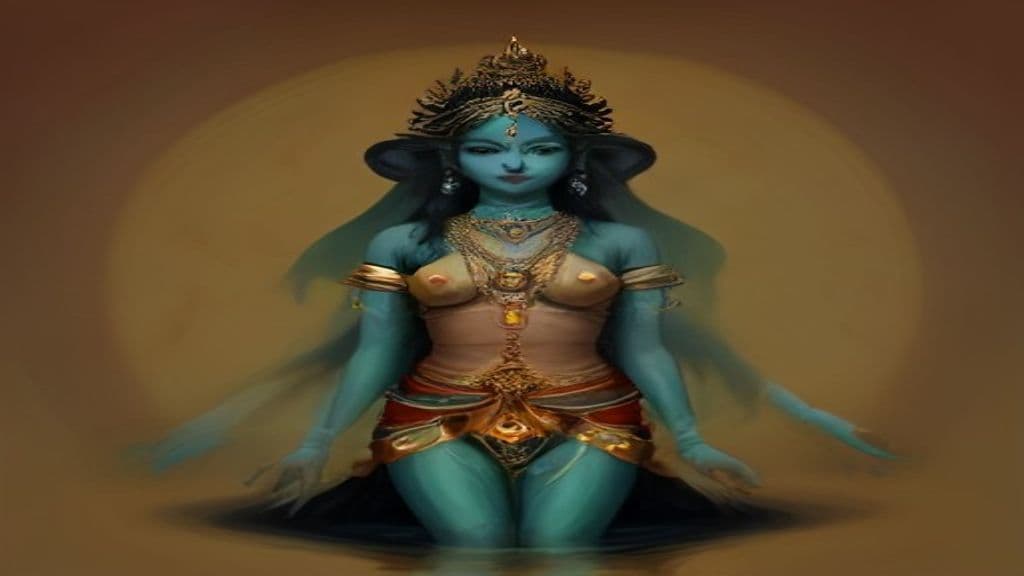
Geographical origin: The river Yamunā rises at the Yamunotri Glacier on the southwestern slopes of Bandarpunch in the Lower Himalaya (Uttarakhand), flows through Himachal Pradesh and the Indo‑Gangetic plains (Uttar Pradesh and Haryana) for approximately 1,376 km and merges with the Ganges at the Triveni Sangam, Prayagraj (source: geographic/encyclopedic accounts). Mythological/genealogical origin: In Hindu textual traditions the river is personified as a goddess; early texts refer to her as Yami and later literature also calls her Kalindi. Some accounts describe Yamunā as a daughter of the Sun and as sister to other solar offspring, and certain devotional (Vaishnava) sources identify her as the younger sister of Yamaraja and portray Krishna as intimately associated with the river (sources: textual and devotional summaries).
The supplied sources do not provide a sustained anthropomorphic or iconographic description of Yamunā-as-goddess. What the record does show is the river/goddess' visible presence in ritual spaces along its banks: ghats (for example Geeta Ghat in Delhi) where public festivals and immersion rites take place, and pilgrimage congregations at the Triveni Sangam. Photographic and archival references document ritual activity on the riverbank but not a canonical bodily iconography in the provided excerpts (sources: festival/archival notes; devotional texts).
The sources frame Yamunā primarily as a sacred, worshipped river-goddess with ritual and devotional functions rather than as a being of explicitly described magical attacks or malefic action. She is treated as sacral water—associated with purification and pilgrimage practices by virtue of being a holy river (sources: encyclopedic and ritual geography summaries). Mythic texts and devotional accounts situate her in relational networks with other deities: she is portrayed as a daughter of the Sun (textual/genealogical tradition) and, in Vaishnava accounts, Krishna is described as 'the life of the river' because of his pastimes on her banks; Indra is also mentioned in narratives affecting the river's waters (sources: mythological summaries; Vaishnava material).
Adi (asura)
Adi is attested in modern reference works as the name of an Asura who 'appears in the Matsya Purāṇa.' Beyond this single-line citation in secondary sources, no descriptive material about the figure is provided in the supplied research notes.
Adi Shakti
Adi Shakti (also Adi Parashakti, Mahadevi, Adya Shakti) is the primordial feminine power in Hindu/Shakta theology, regarded as the ultimate reality (Para Brahman) and the source from which all goddesses and gods manifest. She is both an impersonal cosmic principle (Mulaprakriti) and a focus of devotional invocation in temples, mantras, and pilgrimage sites such as Shakti Peethas.
Adi Vinayaka
Adi Vinayaka (Ādi Vināyaka; also called Nara Mukha Vinayaka) is a named iconographic and devotional form of the Hindu god Ganesha portraying the deity with a human head, described in sources as the form before the episode of decapitation by Shiva. It is rarely worshipped and appears in a small number of South Indian shrines and in devotional/musical repertoires.
Aditi
Aditi is a major Vedic goddess in Hindu tradition who personifies the boundless, infinite cosmic principle and functions as the maternal matrix from which many celestial deities (the Ādityas and other groups) are born. In the Vedic hymns she is invoked as a protective liberator who guards petitioners, provides wealth and safety, and frees devotees from hindrances such as sin and sickness.
Agni
Agni is the Vedic personification of fire in Hindu tradition: a sacred, mediating principle that manifests as terrestrial fire, atmospheric lightning, and celestial sun, and that receives and conveys sacrificial offerings. Prominent in the Rigvedic corpus, Agni functions as sanctifier, witness of rites of passage, and a transformational inner principle in later Upanishadic literature.
Ahalya
Ahalya is a mytho-legendary woman of South Asian (primarily Hindu) narrative tradition, described as created by the god Brahma, married to the sage Gautama, seduced (or tricked) by Indra, cursed by her husband, and ultimately redeemed by Rama. Her tale is a locus for themes of creation, desire, curse/penance, and redemption and she is counted among the ritual-mnemonic panchakanya.
Aindri (Indrani / Shachi / Paulomi)
Aindri (commonly rendered in sources as Indrani, also called Shachi or Paulomi) is a Hindu goddess presented as the queen-consort of Indra. She is depicted in the available material as a courtly queen associated with beauty, pride and kindness who also appears in at least one account as an active martial participant in the devas' battles with asuras.
Akshayavata
In Hindu mythology, Akshayavata is a sacred banyan tree and/or lake that symbolizes eternal life. It is mentioned in both Hindu and Jain traditions and associated with the Puranas. (Note: - The power tier should be "Greater" or at least "Ancient", as it is associated with the Puranas, which are considered ancient texts. - No specific physical description is provided, but that doesn't m)
Alakshmi
Alakshmi is an inauspicious female supernatural figure in Hindu tradition, presented as the negation or shadow-counterpart of the prosperity-goddess Lakshmi. She personifies poverty, grief, jealousy and social discord and is managed in domestic ritual and festival practice.
Alamelu
Alamelu (also Alamelu Manga / Alarmel Mangai) is a South Indian devotional name for the goddess Padmavati, identified in sources as an avatar of Lakshmi and the consort of Venkateswara; the name is also used widely as a female personal name and in titles of cultural works in Tamil and Telugu contexts.
Amrita (Buddhist tradition)
In the context of Indian religions, particularly within Hinduism and Buddhism, Amrita is a divine elixir that grants immortality and eternal life. (Note: - Power tier should be Ancient (deity-level), not Primordial. - Origin story appears accurate but lacks specificity on when Amrita was first mentioned in the Rigveda; add more detail. - Abilities are )
Ananta (Infinite)
Ananta (Sanskrit: अनन्त, 'without end') is primarily an epithet of Vishnu and a symbolic principle of infinity that is personified as the cosmic serpent Shesha. In Puranic imagery Ananta/Shesha forms the multi‑headed couch and canopy for Vishnu as he rests on the cosmic waters between cycles of creation (pralaya), and thus underwrites cyclical cosmogenesis.
Community Record
- [1]Yamunā. Wikipedia, 'Yamuna'.wiki
- [2]Yamuna in Hinduism. Wikipedia, 'Yamuna in Hinduism'.wiki
- [3]Myth and Folklore entry: Yamuna. Mythfolklore.net, 'Yamuna' (encyclopedic summary).folk
- [4]The Hare Krsnas - Yamuna (Demigods and Controlling Deities). Hare Krsna/ISKCON devotional material, 'Yamuna'.other
- [5]Photograph: Durga immersion at Geeta Ghat, Yamuna, Delhi (captioned). Archival photograph caption noting singing and dancing prior to Durga immersion at Geeta Ghat (2005).other
- [6]Impact of Covid-19 on Yamuna River water quality: Possible ways to rejuvenate the riverine ecosystem in national capital. Academic article addressing Yamuna water quality and riverine ecosystem (environmental study referenced).academic
- [7]How Vedāntic was Yāmuna? | Elisa Freschi. Scholarly/blog discussion of Yamuna in Vedāntic context (supplementary interpretive material).other